
If you are about to buy a textbook online, the safest move is simple: trust the seller only after you verify the seller, the exact book, and the checkout terms. A listing can look polished and still be wrong, fake, or risky. The good news is that you can spot most bad listings in a few minutes if you know what to check.
The short version: verify the seller, the exact ISBN and edition, and the checkout terms. If you want to compare exact editions after you verify the listing, search by ISBN or title on Textbook Nova and compare your options before you buy.
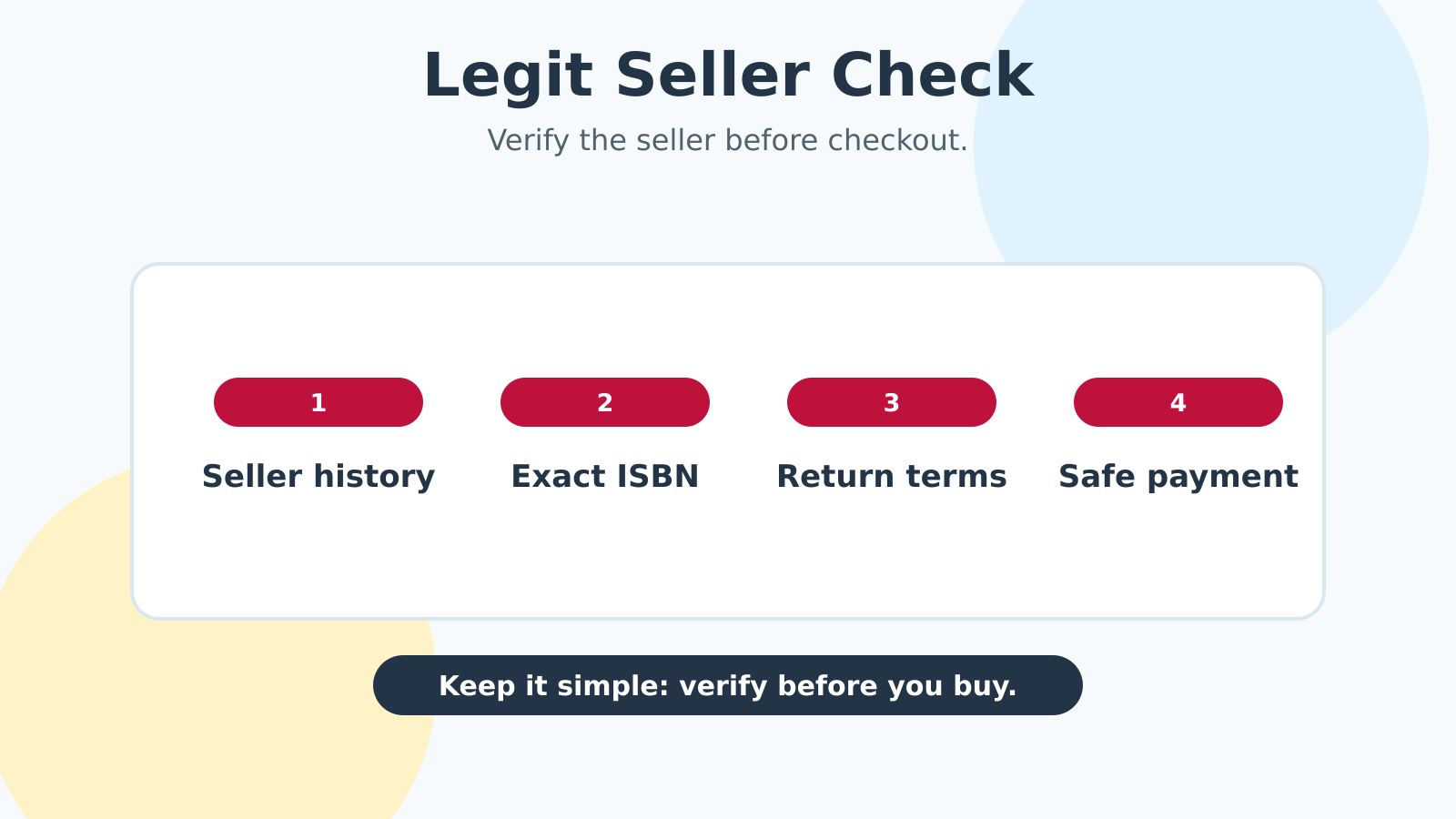
Quick answer: the safest textbook listing is the one you can verify
The fastest legitimacy check is this:
- Seller identity: Can you find a real seller name, history, and contact path?
- Listing accuracy: Does the ISBN, edition, format, and bundle/access-code wording match your class?
- Photos and description: Are there original photos and specific condition notes, not just vague sales copy?
- Payment and returns: Are you paying through a protected checkout with a return policy you can actually use?
That lines up with the FTC’s advice on online shopping and buying from an online marketplace. The BBB’s online shopping scam warnings make the same point: if a deal looks too easy and the seller is hard to pin down, slow down.
Check the seller before you trust the listing
Search the seller name, reviews, and complaint history
Start with the seller, not the price. Search the seller name plus words like scam, complaint, fake, review, refund, or marketplace. You are looking for a pattern, not a single grumpy comment. Repeated stories about wrong items, missing shipments, or no refunds are different.
On marketplaces, pay attention to seller age, completed sales, and response history. A seller with a long track record and consistent feedback is usually safer than a brand-new account with a “too good to miss” price. The FTC and BBB both push buyers toward this kind of basic due diligence because it catches the obvious trouble before money changes hands.
Look for real contact info and marketplace protection
A legitimate seller should not feel anonymous. At minimum, you want a real seller profile, a platform checkout path, and a way to contact support if the item never arrives or turns out wrong. If the seller wants to move the deal off-platform right away, that is a warning sign.
Protected marketplaces give you a trail: order history, messages, receipts, and dispute tools. The FTC specifically recommends keeping records and using payment methods that give you recourse if the transaction goes sideways.
Check the listing details, not just the headline price
Match the ISBN, edition, format, and access-code wording
For textbooks, the headline title is not enough. The ISBN is the fastest way to identify the exact book, edition, publisher, and format. ISBN.org’s explanation of the ISBN standard is clear on that point.
That matters because two listings can share a title and still be wrong for your class. One might be a previous edition. Another might be international. Another might be a paperback when your course needs a hardcover or digital code bundle. Read the words around the title carefully:
- Edition: First, second, revised, international, loose-leaf, or instructor edition all matter.
- Format: Hardcover, paperback, loose-leaf, rental, eBook, or bundle are not interchangeable.
- Access code wording: “Code included” is not the same as “code may have been redeemed.”
If the listing does not make these details obvious, assume you have work to do before checkout.
Prefer actual photos and specific condition notes over stock images. Stock photos are fine for marketing. They are not enough for verification. Real photos of the actual copy tell you much more: cover condition, spine wear, highlighting, writing, water damage, or missing pages.
Good listings also use specific language. “Some wear” is not great, but it is better than “great condition” with no details. If the seller can tell you whether there is highlighting, a name written inside the front cover, bent corners, or cover damage, that is a better sign than a slick headline and a fuzzy image.
Red flags that should make you walk away
Prices that are wildly below market are often bait
A textbook that is priced far below every comparable listing can be a bargain. It can also be bait, a counterfeit, the wrong edition, or a listing that hides missing materials. If the discount feels unreal, compare a few other sources before you bite.
Other red flags include copied product descriptions, broken English that does not fit the rest of the listing, seller names that look randomly generated, and a refusal to answer straightforward questions. The BBB’s scam guidance repeatedly points to this pattern: fake retailers often lean on urgency, too-good pricing, and weak seller identity.
Pushy payment methods and vague return policies are bad signs. Be careful if the seller pushes you toward wire transfers, gift cards, person-to-person payments with no protection, or any method that removes your ability to dispute a bad transaction.
The same goes for return policy language that is hard to find, too short to be useful, or written so broadly that it could be denied for anything. A legit seller should be comfortable stating how long you have to return the book, who pays return shipping, and what counts as a valid problem.
If you cannot understand the return policy in one reading, that policy may be doing that on purpose.
How counterfeit, wrong-edition, and access-code traps show up
Why ISBN and edition mismatches matter so much
Textbook scams are not always dramatic. Sometimes the seller simply lists the wrong version and hopes you do not notice until it is too late. That is why ISBN checking matters so much. It is the quickest way to confirm you are buying the exact version your class expects.
This is also where counterfeit books can slip in. If a seller is vague about the edition, the publisher, or the format, you have less to compare against. A counterfeit can look close enough in a listing photo to fool a rushed buyer, but the details often give it away: blurry printing, odd cover color, mismatched publisher info, or a title page that does not line up with the ISBN.
If the book is for a technical class or a professor who assigns specific page numbers, the wrong edition can mean missed homework, wrong problem sets, and avoidable stress.
Why a used textbook may not include a usable access code. This is one of the most expensive surprises for students. Many textbooks come with digital homework or eText access, and those codes are often one-time use only. Pearson’s eTextbook support notes that access codes are tied to redemption, and McGraw Hill’s Connect access code FAQ makes the same basic point: a code is not automatically reusable just because the book is.
So if the course requires a platform for homework, do not assume a used book solves the whole problem. A used copy may still be fine for reading, but it may not unlock quizzes, assignments, or eBook access. Check the syllabus before you buy.
Safer ways to buy if the listing still looks tempting
Use a protected payment method and save proof
If the listing passes the basic smell test but you still feel uneasy, give yourself a paper trail. Use a credit card or a marketplace checkout with buyer protection when possible. Save screenshots of the listing, seller profile, return policy, and any messages about edition, condition, or access codes.
That is what you do when the upside is saving money and the downside is buying the wrong textbook twice.
If the seller later claims the listing said something different, your screenshots matter. If the item arrives damaged or incomplete, your records matter. If the seller disappears, your payment trail matters.
Ask one last question before you click buy. If you are still unsure, ask this: “Would I still be happy with this purchase if the book arrived exactly as described?” That question cuts through the impulse to chase the lowest price.
If the answer is no, keep shopping. If the answer is yes, and the seller, ISBN, photos, return policy, and payment method all check out, you are probably in safe territory.
Bottom line checklist before you click buy
Use this final check:
- Search the seller name plus scam, review, or complaint.
- Confirm the exact ISBN and edition.
- Make sure the format matches your class.
- Read the listing for access-code, bundle, or supplement wording.
- Prefer actual photos over stock images.
- Skip vague condition notes and copied descriptions.
- Avoid off-platform payment requests.
- Check the return policy before checkout.
- Save screenshots and receipts.
If you can verify all of that, the seller is much more likely to be legit. If not, walk away and compare other options. For the rest of the semester-buying strategy, pair this legitimacy check with the broader textbook savings guide.
The best textbook deal is the one that gets you the right book, from a real seller, with no unpleasant surprises.
Leave a Reply