Tag: Used Textbooks

  • Can You Use an Older Edition of a Textbook? A Student Checklist Before You Buy

    Can You Use an Older Edition of a Textbook? A Student Checklist Before You Buy

    An older textbook edition can be a smart buy, but only if it still matches the way your class is actually taught. Before you order the cheaper copy, check four things: the ISBN and edition, any required access code or homework platform, the assigned chapters and problem numbers, and whether your instructor will accept the older version.

    That quick check matters because “close enough” can still cost you money. A previous edition might explain the same concepts, but the page numbers, case studies, problem sets, online homework, or bundled digital access can be different. If the older copy fails one of those checks, the savings may disappear fast.
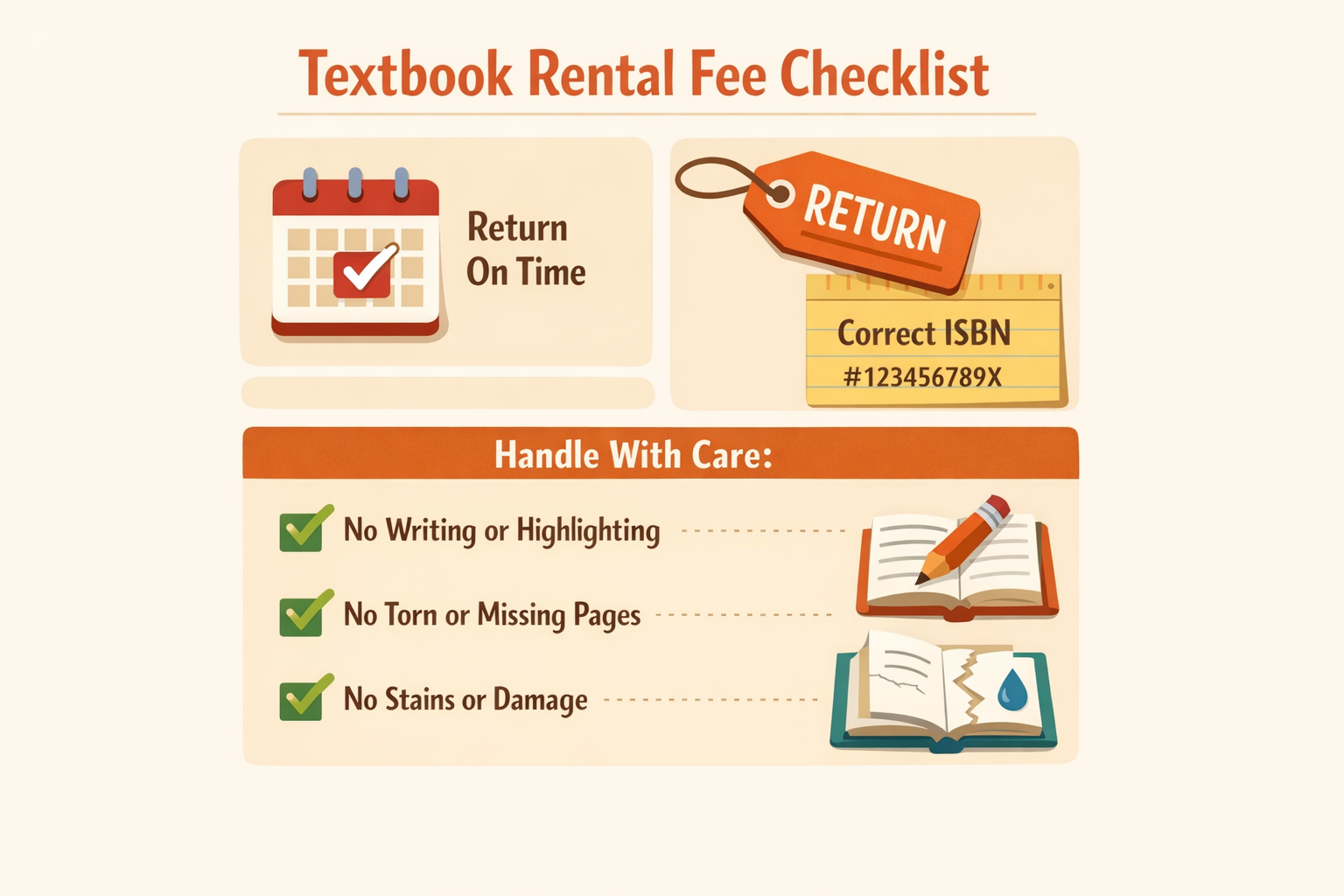
    Older edition decision checklist

    Use this as a go/no-go checklist before you buy.

    Use the older edition only if all four checks pass

    • The ISBN or edition is close enough for the assignment.
    • No required access code or courseware is missing.
    • Chapter order and problem numbers still line up.
    • Your instructor says yes, or the syllabus leaves room for it.
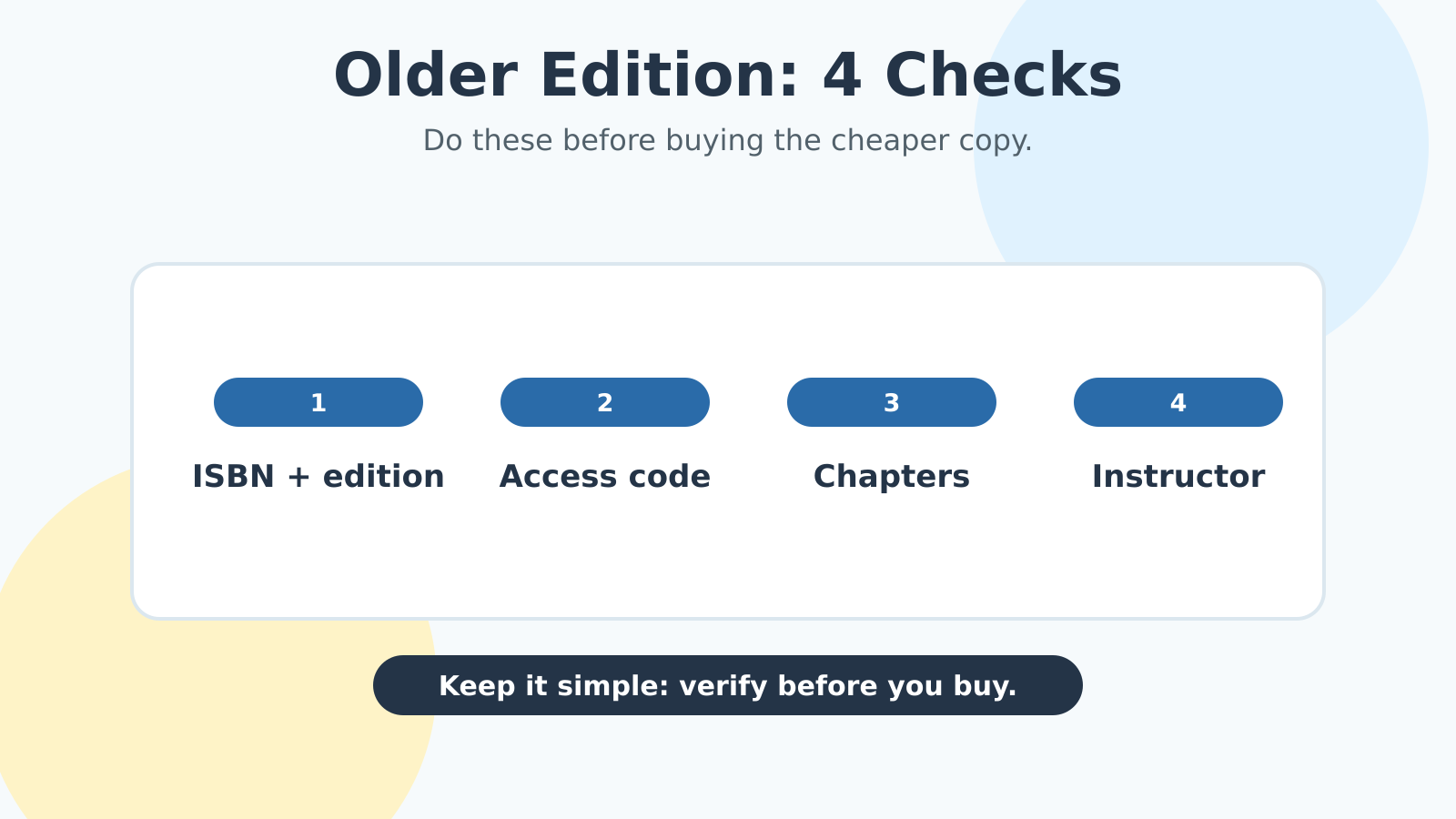
    Four checks for deciding whether an older textbook edition will work for class.
    Older editions are safest when the ISBN, access requirements, chapters, and instructor expectations line up.

    Quick answer: older editions can work, but only after four checks

    A used older edition is usually worth considering when the course uses the textbook mainly for reading, concepts, definitions, or optional practice. It is riskier when your grade depends on assigned page numbers, exact problem sets, current legal or medical information, publisher homework, quizzes inside a course platform, or a one-time access code.

    Here is the short version:

    1. Match the assigned title, author, edition, format, and ISBN.
    2. Confirm whether an access code, courseware subscription, or course ID is required.
    3. Compare the table of contents, chapter order, and assigned questions.
    4. Ask the instructor one specific question before you rely on the older copy.

    If you are using an older edition to save money on textbooks, do these checks before the return window closes. The goal is the cheapest version that will not break your class workflow.

    Check 1: match the ISBN, edition, author, and format

    Start with the course listing or syllabus. Write down the exact title, authors, edition number, publisher, publication year, format, and ISBN. The University of Portland’s student textbook guidance specifically tells students to check the ISBN, edition, and access-code requirement before buying, which is exactly the information you need for this decision.

    The ISBN is especially useful because an ISBN identifies a specific edition and format. A hardcover, paperback, ebook, loose-leaf copy, international edition, or custom campus edition can have a different ISBN even when the title looks nearly identical.

    A different ISBN is not automatically unusable, but it does mean you should slow down. Search the required ISBN and title on the bookstore page, publisher page, library catalog, and marketplaces. You can also search by ISBN on Textbook Nova to compare the assigned book against cheaper used or rental options. Treat the older edition as a candidate, not a confirmed match.

    Red flags in the listing

    Be careful if the cheaper copy says any of these:

    • “Instructor’s edition”
    • “International edition”
    • “Custom edition”
    • “Volume 1 only” or “Volume 2 only”
    • “Access code not included”
    • “May not include supplemental materials”
    • “Loose-leaf pages only”

    Check 2: look for access codes, homework platforms, and course IDs

    This is where many older-edition savings plans fail.

    If your course uses MyLab, Mastering, Connect, MindTap, Achieve, WebAssign, WileyPLUS, or another publisher platform, the physical book may not be the main purchase. Your grade may depend on online homework, quizzes, an ebook, or a course-specific enrollment link.

    Pearson’s support page notes that used textbooks may not include usable access codes, and McGraw Hill’s support documentation explains that publisher access may need to be purchased separately if a registration code did not come with the book. In plain English: a used copy with a scratched-off or missing code may not save you anything if you still have to buy platform access.

    Before buying the older edition, answer these questions:

    • Does the syllabus require online homework or quizzes?
    • Does the bookstore listing say “access code required”?
    • Is the code bundled only with a new book or digital package?
    • Can you buy access separately, and what does that include?
    • Does standalone access include the ebook, making the print book optional?

    If the class is already charging a digital course-material fee, read the details before buying another copy. This is where inclusive access textbooks can get confusing: you may already be billed for digital access unless you opt out by the deadline.

    Check 3: compare chapters, problem numbers, and assigned readings

    If there is no access-code issue, compare the content itself. Do not just compare titles. Open the table of contents for both editions if previews are available, or use library copies, bookstore screenshots, publisher samples, or classmates’ books.

    Look for:

    • chapter titles and order
    • missing or added chapters
    • page-number changes
    • end-of-chapter problem numbers
    • case studies, datasets, readings, or examples
    • lab manuals, appendices, charts, or online supplements

    For a history, literature, philosophy, or general education class, a previous edition may be fine if your instructor assigns broad chapter topics and lecture fills in the details. For accounting, chemistry, math, engineering, statistics, law, health sciences, or courses with graded problem sets, the exact edition matters more because question numbers and examples can shift.

    The problem-number test

    Here is the fastest practical test: find one week of assigned homework and compare those exact problems in both editions.

    If “Chapter 4, problems 12, 18, 24, and 31” are the same in both books, the older edition may work. If problem 18 is completely different, you will spend the semester translating assignments. That is possible, but it is not free.

    The current-information test

    Some subjects age faster than others. An older edition of a calculus text may still teach derivatives, but an older edition of a tax, nursing, computer security, legal, or public policy text may miss important updates. OpenStax’s explanation of textbook revisions and updates notes that updates can range from small corrections to more substantial edition-level changes, which is a useful reminder that “new edition” does not always mean the same amount of change.

    Ask whether the course depends on current rules, current data, or recent research. If yes, be more conservative.

    Check 4: use reserves or scans legally while you verify

    If you are not sure yet, do not panic-buy the expensive copy on day one. Check whether the library has a reserve copy, ebook access, or a short-term loan. George Mason University Libraries notes that course reserves can help while you verify the right edition, though reserve copies may have limited checkout windows and may not match every assigned version.

    A reserve copy can help you compare the required edition before spending money and can cover the first week while you wait for a used copy, rental, or instructor answer. Stay inside your school’s rules: use library reserves, legitimate ebooks, bookstore previews, or legally shared excerpts, not pirated PDFs.

    When an older edition is usually low risk

    An older edition is usually safer when most of these are true:

    • The instructor says older editions are okay.
    • The book is used mainly for concepts, not exact homework problems.
    • There is no required access code or platform.
    • The table of contents is mostly the same.
    • Assigned readings use chapter topics instead of exact page numbers.
    • The subject is not heavily dependent on current rules or recent data.
    • You can borrow the current edition if you need to compare a few assignments.

    In that situation, the older copy can be a reasonable way to cut costs, especially if the price difference is large and the return policy gives you a safety net.

    When you should buy or rent the required edition instead

    Buy, rent, or use the assigned version when your grade depends on exact alignment. The required edition is usually the safer choice if:

    • online homework access is required
    • the older copy does not include a usable code
    • problem numbers differ
    • page-specific readings are assigned every week
    • the instructor uses a custom campus edition
    • the class relies on current laws, standards, or clinical guidance
    • the professor says older editions are not acceptable

    You may still be able to rent the correct edition, buy used with access separately, use an ebook, borrow from the library, or compare prices across sellers. In these cases, “older” is not the first filter. “Correct” is.

    A short email to ask your professor before you buy

    If the checklist is still unclear, ask one specific question. Do not send a vague “Can I use an older edition?” message with no details. Make it easy for the instructor to say yes, no, or “yes, but watch out for Chapter 8.”

    Try this:

    Hi Professor [Name],

    I found a cheaper copy of [Book Title], [Older Edition], ISBN [older ISBN]. The syllabus lists [Required Edition], ISBN [required ISBN]. I checked that the chapters look similar, but I wanted to confirm before buying: will the older edition work for readings and assignments in this course, or do we need the exact required edition because of page numbers, problem sets, or online access?

    Thank you,

    [Your Name]

    That email gives your professor the information they need. If they approve the older edition, save the reply. If they warn you about access codes or mismatched assignments, you just avoided a bad purchase.

    The best textbook deal is the one that actually works for the course. Check the ISBN, access, assignments, and instructor expectations first; then buy the cheapest acceptable option with a return window you can live with.

  • How to Judge Used Textbook Condition Before You Buy Online

    How to Judge Used Textbook Condition Before You Buy Online

    If you’re buying a used textbook online, the safest move is simple: buy the cheapest copy that is complete, readable, correct for your class, and returnable. A book in Good or even Acceptable/Fair condition can be totally fine if the pages are intact and the text is legible. But if the listing hides water damage, missing pages, or the wrong edition, the bargain is fake.

    That’s why the real question is not “What does the label say?” It’s “Will this copy actually work for the class?” Before you click buy, verify the ISBN on Textbook Nova or compare your options by ISBN and title, then use the seller’s condition notes to judge the copy itself. If you’re building a bigger semester plan, the broader textbook savings checklist helps you decide when used is the right play and when renting or buying new makes more sense.

    Used textbook condition guide

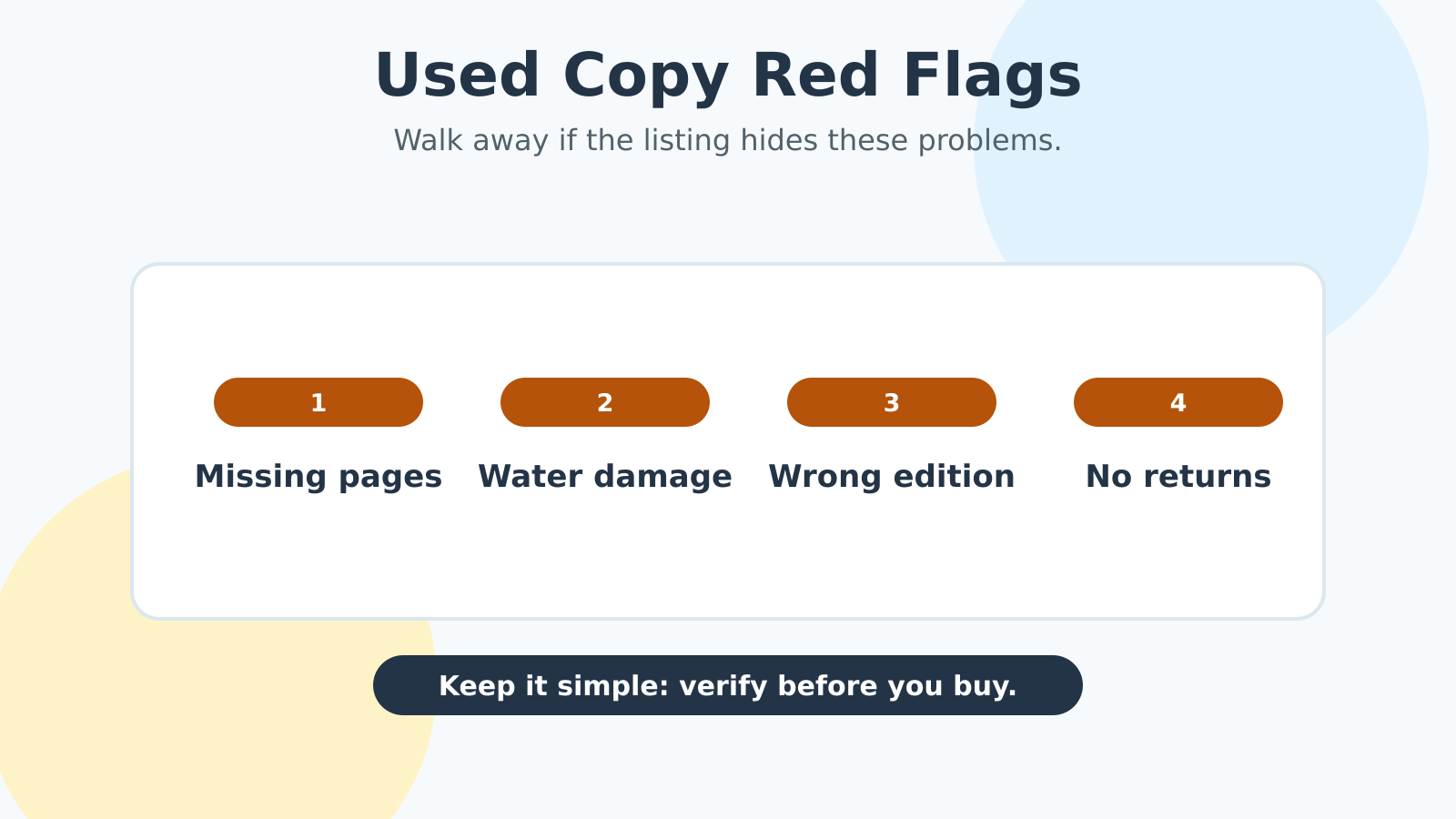
    Used textbook condition red flags to check before buying online.
    A low price is not a good deal if the copy is incomplete, damaged, the wrong edition, or non-returnable.

    Quick answer: what to buy

    Label Usually means Buy when
    Like New / Very Good Light cosmetic wear You want the safest copy or a nicer gift
    Good Clearly used but readable and complete You want the best value
    Acceptable / Fair Heavier wear or seller-specific grading The pages are intact and the price gap is real
    Avoid Missing pages, water damage, unreadable text Never
    • Best value for most students: Good condition if the book is complete and the seller is clear.
    • Worth paying more for: Like New or Very Good when the class is technical, annotation-heavy, or hard to replace.
    • Walk away fast: Missing pages, unreadable text, mold, bad water damage, or the wrong edition.

    Amazon’s book condition guidelines are a useful shorthand because they draw a bright line between books that are still readable and books that are not. AbeBooks’ used-book condition guide adds the other big lesson: read the full seller description, not just the grade.

    What used textbook condition labels usually mean

    Most marketplaces use condition labels as shorthand for wear, not as a guarantee of classroom usability. The label tells you roughly how beat-up the book is. The listing description tells you whether the book will actually work for your class.

    Like New / Very Good

    These are the safest used copies. A Like New book should look almost untouched, with only tiny cosmetic wear at most. Very Good usually means a little more wear, but the book is still in strong shape. Amazon’s book condition guidelines treat Very Good as a near-new book with room for minor wear, while HPB’s condition guide describes Fine/Like New and Very Good as copies that are still in very good shape for reading.

    For students, these are worth paying extra for when the class is annotation-heavy, the textbook has complex diagrams, or you know you will resell it later. You are paying for peace of mind, not just a prettier cover.

    Good

    Good is usually the sweet spot for budget buyers. It often means a textbook that is clearly used but still complete and readable. HPB’s condition guide describes Good copies as average used books with all pages present, and Biblio’s book condition guide says a Good book is typically a reading copy with the full text still available.

    This is often the best value if the book is a reading text, a humanities book, or a class where light wear will not matter much.

    Acceptable or Fair

    This is where you need to read carefully. Amazon’s book condition guidelines allow Acceptable copies to have heavier wear, including minor water damage that does not hurt readability. Biblio notes that “Acceptable” is not a standard traditional grade and can mean different things from seller to seller, which is exactly why the listing description matters. HPB’s condition guide is even blunter: Fair books may be very worn, torn, or barely holding together.

    Acceptable can still be fine for a class if the text is clear and the price drop is real. It is a lot less fine if you need a book that will survive a whole semester of regular use.

    The five flaws that matter most for students

    A scraped cover is annoying. A broken textbook is expensive. Focus on the damage that affects whether you can actually use the book.

    Missing pages, obscured text, and weak bindings

    These are hard-stop issues. Amazon’s book condition guidelines treat missing pages, obscured text, and unreadable text as unacceptable. TextbookRush’s condition and edition notes also make clear that books with missing pages or obscured text are not okay, and HPB’s condition guide notes that books in poor shape may be missing parts or barely holding together.

    If the binding is weak, ask yourself one question: will this survive being opened every day for 15 weeks? If not, skip it.

    Highlighting, notes, water damage, and odors

    This is where student judgment matters. Light highlighting is often harmless. Heavy highlighting can be miserable if the class depends on precise reading. Amazon’s book condition guidelines allow some wear and tear in the lower grades, while HPB’s condition guide shows that used copies can include highlighting, library markings, or other wear and still be sold as reading copies.

    Water damage is trickier than it looks. A little waviness may be okay; staining, mold, or pages stuck together is not. TextbookRush’s condition and edition notes and buying FAQ make supplements and edition checking important, and HPB’s guide makes clear that moisture damage can push a book into much worse territory. If a listing mentions odor, mildew, or smoke, walk away unless the price is almost giveaway-level and the seller has a strong return policy.

    Do not confuse physical condition with textbook usability

    A textbook can be physically rough and still academically fine. It can also look clean and still be useless.

    The first thing to verify is the exact edition and ISBN. TextbookRush’s buying FAQ tells buyers to verify author, title, edition, and ISBN so they get the correct version. Some courses use nearly identical covers with different problem sets, page numbers, or chapter order.

    The second thing is supplements. Used textbooks may not come with CDs, workbooks, online access codes, or other extras. HPB’s condition guide says used textbooks do not come with supplemental materials, and TextbookRush says the only way to guarantee supplements is to buy a brand-new US student edition that includes them. If your professor requires an access code, a cheap used copy may be the most expensive mistake you make all semester.

    The third thing is the seller’s return policy. TextbookRush’s buying FAQ recommends checking return information before buying marketplace books. That kind of buffer matters if the listing photos are vague or the condition grading feels optimistic.

    A pre-buy checklist for online used textbook listings

    Use this before you buy:

    • Confirm the ISBN, title, author, and edition.
    • Read the full condition note, not just the grade.
    • Look for mention of highlighting, notes, water damage, stains, mold, or odors.
    • Check whether the book includes supplements, access codes, CDs, or workbooks.
    • Verify the return window and who pays return shipping.
    • Compare the used price with new, rental, and other used options.
    • If the book is for a hard STEM course, lean toward better condition.
    • If the book is mostly for reading, Good or Acceptable may be enough.

    A practical rule: if you would be annoyed to carry it around campus every day, do not buy the cheapest copy just because it is cheapest.

    When to pay more—and when to walk away

    Pay more when the textbook is central to the course, the class is technical, or you expect to keep the book for reference. Better condition usually means less frustration, fewer missing-page surprises, and a better resale shot later. It also makes sense to pay up when the seller’s photos are weak but the return policy is weak too.

    Walk away when the listing mentions missing pages, obscured text, mold, liquid damage, or a likely wrong edition. Walk away if the book needs an access code and the seller cannot clearly confirm it is included. And walk away if the price difference between a worn copy and a cleaner copy is tiny; in that case, the extra few dollars are insurance.

    The best used-textbook deal is not the grubbiest one. It is the copy that gets you through the semester with no drama.

    If you want to compare used, new, and rental options quickly, search by ISBN on Textbook Nova and start with the copy that fits your class, your budget, and your tolerance for wear.

  • How to Tell If an Online Textbook Seller Is Legit Before You Buy

    How to Tell If an Online Textbook Seller Is Legit Before You Buy

    If you are about to buy a textbook online, the safest move is simple: trust the seller only after you verify the seller, the exact book, and the checkout terms. A listing can look polished and still be wrong, fake, or risky. The good news is that you can spot most bad listings in a few minutes if you know what to check.

    The short version: verify the seller, the exact ISBN and edition, and the checkout terms. If you want to compare exact editions after you verify the listing, search by ISBN or title on Textbook Nova and compare your options before you buy.

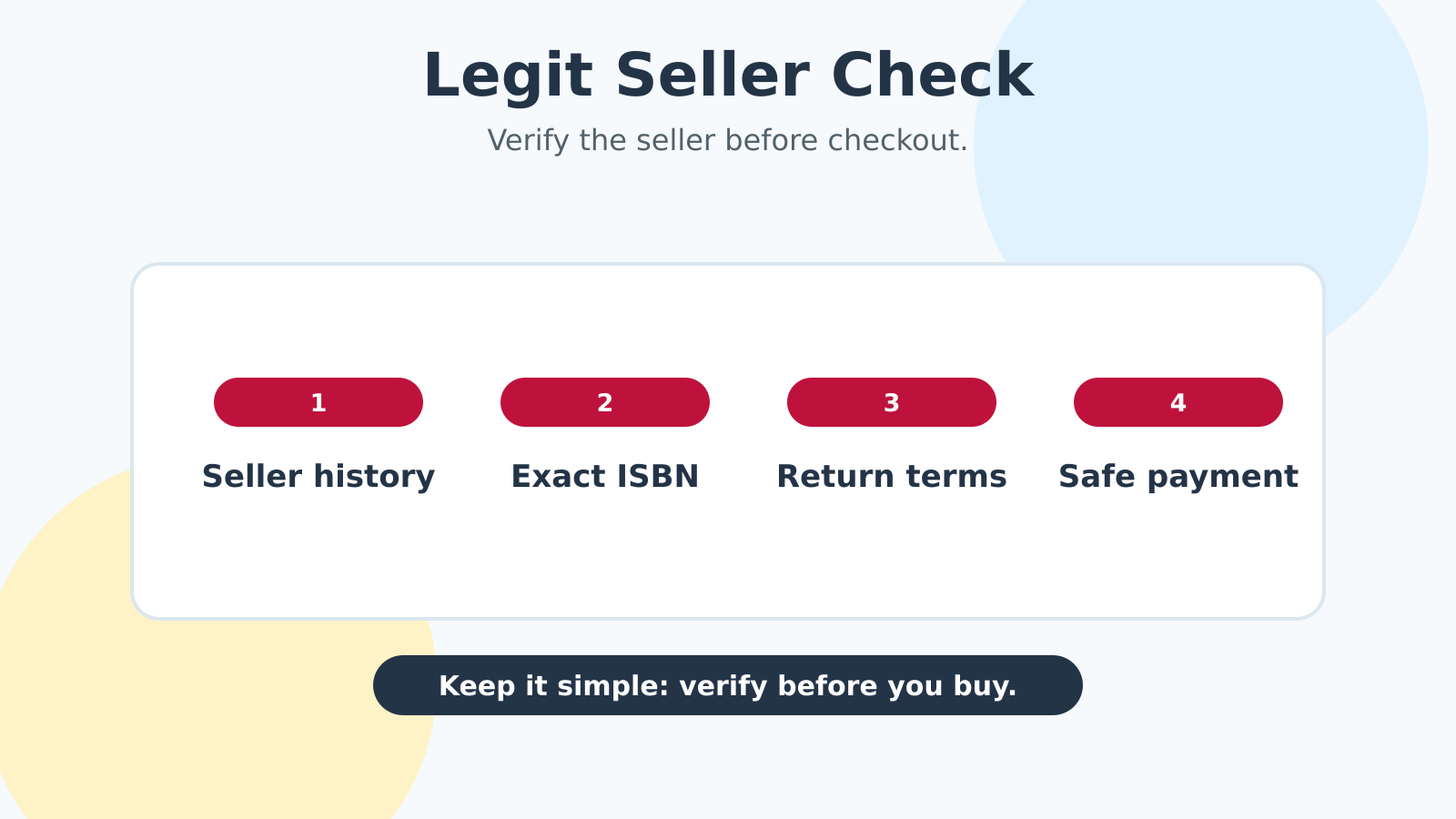
    Legit seller checklist for checking an online textbook listing before buying.
    A safe textbook listing should have a verifiable seller, exact ISBN details, clear return terms, and protected payment.

    Quick answer: the safest textbook listing is the one you can verify

    The fastest legitimacy check is this:

    • Seller identity: Can you find a real seller name, history, and contact path?
    • Listing accuracy: Does the ISBN, edition, format, and bundle/access-code wording match your class?
    • Photos and description: Are there original photos and specific condition notes, not just vague sales copy?
    • Payment and returns: Are you paying through a protected checkout with a return policy you can actually use?

    That lines up with the FTC’s advice on online shopping and buying from an online marketplace. The BBB’s online shopping scam warnings make the same point: if a deal looks too easy and the seller is hard to pin down, slow down.

    Check the seller before you trust the listing

    Search the seller name, reviews, and complaint history

    Start with the seller, not the price. Search the seller name plus words like scam, complaint, fake, review, refund, or marketplace. You are looking for a pattern, not a single grumpy comment. Repeated stories about wrong items, missing shipments, or no refunds are different.

    On marketplaces, pay attention to seller age, completed sales, and response history. A seller with a long track record and consistent feedback is usually safer than a brand-new account with a “too good to miss” price. The FTC and BBB both push buyers toward this kind of basic due diligence because it catches the obvious trouble before money changes hands.

    Look for real contact info and marketplace protection

    A legitimate seller should not feel anonymous. At minimum, you want a real seller profile, a platform checkout path, and a way to contact support if the item never arrives or turns out wrong. If the seller wants to move the deal off-platform right away, that is a warning sign.

    Protected marketplaces give you a trail: order history, messages, receipts, and dispute tools. The FTC specifically recommends keeping records and using payment methods that give you recourse if the transaction goes sideways.

    Check the listing details, not just the headline price

    Match the ISBN, edition, format, and access-code wording

    For textbooks, the headline title is not enough. The ISBN is the fastest way to identify the exact book, edition, publisher, and format. ISBN.org’s explanation of the ISBN standard is clear on that point.

    That matters because two listings can share a title and still be wrong for your class. One might be a previous edition. Another might be international. Another might be a paperback when your course needs a hardcover or digital code bundle. Read the words around the title carefully:

    • Edition: First, second, revised, international, loose-leaf, or instructor edition all matter.
    • Format: Hardcover, paperback, loose-leaf, rental, eBook, or bundle are not interchangeable.
    • Access code wording: “Code included” is not the same as “code may have been redeemed.”

    If the listing does not make these details obvious, assume you have work to do before checkout.

    Prefer actual photos and specific condition notes over stock images. Stock photos are fine for marketing. They are not enough for verification. Real photos of the actual copy tell you much more: cover condition, spine wear, highlighting, writing, water damage, or missing pages.

    Good listings also use specific language. “Some wear” is not great, but it is better than “great condition” with no details. If the seller can tell you whether there is highlighting, a name written inside the front cover, bent corners, or cover damage, that is a better sign than a slick headline and a fuzzy image.

    Red flags that should make you walk away

    Prices that are wildly below market are often bait

    A textbook that is priced far below every comparable listing can be a bargain. It can also be bait, a counterfeit, the wrong edition, or a listing that hides missing materials. If the discount feels unreal, compare a few other sources before you bite.

    Other red flags include copied product descriptions, broken English that does not fit the rest of the listing, seller names that look randomly generated, and a refusal to answer straightforward questions. The BBB’s scam guidance repeatedly points to this pattern: fake retailers often lean on urgency, too-good pricing, and weak seller identity.

    Pushy payment methods and vague return policies are bad signs. Be careful if the seller pushes you toward wire transfers, gift cards, person-to-person payments with no protection, or any method that removes your ability to dispute a bad transaction.

    The same goes for return policy language that is hard to find, too short to be useful, or written so broadly that it could be denied for anything. A legit seller should be comfortable stating how long you have to return the book, who pays return shipping, and what counts as a valid problem.

    If you cannot understand the return policy in one reading, that policy may be doing that on purpose.

    How counterfeit, wrong-edition, and access-code traps show up

    Why ISBN and edition mismatches matter so much

    Textbook scams are not always dramatic. Sometimes the seller simply lists the wrong version and hopes you do not notice until it is too late. That is why ISBN checking matters so much. It is the quickest way to confirm you are buying the exact version your class expects.

    This is also where counterfeit books can slip in. If a seller is vague about the edition, the publisher, or the format, you have less to compare against. A counterfeit can look close enough in a listing photo to fool a rushed buyer, but the details often give it away: blurry printing, odd cover color, mismatched publisher info, or a title page that does not line up with the ISBN.

    If the book is for a technical class or a professor who assigns specific page numbers, the wrong edition can mean missed homework, wrong problem sets, and avoidable stress.

    Why a used textbook may not include a usable access code. This is one of the most expensive surprises for students. Many textbooks come with digital homework or eText access, and those codes are often one-time use only. Pearson’s eTextbook support notes that access codes are tied to redemption, and McGraw Hill’s Connect access code FAQ makes the same basic point: a code is not automatically reusable just because the book is.

    So if the course requires a platform for homework, do not assume a used book solves the whole problem. A used copy may still be fine for reading, but it may not unlock quizzes, assignments, or eBook access. Check the syllabus before you buy.

    Safer ways to buy if the listing still looks tempting

    Use a protected payment method and save proof

    If the listing passes the basic smell test but you still feel uneasy, give yourself a paper trail. Use a credit card or a marketplace checkout with buyer protection when possible. Save screenshots of the listing, seller profile, return policy, and any messages about edition, condition, or access codes.

    That is what you do when the upside is saving money and the downside is buying the wrong textbook twice.

    If the seller later claims the listing said something different, your screenshots matter. If the item arrives damaged or incomplete, your records matter. If the seller disappears, your payment trail matters.

    Ask one last question before you click buy. If you are still unsure, ask this: “Would I still be happy with this purchase if the book arrived exactly as described?” That question cuts through the impulse to chase the lowest price.

    If the answer is no, keep shopping. If the answer is yes, and the seller, ISBN, photos, return policy, and payment method all check out, you are probably in safe territory.

    Bottom line checklist before you click buy

    Use this final check:

    • Search the seller name plus scam, review, or complaint.
    • Confirm the exact ISBN and edition.
    • Make sure the format matches your class.
    • Read the listing for access-code, bundle, or supplement wording.
    • Prefer actual photos over stock images.
    • Skip vague condition notes and copied descriptions.
    • Avoid off-platform payment requests.
    • Check the return policy before checkout.
    • Save screenshots and receipts.

    If you can verify all of that, the seller is much more likely to be legit. If not, walk away and compare other options. For the rest of the semester-buying strategy, pair this legitimacy check with the broader textbook savings guide.

    The best textbook deal is the one that gets you the right book, from a real seller, with no unpleasant surprises.