Tag: college tips

  • Is a Textbook Subscription Worth It? Compare Before You Pay

    Is a Textbook Subscription Worth It? Compare Before You Pay

    Usually, a textbook subscription is worth it only when it replaces enough required material to beat the total cost of buying, renting, or using a used copy. That sounds obvious, but students get tripped up because they compare the subscription price to just one book price. The real comparison has to include how many courses the plan covers, whether the class needs graded homework access, how long you need the material, and whether you can resell anything later.

    If you think of it as “subscription vs. one book,” you can overpay fast. If you think of it as “total course-material cost for this term,” the answer gets much clearer.

    Quick answer: a textbook subscription is worth it only when it covers enough required material

    A subscription makes the most sense when all of these are true:

    • you have multiple required titles or platforms from the same publisher,
    • the subscription covers the exact books or courseware your classes need,
    • you will use the access long enough to justify the term price,
    • and you would otherwise have to buy several separate eBooks, rentals, or access codes.

    That is why a plan like Cengage Unlimited can be a smart deal for some students and a waste for others. Cengage says the plan covers its learning platforms and thousands of eBooks, but it is still only valuable if your courses are actually inside that ecosystem. Cengage offers term-based access, but prices, included products, and campus bookstore arrangements can change, so check the current checkout page before you decide.

    First, separate reading access from graded homework access

    This is the biggest mistake students make. Not every required digital product is just an eBook.

    Reading-only eTextbooks are easier to compare

    If you only need a reading copy, the comparison is straightforward: used book, rental, eBook, subscription, or free/open textbook. In that case, the cheapest option often wins as long as the edition matches what the instructor wants.

    Courseware and access codes can be mandatory even if you find the book cheaper

    Platforms like McGraw Hill Connect are not just books in digital form. They are complete course experiences with assignments, quizzes, and homework tools. If your grade depends on that platform, a used textbook does not replace it.

    That same logic applies to publisher bundles and access-code packages. A cheaper used copy can still leave you paying twice if the course requires separate digital access.

    Build a quick break-even table before you pay

    Before checkout, list the exact ISBN, platform, access length, and return window for every required item. Then compare the real totals, not the sticker prices.

    What to compare Subscription Used / rental / eBook
    Base price Flat term fee Single-item price
    Shipping / handling Sometimes extra Often extra
    Taxes Maybe Maybe
    Included access length Must cover the full course Must cover the full course
    Homework / courseware Sometimes included Often separate
    Resale value Usually none Used books may have some
    Extra rentals / extensions Can add up Can add up
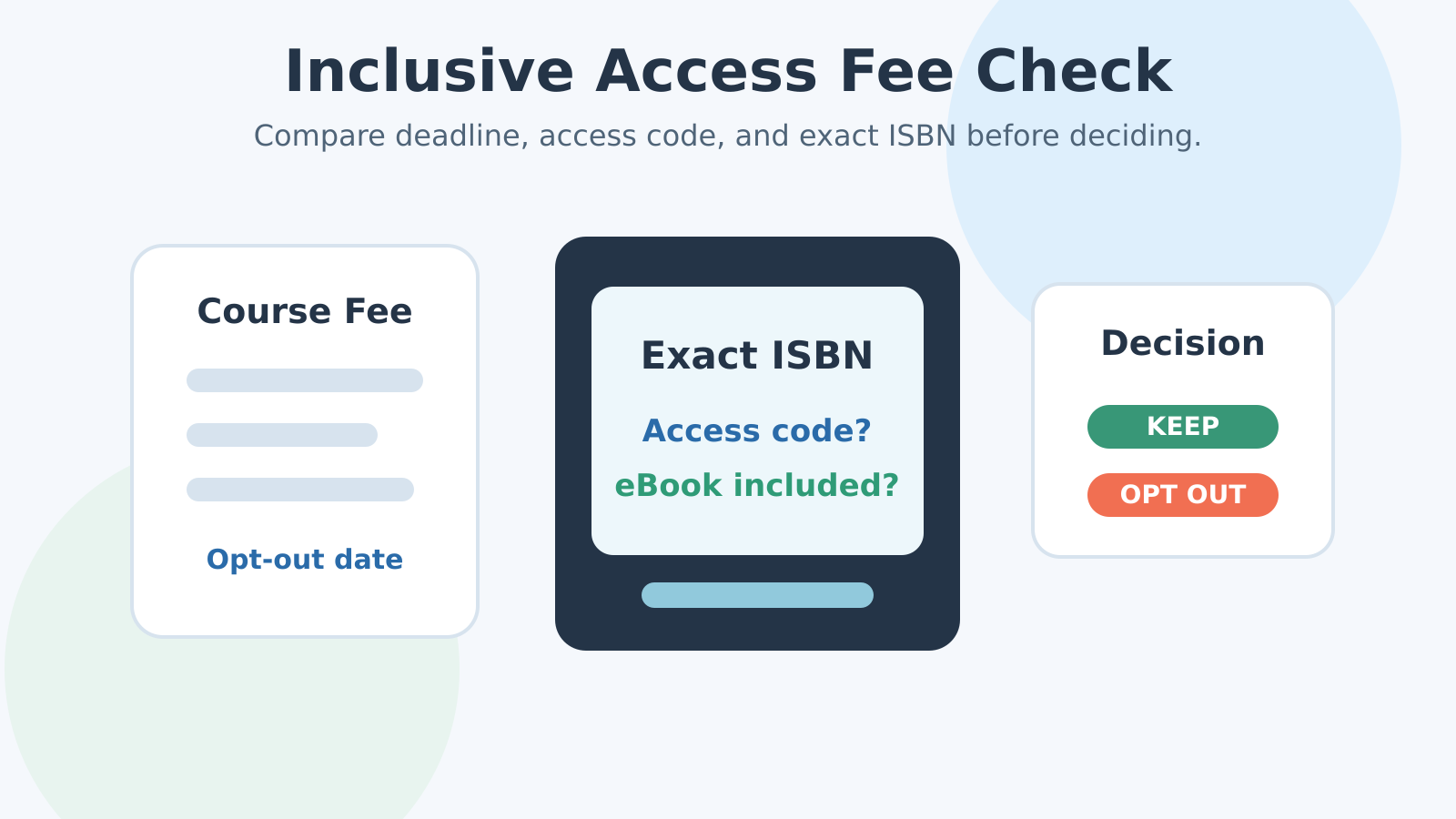
    Student studying with books and a laptop while comparing course material options.
    Compare textbook subscriptions against exact ISBN, rental, used, and eBook options before checking out.

    A simple break-even rule:

    If the subscription cost + fees is less than the total of the cheapest combination of required books/platforms minus any resale value you would keep, the subscription wins.

    That means you should compare against the full semester cost, not just one title. NerdWallet’s textbook guide gives the right shopping habit here: search by title, author, or ISBN, and include shipping, handling, taxes, and returns in the total cost. It also warns that older editions may not include everything your course needs, which is exactly how students end up buying the wrong “cheap” book.

    When Cengage Unlimited or a similar all-access plan can make sense

    A broad subscription can be a good deal when you have several covered courses in the same term.

    For example, if two or three classes all use Cengage materials, the subscription may beat buying each courseware package separately. Cengage also says included print rentals exist, which can help if you still prefer paper for reading. But the fine print matters: Cengage’s print-rental help says included print rentals are limited by subscription length, students still pay shipping and handling, and additional rentals after the allowance are priced separately. That is useful, but it is not the same as “unlimited physical books.” It is a capped perk, not a blank check.

    A Cengage-style plan is most attractive when:

    • several of your courses use the same publisher,
    • you need both the eBook and the homework platform,
    • and you will actually use the included rentals instead of letting them go to waste.

    When a single-title eTextbook subscription may be enough

    Not every student needs a giant bundle. Sometimes a single-title digital access plan is enough, especially if you only need one book for one class.

    Pearson’s Pearson+ is a good example. Pearson lists monthly and up-front payment options for Pearson+ eTextbooks, and fixed 6-month access can function like a digital rental. It also describes a longer “lifetime access” option as a one-time 5-year web access term, with app access if the book is downloaded before the term ends. Extension charges can continue monthly until you cancel.

    That makes Pearson+ a different kind of decision than an all-access subscription. If you need one Pearson title for one term, a fixed access window may be perfect. If you need long-term reference access, or if the class runs longer than the access period, buying a different format may be smarter.

    When buying used, renting, or using free options is smarter

    Sometimes the subscription answer is simply no.

    Buy used, rent, or go open when:

    • you only need a reading copy,
    • the class does not require a proprietary platform,
    • the book has solid resale value,
    • or the professor allows an open resource.

    OpenStax is the cleanest reminder that not every class needs a paid publisher platform. OpenStax says its digital textbooks are free online or downloadable as PDFs, which can save a ton of money when the course allows it.

    That said, free does not always mean complete for every class. If the syllabus requires a branded homework system, an open textbook may cover the reading but not the graded assignments.

    Student PIRGs’ 2026 report on textbook market problems also makes the broader point that students often get squeezed by access codes and automatic billing. It is advocacy research, so treat it as a consumer warning rather than a neutral publisher guide, but the underlying lesson is useful: always confirm what is truly required before paying for a bundle you may not need.

    Subscription red flags and the final checklist

    Watch for these warning signs before checkout:

    • The subscription covers only some of your required courses.
    • The class needs a platform, not just a book.
    • The access term ends before finals.
    • The “included” rentals still charge shipping or come with strict limits.
    • The book is cheaper used, but the platform still costs extra.
    • You could use a resale-friendly print copy and recover part of the cost later.
    • The plan’s terms say products or ancillaries may change.

    That last one matters. Cengage’s legal terms note that Cengage Unlimited products can change and that not all materials or ancillaries are guaranteed. In plain English: do not assume every future course will be covered exactly the way the sales page makes it sound today.

    So the final call is simple:

    • Subscribe if multiple required courses are covered and the total is lower than buying each item separately.
    • Rent if you only need one book for one term and resale does not matter.
    • Buy used if the class only needs a reading copy and the edition matches.
    • Use open/free resources if the instructor allows them and the assignment requirements are covered.
    • Ask first if the syllabus mentions access codes, courseware, or inclusive-access billing.

    If you want the safest move, compare exact ISBNs and platform names before you pay; a quick search on Textbook Nova can help you sanity-check used, rental, and edition options before you commit to a subscription. The best deal is not the lowest price on the screen; it is the lowest total cost for the actual course requirements.

  • How to Tell If an Online Textbook Seller Is Legit Before You Buy

    How to Tell If an Online Textbook Seller Is Legit Before You Buy

    If you are about to buy a textbook online, the safest move is simple: trust the seller only after you verify the seller, the exact book, and the checkout terms. A listing can look polished and still be wrong, fake, or risky. The good news is that you can spot most bad listings in a few minutes if you know what to check.

    The short version: verify the seller, the exact ISBN and edition, and the checkout terms. If you want to compare exact editions after you verify the listing, search by ISBN or title on Textbook Nova and compare your options before you buy.

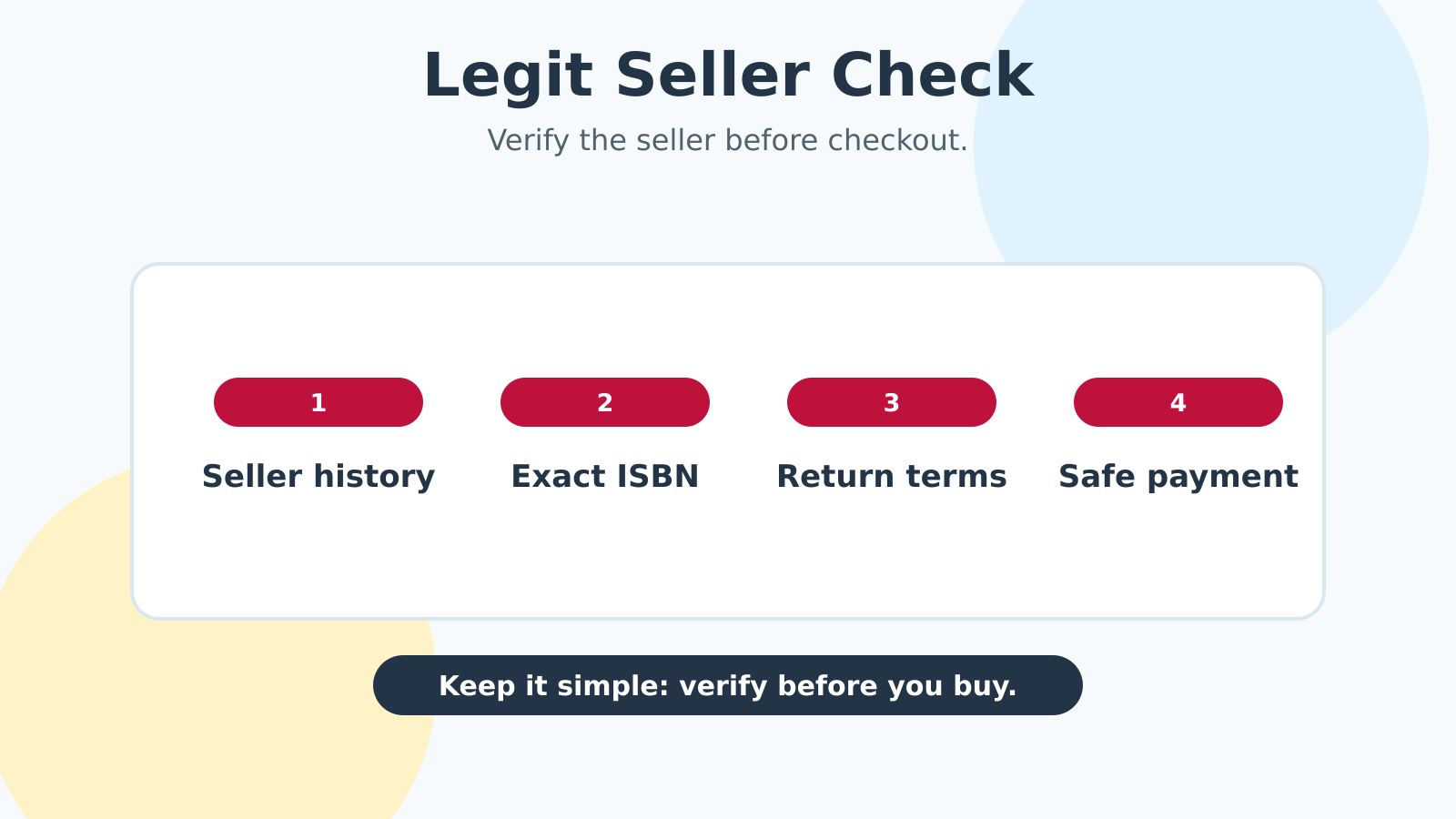
    Legit seller checklist for checking an online textbook listing before buying.
    A safe textbook listing should have a verifiable seller, exact ISBN details, clear return terms, and protected payment.

    Quick answer: the safest textbook listing is the one you can verify

    The fastest legitimacy check is this:

    • Seller identity: Can you find a real seller name, history, and contact path?
    • Listing accuracy: Does the ISBN, edition, format, and bundle/access-code wording match your class?
    • Photos and description: Are there original photos and specific condition notes, not just vague sales copy?
    • Payment and returns: Are you paying through a protected checkout with a return policy you can actually use?

    That lines up with the FTC’s advice on online shopping and buying from an online marketplace. The BBB’s online shopping scam warnings make the same point: if a deal looks too easy and the seller is hard to pin down, slow down.

    Check the seller before you trust the listing

    Search the seller name, reviews, and complaint history

    Start with the seller, not the price. Search the seller name plus words like scam, complaint, fake, review, refund, or marketplace. You are looking for a pattern, not a single grumpy comment. Repeated stories about wrong items, missing shipments, or no refunds are different.

    On marketplaces, pay attention to seller age, completed sales, and response history. A seller with a long track record and consistent feedback is usually safer than a brand-new account with a “too good to miss” price. The FTC and BBB both push buyers toward this kind of basic due diligence because it catches the obvious trouble before money changes hands.

    Look for real contact info and marketplace protection

    A legitimate seller should not feel anonymous. At minimum, you want a real seller profile, a platform checkout path, and a way to contact support if the item never arrives or turns out wrong. If the seller wants to move the deal off-platform right away, that is a warning sign.

    Protected marketplaces give you a trail: order history, messages, receipts, and dispute tools. The FTC specifically recommends keeping records and using payment methods that give you recourse if the transaction goes sideways.

    Check the listing details, not just the headline price

    Match the ISBN, edition, format, and access-code wording

    For textbooks, the headline title is not enough. The ISBN is the fastest way to identify the exact book, edition, publisher, and format. ISBN.org’s explanation of the ISBN standard is clear on that point.

    That matters because two listings can share a title and still be wrong for your class. One might be a previous edition. Another might be international. Another might be a paperback when your course needs a hardcover or digital code bundle. Read the words around the title carefully:

    • Edition: First, second, revised, international, loose-leaf, or instructor edition all matter.
    • Format: Hardcover, paperback, loose-leaf, rental, eBook, or bundle are not interchangeable.
    • Access code wording: “Code included” is not the same as “code may have been redeemed.”

    If the listing does not make these details obvious, assume you have work to do before checkout.

    Prefer actual photos and specific condition notes over stock images. Stock photos are fine for marketing. They are not enough for verification. Real photos of the actual copy tell you much more: cover condition, spine wear, highlighting, writing, water damage, or missing pages.

    Good listings also use specific language. “Some wear” is not great, but it is better than “great condition” with no details. If the seller can tell you whether there is highlighting, a name written inside the front cover, bent corners, or cover damage, that is a better sign than a slick headline and a fuzzy image.

    Red flags that should make you walk away

    Prices that are wildly below market are often bait

    A textbook that is priced far below every comparable listing can be a bargain. It can also be bait, a counterfeit, the wrong edition, or a listing that hides missing materials. If the discount feels unreal, compare a few other sources before you bite.

    Other red flags include copied product descriptions, broken English that does not fit the rest of the listing, seller names that look randomly generated, and a refusal to answer straightforward questions. The BBB’s scam guidance repeatedly points to this pattern: fake retailers often lean on urgency, too-good pricing, and weak seller identity.

    Pushy payment methods and vague return policies are bad signs. Be careful if the seller pushes you toward wire transfers, gift cards, person-to-person payments with no protection, or any method that removes your ability to dispute a bad transaction.

    The same goes for return policy language that is hard to find, too short to be useful, or written so broadly that it could be denied for anything. A legit seller should be comfortable stating how long you have to return the book, who pays return shipping, and what counts as a valid problem.

    If you cannot understand the return policy in one reading, that policy may be doing that on purpose.

    How counterfeit, wrong-edition, and access-code traps show up

    Why ISBN and edition mismatches matter so much

    Textbook scams are not always dramatic. Sometimes the seller simply lists the wrong version and hopes you do not notice until it is too late. That is why ISBN checking matters so much. It is the quickest way to confirm you are buying the exact version your class expects.

    This is also where counterfeit books can slip in. If a seller is vague about the edition, the publisher, or the format, you have less to compare against. A counterfeit can look close enough in a listing photo to fool a rushed buyer, but the details often give it away: blurry printing, odd cover color, mismatched publisher info, or a title page that does not line up with the ISBN.

    If the book is for a technical class or a professor who assigns specific page numbers, the wrong edition can mean missed homework, wrong problem sets, and avoidable stress.

    Why a used textbook may not include a usable access code. This is one of the most expensive surprises for students. Many textbooks come with digital homework or eText access, and those codes are often one-time use only. Pearson’s eTextbook support notes that access codes are tied to redemption, and McGraw Hill’s Connect access code FAQ makes the same basic point: a code is not automatically reusable just because the book is.

    So if the course requires a platform for homework, do not assume a used book solves the whole problem. A used copy may still be fine for reading, but it may not unlock quizzes, assignments, or eBook access. Check the syllabus before you buy.

    Safer ways to buy if the listing still looks tempting

    Use a protected payment method and save proof

    If the listing passes the basic smell test but you still feel uneasy, give yourself a paper trail. Use a credit card or a marketplace checkout with buyer protection when possible. Save screenshots of the listing, seller profile, return policy, and any messages about edition, condition, or access codes.

    That is what you do when the upside is saving money and the downside is buying the wrong textbook twice.

    If the seller later claims the listing said something different, your screenshots matter. If the item arrives damaged or incomplete, your records matter. If the seller disappears, your payment trail matters.

    Ask one last question before you click buy. If you are still unsure, ask this: “Would I still be happy with this purchase if the book arrived exactly as described?” That question cuts through the impulse to chase the lowest price.

    If the answer is no, keep shopping. If the answer is yes, and the seller, ISBN, photos, return policy, and payment method all check out, you are probably in safe territory.

    Bottom line checklist before you click buy

    Use this final check:

    • Search the seller name plus scam, review, or complaint.
    • Confirm the exact ISBN and edition.
    • Make sure the format matches your class.
    • Read the listing for access-code, bundle, or supplement wording.
    • Prefer actual photos over stock images.
    • Skip vague condition notes and copied descriptions.
    • Avoid off-platform payment requests.
    • Check the return policy before checkout.
    • Save screenshots and receipts.

    If you can verify all of that, the seller is much more likely to be legit. If not, walk away and compare other options. For the rest of the semester-buying strategy, pair this legitimacy check with the broader textbook savings guide.

    The best textbook deal is the one that gets you the right book, from a real seller, with no unpleasant surprises.

  • Inclusive Access Textbooks: Should You Opt Out of Your Course Materials Fee?

    Inclusive Access Textbooks: Should You Opt Out of Your Course Materials Fee?

    If you see an Inclusive Access, First Day, Follett ACCESS, or course materials fee on your bill, the safest default is simple: keep it only if it is the cheapest required way to complete the class. If you can replace it with a cheaper legal alternative before the deadline, opt out. If you cannot, paying the fee may be the practical move.

    The key is not to guess. Compare the exact material, the exact deadline, and the exact access requirements before the charge locks in.

    What Inclusive Access actually means on your bill

    Inclusive Access is also known as automatic textbook billing. In that model, the cost of digital course content is built into tuition and fees, and students are typically billed unless they opt out before the deadline. Programs often deliver access through the campus LMS on or near the first day of class, and access may end when the course ends. See the InclusiveAccess.org FAQ for the common program names and student-facing definition.

    That label can change from campus to campus. Common names include First Day, Follett ACCESS, All Access, All Students Acquire, Auto Access, Course Material Fee, Day One Access, Equitable Access, and Immediate Access.

    Federal aid rules also matter here. The current books-and-supplies provisions live in 34 CFR 668.164, and the Department of Education’s 2024 Federal Register notice kept those current requirements in place while emphasizing a clearly communicated, actionable opt-out policy.

    The 10-minute opt-out checklist

    Use this before the deadline hits.

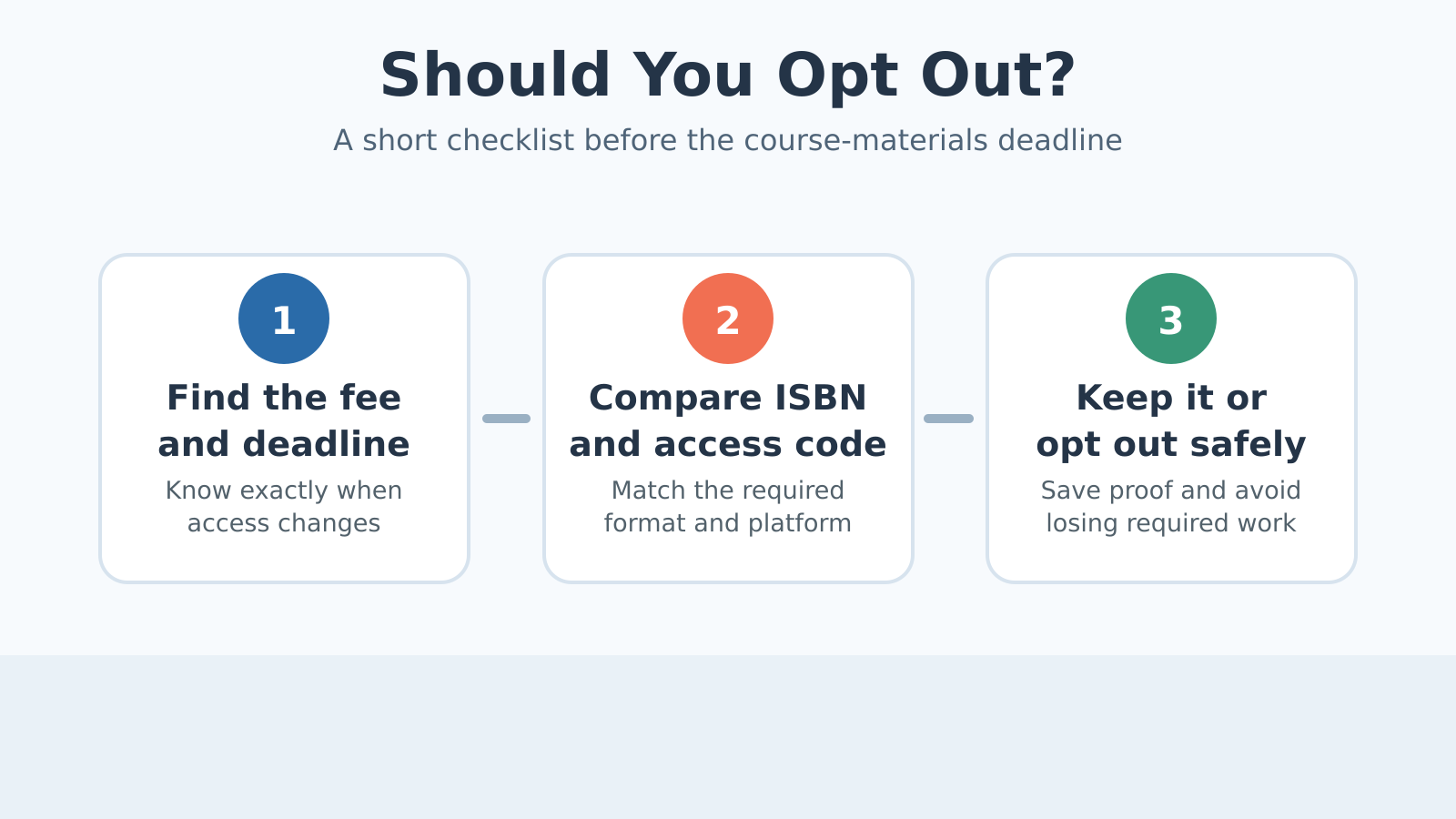
    Decision flow for whether to opt out of an inclusive access textbook fee.
    A quick decision flow: find the fee and deadline, compare exact access requirements, then keep the fee or opt out safely.
    Check What to verify Why it matters
    Fee name Is this Inclusive Access, First Day, Follett ACCESS, or just a bookstore charge? The billing model changes what happens if you do nothing.
    Deadline When is the opt-out cutoff, and where is it posted? Miss the deadline and you may be billed automatically.
    Required access Does homework, quizzes, or the gradebook require a code or LMS license? A used book may not help if the code is single-use.
    Exact alternative Can you buy the same ISBN, rental, ebook, or access code separately? You need a real apples-to-apples comparison, not a guess.
    After opt-out What happens to LMS access, and what do you still need to buy? Opting out does not erase course requirements.

    1. Find the exact fee and deadline

    Start with the course page, bookstore page, or LMS announcement. Look for the exact wording and the deadline. Some campuses make the opt-out button easy to find; others bury it. Don’t assume the first charge you see is the final answer.

    If the school uses a books-and-supplies arrangement under federal aid rules, it must provide a way for students to obtain those materials by the seventh day of the payment period in the situations covered by the rule. That timing is one reason deadlines matter so much. See 34 CFR 668.164 and the 2024 Federal Register notice.

    2. Check whether homework or quizzes require a code

    This is the big one. If the course uses a one-time access code, a used copy alone may not work. Check the syllabus, LMS, bookstore listing, or instructor note for words like access code, homework platform, courseware, license, or single-use registration.

    3. Compare the exact ISBN, rental, used, ebook, and access-code-only prices

    Do not compare a billed course fee to a random used copy of a different edition. Compare like with like:

    • exact ISBN
    • rental price
    • used print price
    • ebook price
    • access-code-only price
    • shipping or tax

    If the class only needs the text, a used copy or rental may be cheaper. If the grade depends on the platform, the real comparison may be between the program fee and the cost of buying the same digital access elsewhere.

    Textbook Nova is useful here because you can search by title, author, or ISBN and check exact-edition matches instead of trusting a vague bookstore listing. Use Textbook Nova to compare exact editions.

    4. Ask whether OER, library reserves, or an older edition is allowed

    If your class can use an open textbook, a library reserve copy, or an older edition, you may be able to skip the fee entirely. OpenStax makes its digital textbooks free to access online or as downloadable PDFs, and it also offers print options for many titles.

    For a broader OER search, the Open Textbook Library is a good place to check. If the course still needs publisher homework access, OER may help with reading but not with grading tools.

    5. Confirm what happens after opting out

    This is where people get burned. Opting out usually means you lose the automatically delivered content, and you are responsible for finding the required materials another way. OpenStax says that if a student opts out of an inclusive access program, the student is still responsible for obtaining required course materials through another method.

    So do not opt out until you know exactly what you still need.

    When keeping Inclusive Access is probably worth it

    Keep the fee when one or more of these are true:

    • the required access code costs about the same elsewhere
    • the course runs on a digital homework platform you must use
    • the school’s fee really is cheaper than buying print plus code separately
    • the deadline is near and you have not found a better option
    • the included access already matches the exact course version you need

    This is the one time where convenience can be rational. If the program fee is below the full cost of a separate ebook, code, and shipping, keeping it may be the cleanest choice.

    When opting out may save money

    Opt out when one of these is true:

    • the class does not actually require a code
    • you found a cheaper used, rental, or ebook path
    • the school’s fee is based on a newer version than your instructor will accept
    • the material is available through OpenStax, a library reserve, or another approved OER source
    • the included content is temporary, but you need the book longer than the access window

    Federal regulations allow institutions to include books and supplies in tuition and fees only when certain conditions are met, including below-market pricing, timely access, and an opt-out policy. That means the fee can be legitimate and still not be the best deal for you. See 34 CFR 668.164 for the rule text.

    Email scripts you can copy

    Professor email script

    Subject: Question about the required course materials

    Hi Professor [Name],

    I’m reviewing the course materials and saw an Inclusive Access / First Day / course materials fee. Before the opt-out deadline, could you confirm whether we need the digital access code for homework, quizzes, or grading?

    If there is a cheaper legal alternative, such as a used copy, rental, or open textbook version, would that still work for this class?

    Thanks, [Your Name]

    Bookstore/support email script

    Subject: Inclusive Access opt-out question

    Hi,

    I see a course materials fee listed for [Course/Section]. Can you confirm:

    1. the opt-out deadline,
    2. what materials I lose access to if I opt out,
    3. whether the required content includes a one-time code or LMS license,
    4. and whether the same materials can be purchased separately?

    Please send the opt-out instructions or direct link if available.

    Thank you, [Your Name]

    Bottom line: decide before the deadline, not after the charge posts

    Inclusive Access is not automatically good or bad. It is a billing method. Your job is to decide whether it is the cheapest required path to pass the class.

    If the fee covers the exact access you need for less than any realistic alternative, keep it. If a used book, rental, OER title, library reserve, or separately purchased code is cheaper and still valid for the course, opt out before the deadline.

    When in doubt, compare by exact ISBN and exact access requirement first. Textbook Nova makes that part easier.

  • What to Do When Your Textbook Requires an Access Code

    What to Do When Your Textbook Requires an Access Code

    If your syllabus says you need a textbook access code, the most important thing to know is this: the code may matter more than the book. A used or rental copy can still be a smart buy, but only if your class does not require a one-time login for homework, quizzes, or an eBook platform.

    That is why the first move is not hunting for the cheapest copy. It is figuring out exactly what your class actually requires. Publisher help pages for Pearson access code help, Cengage MindTap access code registration, and McGraw Hill Connect access code and purchase options all point to the same basic reality: access codes are tied to courseware, and not every book you buy secondhand will unlock that courseware.

    Student checking online course materials beside an open textbook.
    Before buying used, confirm whether the course requires a fresh access code for homework, quizzes, or graded online work.

    Quick answer: if homework is in the platform, the code matters more than the book

    If your grade depends on MyLab, MindTap, Connect, WebAssign, ALEKS, or another homework platform, treat the access code as the real requirement and the print book as a separate decision. If the course only uses the book for reading, note-taking, or reference, you have much more flexibility.

    That distinction is the whole game. Students often buy a cheap used copy first and only later discover that the homework portal is where the assignments live. By then, they have paid twice.

    The safest default is simple:

    • if the platform is required for graded work, verify the code first;
    • if the code is optional, compare used, rental, and digital copies like normal;
    • if you are unsure, ask before checkout.

    Textbook Nova is useful here because you can compare exact ISBNs and editions before you commit. Search Textbook Nova by title or ISBN, then check whether the print book is really separate from the courseware.

    Step 1 — Identify what is actually required

    Check the syllabus and bookstore listing for platform names

    Look for words like access code, eBook, courseware, homework manager, license, digital homework, or registration. The exact brand name matters too. A class might use Pearson, McGraw Hill, Cengage, or a school-specific portal, and each one has its own buying path.

    If the syllabus only names the print textbook, you may not need a code at all. If it names both the textbook and the platform, the platform is probably part of the class requirement.

    Confirm whether the code is for reading only or graded work

    Some access codes unlock an eBook. Others unlock graded assignments, quizzes, or adaptive practice. Those are not equally optional.

    A code that only unlocks reading is easier to replace than a code that controls your homework grade. If the assignment system is built into the class, plan around that early so you do not get stuck waiting on shipping or bookstore support in week one.

    Step 2 — Do not assume a used textbook includes a usable code

    Why most codes are one-use

    Publisher support pages are very clear that access codes are generally tied to a single student account. Pearson’s access-code help warns that codes from used books have probably already been redeemed. Cengage explains that an access code acts as proof of purchase for MindTap courseware or eBook access.

    In plain English: a used book can still be a good buy, but the code inside it may be worthless.

    When a sealed access card or new bundle might still be valid

    A sealed access card, a fresh bookstore bundle, or a new copy that clearly includes unused access may still solve the problem. The key word is unused. If the seller cannot verify that the code is still valid, assume it is not.

    That is especially important if you are buying from a marketplace listing that does not clearly separate the book from the access package.

    Step 3 — Compare the real options before you buy

    Standalone access code or direct course purchase

    Sometimes the cheapest path is to buy access without the print book at all. If you already have a book or only need the platform, this can be the cleanest move. McGraw Hill’s Connect access code and purchase FAQ lays out multiple purchase paths, including direct purchase and bookstore options.

    Campus bookstore bundle, inclusive access, or temporary access

    Sometimes the bookstore bundle is the better value. Sometimes the school has already added the content through inclusive access or day-one access, which means the cost may already be embedded in your course bill. Student PIRGs’ 2026 report, Fixing the Broken Textbooks Market, Fourth Edition, explains how access codes and automatic billing can narrow student choice, so it is worth checking whether you are already paying for access before you buy anything extra.

    Some platforms also offer temporary access or a short trial period. That can be a useful bridge if you are waiting on financial aid, a bookstore order, or instructor confirmation. Just do not mistake temporary access for a full-term solution.

    The decision should be based on the total cost and the actual course requirement, not the first price you see.

    Step 4 — Questions to ask before you spend money

    Ask the instructor about older editions, optional print, and OER

    This is where you can sometimes save the most. Ask whether an older edition is acceptable, whether the print book is optional, or whether a free/open alternative would work for the reading portion of the class.

    OpenStax’s student book access help is a good reminder that some textbooks are available free online or as PDFs. That will not replace every required homework platform, but it can sometimes cover the reading requirement while you sort out the rest.

    Ask the bookstore or publisher support about refunds, duration, and course-section match

    Before you buy, confirm three things:

    1. Does the code match my exact course section?
    2. What happens if I buy the wrong version?
    3. Is there any refund policy or replacement policy if the access does not work?

    Do not rely on assumptions here. A code for the right title but the wrong section can still fail when you try to register it. And access terms can vary by publisher, school, and platform.

    Common mistakes that make students buy twice

    The most common mistake is buying the cheapest book first and asking about access later. The second mistake is assuming any used copy will include a working code. The third is mixing up a reading requirement with a graded homework requirement.

    A few more expensive mistakes:

    • buying the wrong edition because the title looked close enough;
    • assuming the bookstore bundle is automatically the cheapest option;
    • ignoring temporary access when you need a short bridge;
    • waiting until the night before class to sort out registration.

    Bottom line checklist before checkout

    Use this before you click buy:

    • Is the access code required for graded homework or just for reading?
    • Does the syllabus name a specific platform like MyLab, MindTap, Connect, WebAssign, or ALEKS?
    • Are you sure the used or rental copy includes unused access, if needed?
    • Have you compared standalone access, a bookstore bundle, and any school-billed access?
    • Have you asked whether an older edition, OER, or a free library option would work?
    • Have you verified the exact ISBN and course section?

    If you can answer those questions clearly, you are in good shape. If you cannot, pause before paying.

    The short version is this: do not treat the book and the code as the same purchase. Figure out what the class actually needs, compare the real options, and then buy only once.

    When you want to compare exact editions or search for a better print copy after you have sorted out the access code question, Textbook Nova is a good place to start.

  • 6 Best Habits Of A Successful Student

    6 Best Habits Of A Successful Student

    Wondering how to be the most successful student you can be? Check out the following list of 6 awesome habits that you need in your life!

    From weekly homework and monthly assignments to studying for that big final exam (all while trying to eat right!), it’s no wonder many students feel overwhelmed throughout the year. 

    The good news is that it’s completely possible to get ahead of this frustation by developing good habits.

    After all, good habits help students succeed. 

    So if you want to get ahead in the classroom, we’ve outlined the following list of 6 habits of successful students. 

    person writing on brown wooden table near white ceramic mug

    Take Notes (And Lots Of ‘Em!)

    It’s important to take notes while your instructor teaches a lesson. Taking good notes helps you to stay engaged during class.

    But the best part is that good notes also make great review and study materials. 

    Handwritten Notes

    Successful students take notes by hand.

    Studies show that taking notes by hand is associated with more meaningful learning compared to students who use a laptop. Taking notes by hand also gives students the advantage when noting graphs, illustrations, and charts. 

    As a result, a student who reviews handwritten notes has an advantage over a student who reviews notes written on a laptop.  

    woman wearing blue denim jacket holding book

    Listen for Verbal Cues

    Taking good notes doesn’t mean you need to record every word your teacher says during class. 

    In fact, it’s better to listen for verbal cues, and only jot down the most important keywords that will cue your memory later on.

    In other words, when a teacher says, “this is really important”, or “this is critical”, that information is likely going to be something you need to write down. Leave the rest out.

    Stay Organized

    Student life requires you to take many different courses at the same time.

    For example, you might be studying General Arts, which will require you to take a variety of math English, and science courses all at the same time.

    This is why staying organized is one of the best habits of successful students. 

    person using MacBook Pro

    Separate Your Time By Subject

    When it’s time to study or complete a project, don’t waste time trying to locate the right material.

    Successful students file or separate each subject into different binders, folders, or notebooks. 

    That way, when it comes time to study, you’ll already know where all your study materials are, and you won’t waste time digging through unorganized notes.

    Organize Your Work Space

    Completing homework or assignments in an organized space is also a great habit of successful students. Using a designated, quiet space helps the mind recognize that it’s time to focus.  

    black marker on notebook - successful student

    Get An Agenda

    Use an agenda to write down all your assignments, extracurricular activities, and anything else that affects your day to day schedule. 

    Then, make sure to refer to your agenda as often as possible to make the most of your time.

    This will help you to plan study sessions and get homework done on time, every time!

    Find affordable books and textbooks at www.textbooknova.com

    Eat Regular Meals

    Successful students don’t just take good notes and stay organized. They also know the importance of eating regular, healthy meals. 

    Avoid Junk Food

    Junk food doesn’t provide any of the nutrients you need to excel in school.

    According to the Washington Post, eating junk food for just a few days is enough to slow down your metabolism. After eating junk food, your blood sugar can drop, which can make you feel cranky and tired. 

    Neither helps you to focus on learning.

    bowl of vegetable salads - successful student

    Eat A Well-Balanced Diet

    Eating a healthy, well-balanced diet increases your ability to focus and learn. In fact, just one healthy meal a day is enough to reduce inflammation and mental stress.

    A healthy student is a successful student.  

    Remember to Breathe

    When you take shorter breaths, your body reacts by triggering a fight or flight response, which leads to an increase in mental stress and anxiety. 

    And as you already know, stress and anxiety don’t make it easy to achieve success. 

    Breathing Breaks

    Take the time to breathe deeply when studying, sitting in class, or even during breaks. Breathing breaks keep you focused and will increase feelings of calm and well-being.  

    woman sitting on hill - successful student

    When you feel calm and well, you can focus on your studies. This is why successful students develop this habit. 

    Make Time to Study

    It might seem obvious, but the most successful students study every day. This helps to break up their material into considerably more manageable chunks. 

    Be Consistent!

    Always plan when you’re going to study, and do your best to stick to that plan. Whether in the morning, afternoon, or evening, keep this study time part of your daily routine.

    A consistent study routine will help you to develop this habit. 

    Find a Study Group

    While making time to study every day is important, finding a study group can also increase your chances of success.

    three people sitting in front of table laughing together

    Teach To Learn

    Study groups allow you to teach others and answer questions. 

    There’s no better way to figure out whether or not you know or understand the material than when you have to explain it to someone else. 

    At the same time, you’ll also be able to pick up new ideas and perspectives from those that you’re studying with!

    woman wearing academic cap and dress selective focus photography - successful student

    Positive Habits Make Successful Students

    The important thing to remember is to use these habits of successful students to aim high. 

    After all, there’s no doubt that students who develop good habits, tend to see greater success throughout their education and beyond.  

    So what are you waiting for? Try out these tested habits of successful students and see for yourself how well they work. 

  • 5 Tips For Students During COVID-19

    5 Tips For Students During COVID-19

    Need tips for students during COVID-19? Check out this month’s handy college and university survival guide to learn how to face the school year during a pandemic.

    As 2020 has roared on, college students are now preparing to go back for the fall semester. It will no doubt be the most unique fall semester to take place on college campuses in a long time.

    The ongoing global pandemic has changed all of our lives and forced everyone to adapt. Returning college and university students must do the same if they are to get the most out of their education.

    College is often said to be the most fun part of a young person’s life. You don’t want to miss out on some of the best times of your life as a result of COVID-19. You also don’t want to miss out on some truly positive experiences because you were worried about COVID-19 either.

    man in white and black crew neck t-shirt

    If you take the proper precautions and adopt a beneficial mindset, however, you can still make this coming semester an enjoyable and productive time.

    Below we take a look at 5 tips that will help you not only survive the semester but to make the absolute most of it you can.

    Hand Sanitizer & Masks As School Supplies

    The supplies you pack for class in the COVID-19 era are going to be a bit different from the supplies you packed previously. Hand sanitizer is now just as important to college students as their notepads and pens.

    Bring it with you wherever you go and use it after touching surfaces or sharing items with other students.

    blue and white boat on brown wooden dock

    Wear a mask inside whenever you are unable to socially distance. For college students this coming semester, that means wearing your mask to class and keeping it on.

    There will be those that find this inconvenient and even difficult to do.

    But the more you wear a mask, the more natural it feels. And it is one of, if not the most important thing you can do to help stop the spread.

    Remember, wearing a mask and using hand sanitizer isn’t just about protecting you. It’s about protecting those around you and slowing the spread of the virus.

    Keep Informed

    It has never been more important to stay up to date with what health experts are saying.

    We are only about 5 months deep into this pandemic, and the information that we’re being told changes frequently. Therefore, keeping as up-to-date as possible is going to help keep you stay safe.

    black and silver laptop computer tips for students during COVID-19

    Remember that health experts have the knowledge that you do not. And this is the case no matter how much “Googling” you’ve been doing on the subject.

    Knowledge your local health experts may have that you don’t include incidents of community transmission, where the virus has been spreading in your area, and what behaviors are considered risky or unnecessary in your location.

    Always make sure the person you are listening to is a credentialed health expert and that other experts agree with what they are saying.

    When in doubt, the International Federation of Library Associations and Institutions has produced this handout to help determine reliable sources.

    Find cheap, affordable books and more at TextBookNova.com

    Avoid Parties and Large Gatherings

    Part of the fun of college has always been the big parties, socializing and meeting of new people.

    Unfortunately, this is going to be much harder, and less safe, in the COVID-19 era, where social distancing is still going to be just as important as ever.

    Keep in mind that, in general, a person is too close to you if you would touch fingers if you both stretched out your arms. You are going to have to make new friends while always maintaining that distance around new people.

    Try to stop the spread of false information tips for students during COVID-19

    With Zoom, Snapchat, and all the different ways we have to communicate with each other nowadays, the new connections you form with people are going to have to be online, at least for now.

    There will be a time in the future when we don’t have to socially distance anymore. But in the meantime, we must continue to do our part to prevent the spread of this potentially deadly virus.

    Lead A Healthy and Active Lifestyle

    The healthier you are, the less you have to worry personally about COVID-19.

    If you feel as though you aren’t as healthy and active as you could be, now is a great time to change that.

    While it will likely be years still before all the facts are known, it does appear obesity and vitamin D deficiency are linked to poorer outcomes with the virus.

    Fortunately, both of these conditions are reversible. In fact, Vitamin D deficiency is linked with obesity, so solving one will likely help in solving the other.

    man running near sea during daytime tips for students during COVID-19

    Getting outside and enjoying nature will help with a Vitamin D deficiency, and being active while outdoors will help reduce obesity. An active and healthy lifestyle will help you feel better and put you at less risk of developing complications if you do catch the virus.

    Relax and Enjoy

    This is likely far easier said than done but the best thing you can do is try and relax and just enjoy the semester.

    Life will always throw challenges your way and while they might not always be as extreme as a global pandemic, you will eventually need to learn to be happy while dealing with obstacles.

    Students heading back to campus right now are likely feeling as though they have been robbed of some fun times.

    flat lay photography of blue backpack beside book and silver MacBook

    This is only true if you think of it that way, however. This is a difficult time for everyone but thinking about the pandemic in the right way can help.

    Try thinking of this time as an opportunity for you to show the world your best self. Be as selfless as you can, help others who aren’t doing well, get yourself in great shape, and truly be the best version of yourself you can.

    No large college party feels as good as high self-esteem does.

    COVID-19 Student Survival Guide

    By following the tips we’ve outlined above, there is no reason for you to find this semester stressful or scary. Do what you can, worry only about what is in your control, and adopt the best mindset you can to make the most out of a truly unique semester.

  • The Importance Of Self-Care For Students

    The Importance Of Self-Care For Students

    Have you been experiencing any of the symptoms of student burn-out? Below, we discuss burn-out and the importance of self-care during college or university.

    Whether you’re a freshman, a sophomore, or a senior, post-secondary education can be a stressful time in your life. Chances are, you’ll be juggling your school life, friends, a part or full-time job, and maybe even a family.

    No matter how you look at it, these things can lead to a lot of stress in your life.

    And if you don’t care proper care of yourself, it’s easy to find yourself feeling overwhelmed, stressed out, and overtired. All of which can lead to burn-out, if not properly addressed. 

    create a life you love box

    Below, we dive into the best ways to care for yourself during college or university. But first, let’s take a better look at burn-out and what causes it.

    What Causes Burn Out?

    According to HelpGuide.org, burn-out is a state of emotional, physical, and/or mental exhaustion.

    Typically, burn-out is caused by prolonged or excessive stress. This is often linked to feeling overwhelmed and unable to function in daily life.

    The cause of stress can vary wildly. However, it’s not uncommon for college or university students to experience stress over their school work.

    Burn-out tends to reduce a person’s productivity and drains their energy, leaving them feeling helpless and unable to cope. So when a student experiences burn-out, the effects can be detrimental to their grades.

    But, this isn’t where the effects of burn-out end.

    In fact, if not addressed, the negative effects of burn-out will eventually begin to affect other parts of your life. This is why it’s important to understand burn-out. And know how to prevent it while studying in college or university.

    So how can you prevent and/or treat student burn-out? The answer is self-care. With that said, let’s dive into a few of the best self-care tips for students.

    Relax And Unwind

    Student life can be stressful for anyone. This is exactly why it’s so important that you dedicate some of your time to resting and relaxing. And although it may seem counterintuitive, forgetting about your school life from time to time is important.

    Whether you’re in the middle of working on a major research paper or you’re cramming for your finals, a little bit of R&R might just be what you need to help you make it through. 

    Think about it, have you ever found yourself trying to study, but it felt like your brain just wasn’t cooperating with you? 

    In times like these, rather than trying to force yourself to focus and getting frustrated with yourself, the best solution is to step back, walk away, and come back to it when you’re rested.

    Maybe you need sleep, or maybe you just need to get up, walk around and get your blood flowing a bit. 

    Either way, it’s important that you learn to notice when you’re tired and give yourself that much-needed break, which is vital if you get through school without experiencing burn-out.

    woman reading a book while sitting on black leather 3-seat couch

    Find affordable books to help you relax and unwind here.

    Stay Active And Exercise

    I know… Not everyone is going to love the idea of going to the gym… But the good news us that you don’t have to go to the gym to stay active and get a bit of exercise each day.

    Whether you hit the gym or not, the important thing is that you’re staying active and getting some exercise, every single day of the week.

    In fact, experts recommend being physically active for at least 20 to 30 mins per day, which is especially important if you’re sitting in class a lot or have a job that requires you to be seated all day long.

    Not only does proper physical activity ensure that you’ll be in the best shape you can be, but there’s also plenty of research to suggest that there are many mental and psychological benefits to staying active as well.

    people exercising Self-Care

    Get Out And Have Some Fun!

    Above all else, it’s important to remember to have fun during your post-secondary years. 

    If your only focus is on your studies, it’s easy to lose track of other important things in life, like your family and friends, and even your own mental health.

    Therefore, not only is getting out and having fun vital to enjoying your time in school, but it’s also an important part of caring for yourself during the school year.

    Of course, that doesn’t mean you should forget about your studies and prioritize having fun over your school. But still, it’s important to understand that having fun and de-stressing is just as important as sitting down and hitting the books before a test. 

    man sitting on gray dock Self-Care

    Taking Care Of Yourself During College Or University

    Studying in college or university can be one of the biggest, most formative parts of a person’s life. That’s why it’s important to make the most of your time in school by taking proper care of yourself.

    Without proper self-care during school, it’s easy to experience stress and a sense of being overwhelmed, which can lead to student burn-out if not addressed in time.

    That’s why self-care is so important. So remember: relax and unwind, stay active, and have some fun while you’re at it.

  • How To Survive First-Year Of College Or University

    How To Survive First-Year Of College Or University

    Feeling nervous about going off to college or university? Looking for a few tips on how to survive first-year? Learn about the biggest Do’s and Don’ts of post-secondary survival in today’s blog post.

    There’s no doubt about it, starting college or university as a first-year student can be a daunting experience. 

    After all, it’s an entirely different world than what you’ve ever known, filled with all sorts of new experiences and opportunities. And as exciting as that may seem, it can be a little discomforting at first. 

    But the truth is that starting your first year of school doesn’t have to be an uncomfortable experience. And I swear to you that freshman year isn’t nearly as scary as you might think it’s going to be.

    It’s just going to take a bit of getting used to. That’s all. 

    So with that in mind, we’ve put together the following guide on surviving your first year of college or university. In today’s post, we’re going to take a look at both the biggest Do’s and Don’ts of how to survive first-year. 

    Survive First-Year

    The Do’s 

    Do Attend Class

    With the inherent shellshock of starting your first year of college or university, it’s not uncommon for students to feel overwhelmed while trying to balance their new school schedule with their existing lives. 

    And when this happens, it’s easy to try and make up for some time by skipping out on a few classes here and there. But it’s important to know that attending your classes is essential to graduating your course. 

    Not only do some courses actually count your attendance and participation as part of your grade, but by skipping classes, you’ll also miss out on an abundance of important information that you need to graduate, which is after all why you signed up for school in the first place. 

    Do Explore 

    It doesn’t matter whether you’re attending school from home or studying in a new city, it’s easy to feel like you’re in a completely new place during your first year of post-secondary. 

    That’s why it’s important to take some extra time to get out and explore your school’s campus to find out what it really has to offer. 

    And although it’s important for you to explore just to get your bearings straight, you’ll also have the opportunity to meet other students, just like you. Which brings me to my next point… 

    man standing on rooms pathway

    Do Know You’re Not Alone

    During freshman year, especially if you’re studying in a new city, it’s easy to feel as if you’re the only person in the world who feels the way you do. But for first-year students, this isn’t true in any way, shape or form. 

    In fact, there are probably more first-year students at your school than there are sophomores, and seniors combined. 

    So make sure you’re not sitting around letting yourself believe that you’re all alone, or that you’ll never meet any new people.

    Put yourself out there and start socializing. While you’re out exploring, visit your school’s student center, just to say hello and see what’s happening around campus.

    Your school’s library or cafeteria are also great places to meet other students. 

    Regardless, go where other students go, and you’re sure to end up meeting a friend or two! In reality, meeting new people and learning to socialize is also an important part of how to survive first-year.

    The Don’ts

    Don’t Overuse Social Media

    Today, we’ve become so connected via the internet that it’s often easy to lose focus of our priorities. 

    I mean, how many times have you caught yourself staying up later than you wanted to just because you got distracted browsing through Facebook or Instagram? Or, how often have you made plans to study, and then found yourself taking selfies and watching your friend’s Snapchat stories all day?

    Survive First-Year

    I’m not saying that you need to give up social media completely. But you need to make sure that it’s not consuming too much of your time or affecting any of your schoolwork. 

    Your post-secondary education is one of the biggest and most important parts of your life’s journey. So don’t ruin it because you were too busy trying to snap that perfect selfie. 

    Don’t Neglect Study Time

    Post-secondary life can be hectic. Whether you’re juggling a job, a family, extracurricular activities, or just have a busy social life with your friends, it’s easy to feel like you just don’t have enough time to sit down and study. 

    But no matter what type of life you’re living, it’s important to create a study schedule and stick to it.

    This means blocking out a few study sessions and spacing them out throughout the week, which makes it easy to balance studying with the rest of your personal life. 

    Find affordable textbooks here.

    Don’t Have Any Fun

    I’m just kidding… 

    In fact, the best advice for surviving your first is to relax, have fun, and to enjoy the opportunity that you have. After all, you only get to live through freshman year once.

    But while it is important to enjoy your first year, it’s still crucial that you keep your education as your main focus throughout the year. 

    So go out and socialize with your friends, dance your heart, sing karaoke… But just make sure that your fun time isn’t having a negative effect on your studies. 

    group of people in front of stage

    How To Survive First-Year

    It doesn’t matter who you are, your first year of college or university is going to be a bit nervewracking. 

    But that doesn’t mean it needs to be a struggle. 

    And by focusing on what’s the most important throughout the year, your first year of college can be one of the best, most formative years of your life. 

    So make sure to prioritize school, relax, have fun, and make freshman year one of the most unforgettable years of your life. 

  • 6 Awesome Hobbies for College Students to Take Up This Semester

    6 Awesome Hobbies for College Students to Take Up This Semester

    6 New Hobbies for College Students to Take Up This Semester

    Do you have any hobbies outside of school? If you’re like most of us, our hobbies include Netflix and killing time online But what if there was a better way to relieve stress on the weekends?

    It’s important to pursue your own interests outside of the classroom. Hobbies not only add joy to your life but they make you a more interesting person. And if you’re worried you can’t afford to start a hobby, don’t let the student budget get in your way.

    Check out these 6 affordable and fun hobbies for college students…give one a try. What’s the worst that could happen? You might even find your life’s passion. 😊


    1. Start a Blog

    Instead of spending your weekends mindlessly scrolling on social media (we all do it), what about starting a personal blog? There are two major benefits to blogging while you’re still in school.

    First of all, if your future job interviewer sees you’ve taken the time to build your own website, they’re going to be impressed. It takes initiative, creativity, and perseverance to run a blog. You can also earn some money on the side!

    Blogging lets you have an outlet to express yourself, but you also have the chance to get direct feedback from people who have the same interests as you. Ultimately, it’s a growing experience. And if you’re thinking about how you can’t start a blog because you don’t enjoy writing? I get it. You don’t have to write. You can start a vlog on YouTube or a micro-blog in the form of Instagram. Pick one and go for it — you can start in less than 1 hour!

    6 Fun and Interesting Hobbies for College Students - Start a Blog in 1 Hour

    How To Start A Profitable Authority Blog In Under One Hour: Write About What You Love, Create A Website, And Make Money


    2. Cooking for Newbies

    Why should you learn how to cook? After all, you have a dining plan and instant noodles to get by on, right? Here’s the truth. Once you graduate, you’re going to be on your own in the world. There are plenty of people who get by on takeout and frozen convenience food. While you have the option to eat any food you enjoy, you’ll get a lot more out of learning how to cook for yourself.

    For one, it’s WAY cheaper. Second, we don’t have to tell you how much healthier it is for you. And lastly, once you learn how to become a decent cook, you’ll find out it tastes so much better than fast food!

    I know it’s tough to cook in college, where both the space to cook and the funds are limited. Check out this 5-ingredient cookbook created just for students who are new to the kitchen:

    6 Fun and Interesting Hobbies for College Students to Take Up This Semester - Learning to Cook

    The 5-Ingredient College Cookbook: Easy, Healthy Recipes for the Next Four Years & Beyond


    3. Brush Up on Your Trivia

    Have you always been naturally curious? Then trivia is the perfect hobby for you; people who are great at trivia have a deep love of learning. They never stop absorbing knowledge. Likewise, you’ll become awesome at winning Jeopardy.

    There are trivia nights on campus but you’ll find them at bars off campus too — these are usually themed AND offer prizes.

    6 Fun and Interesting Hobbies for College Students to Take Up This Semester - Trivia Night

    Ultimate Book of Trivia: The Essential Collection of over 1,000 Curious Facts to Impress Your Friends and Expand Your Mind

    4. Camping for College Students

    Camping is the ultimate hobby for students. Why’s that? It’s an affordable way to get an escape. Quality time with your friends + relief from the hectic life on campus = win-win vacation. Not only do you get a chance to learn new skills, but you gain an appreciation for nature. Nothing brings you more peace than gazing at a star-studded sky with your friends by your side.


    Likewise, you’ll have an excuse to chow down on amazing campfire treats… like s’mores. This cookbook below has incredible recipes for cooking outdoors (and sections that let you choose recipes by your cooking style).

    6 Fun and Interesting Hobbies for College Students to Take Up This Semester - Camping

    The New Camp Cookbook: Gourmet Grub for Campers, Road Trippers, and Adventurers

    5. Pick Up an Instrument

    If you’re a music lover, then this hobby is definitely worth giving it a shot. You don’t need to hire a teacher or buy a brand spanking new instrument either. You can teach yourself! In fact, some of the worlds greatest musicians were self-taught, like Jimi Hendrix and Prince. Even Paul McCartney was mostly self-taught.

    And now we have YouTube to help us out. You can choose any instrument out there, but the guitar is a good place to start when you’re a student living in a small space. You can easily get a used guitar at a music store or off Craigslist.

    6 Fun and Interesting Hobbies for College Students to Take Up This Semester - Learn an Instrument

    Guitar: The First 100 Chords for Guitar: How to Learn and Play Guitar Chords: The Complete Beginner Guitar Method


    6. Learn a New Language

    Whether you’re already learning a foreign language in school — or studied one in high school — there are tons of benefits to taking up a new language! For starters, bilingual graduates gain a more competitive edge in the job industry.

    And if you think you’re no good at linguistics? You can still learn. A friend of mine became determined to teach herself Japanese. Most of us didn’t take her seriously until she switched her major to Japanese studies. Today, she’s a full-time teacher who lives in Toyko, Japan.

    Plus, studying a new language can actually make your brain sharper. And like everything else, you’ll only get better with practice. If you’ve been thinking about learning a new language, try to teach yourself the very basics before committing to a full course. You can use one of the Living Language books for a jumpstart.

    6 Fun and Interesting Hobbies for College Students to Take Up This Semester

    Living Language Italian: Beginner to Advanced Course

  • How to Enjoy Your General Education Classes in College

    How to Enjoy Your General Education Classes in College

    How to Actually Enjoy Your General Education Classes in College

    Kinda sucks, doesn’t it?

    You enter college thinking it’s about taking courses on topics you want to study, not more general education requirements.

    In reality, most of your first two years of college are spent taking these mandatory classes (aka your “gen ed” courses). Like most things in life, there are pros and cons when it comes to these required subjects.

    For example, when you’re undecided on your major general education can help you figure out what classes interest you. Sometimes the topics we think we’re passionate about–or think we should be passionate about–don’t really interest us at all.

    Either way, since gen eds are a must-do for graduating from college let’s talk about what you can do to make the most of them.


    How to Enjoy Your General Education Classes in College

    How to Actually Enjoy Your General Education Classes in College


    Find Out Who Teaches the Class (Before You Sign Up)

    If you haven’t already heard of it, Rate My Professors is the website that will become the game-changer to your college experience. You just plug in the name of a professor into their search box (or the name of your school) and you’ll find reviews/ratings of their classes from your fellow students.

    Obviously, you should use your best judgment with the reviews. Not every review is reflective of the professor. The students’ effort affects their experience in class too. However, it’s great for getting a rough idea of the experience. If every single rating for a professor is 1 out of 5 or you discover all of the reviews mention an impossible grading system, you probably don’t want to take that class.

    I always used Rate My Professors when it came to my gen eds. What did I get out of it? I met some professors that I genuinely loved learning from because they made the class fun.  


    Choose Topics that Grab Your Attention

    Even though they’re required courses, you get to choose which classes to take. There is still a lot of wiggle room when it comes to general education. Not a fan of geometry? Take a statistics class to fulfill your math requirement. Don’t want to take another American History 100 class? Consider a class in art history or an area of history that interests you.

    The more engaged you are in the topic, the better you’ll do in class. It’s just easier when you like what you’re learning. Who knows, you might even decide to switch majors after taking. That’s why colleges recommend you don’t put off these courses. You might discover a new opportunity or passion in life…or discover your current major isn’t the path you wanted to take after all.

    If you take these classes early on, there’s still plenty of time left to change your major or figure out what industry excites you.


    Don’t Make it Too Hard on Yourself

    Not a morning person? Think carefully before you sign up for that 8 am MWF class. Like I mentioned earlier, you should choose your classes based on what subject matter interests you. Not on the convenience, availability, or how easy you think it will be.

    Some courses might fit better into your schedule, but that doesn’t mean they’re a good fit. If you think about it, each class costs you hundreds of dollars in tuition. Why take something that is a total bore and waste of your time?

    In order to make the most of your general education, don’t take a class that will make you miserable. Or if you take the class and realize it’s not for you, drop it ASAP before the cutoff date.


    Talk to Your Classmates

    Your gen eds are a great place to meet people outside your major. Engage with your classmates!

    You can find amazing new friends and create relationships with people. Once you get to your junior year of college, the rest of your classes will mostly be with the same group of people. General education courses can introduce you to cool friends you may not have met on campus otherwise.