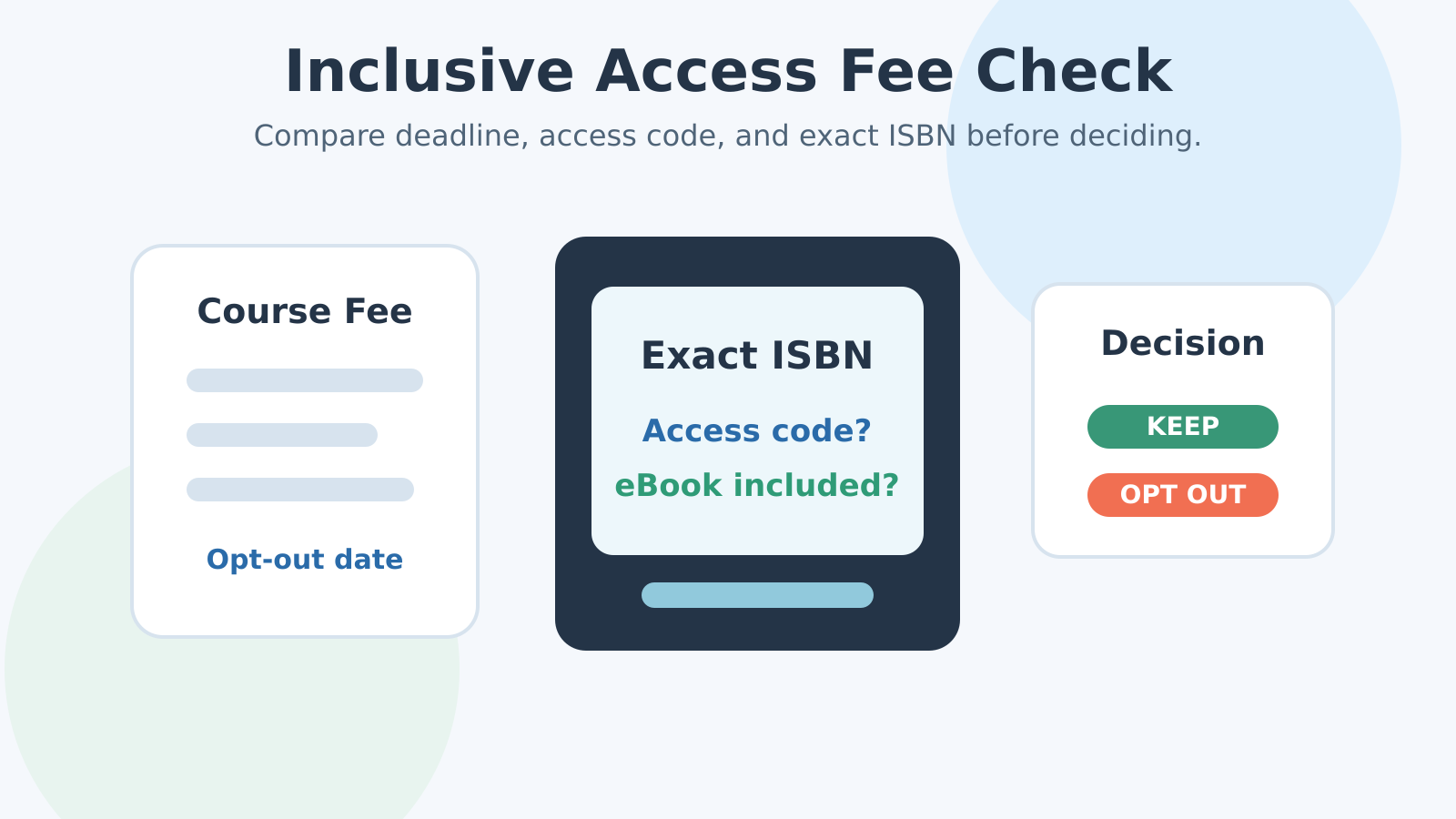
If you see an Inclusive Access, First Day, Follett ACCESS, or course materials fee on your bill, the safest default is simple: keep it only if it is the cheapest required way to complete the class. If you can replace it with a cheaper legal alternative before the deadline, opt out. If you cannot, paying the fee may be the practical move.
The key is not to guess. Compare the exact material, the exact deadline, and the exact access requirements before the charge locks in.
What Inclusive Access actually means on your bill
Inclusive Access is also known as automatic textbook billing. In that model, the cost of digital course content is built into tuition and fees, and students are typically billed unless they opt out before the deadline. Programs often deliver access through the campus LMS on or near the first day of class, and access may end when the course ends. See the InclusiveAccess.org FAQ for the common program names and student-facing definition.
That label can change from campus to campus. Common names include First Day, Follett ACCESS, All Access, All Students Acquire, Auto Access, Course Material Fee, Day One Access, Equitable Access, and Immediate Access.
Federal aid rules also matter here. The current books-and-supplies provisions live in 34 CFR 668.164, and the Department of Education’s 2024 Federal Register notice kept those current requirements in place while emphasizing a clearly communicated, actionable opt-out policy.
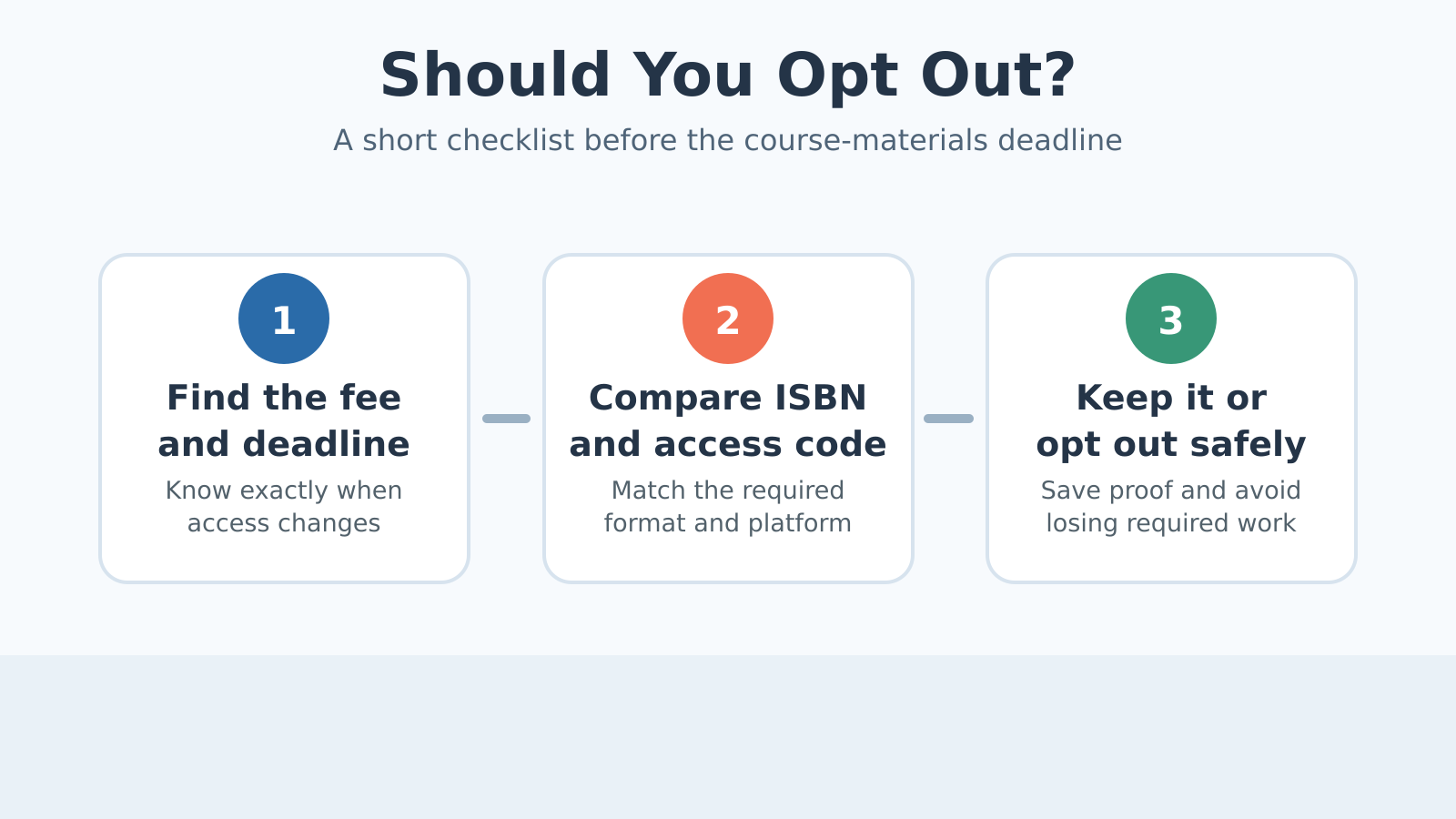
The 10-minute opt-out checklist
Use this before the deadline hits.
| Check | What to verify | Why it matters |
|---|---|---|
| Fee name | Is this Inclusive Access, First Day, Follett ACCESS, or just a bookstore charge? | The billing model changes what happens if you do nothing. |
| Deadline | When is the opt-out cutoff, and where is it posted? | Miss the deadline and you may be billed automatically. |
| Required access | Does homework, quizzes, or the gradebook require a code or LMS license? | A used book may not help if the code is single-use. |
| Exact alternative | Can you buy the same ISBN, rental, ebook, or access code separately? | You need a real apples-to-apples comparison, not a guess. |
| After opt-out | What happens to LMS access, and what do you still need to buy? | Opting out does not erase course requirements. |
1. Find the exact fee and deadline
Start with the course page, bookstore page, or LMS announcement. Look for the exact wording and the deadline. Some campuses make the opt-out button easy to find; others bury it. Don’t assume the first charge you see is the final answer.
If the school uses a books-and-supplies arrangement under federal aid rules, it must provide a way for students to obtain those materials by the seventh day of the payment period in the situations covered by the rule. That timing is one reason deadlines matter so much. See 34 CFR 668.164 and the 2024 Federal Register notice.
2. Check whether homework or quizzes require a code
This is the big one. If the course uses a one-time access code, a used copy alone may not work. Check the syllabus, LMS, bookstore listing, or instructor note for words like access code, homework platform, courseware, license, or single-use registration.
3. Compare the exact ISBN, rental, used, ebook, and access-code-only prices
Do not compare a billed course fee to a random used copy of a different edition. Compare like with like:
- exact ISBN
- rental price
- used print price
- ebook price
- access-code-only price
- shipping or tax
If the class only needs the text, a used copy or rental may be cheaper. If the grade depends on the platform, the real comparison may be between the program fee and the cost of buying the same digital access elsewhere.
Textbook Nova is useful here because you can search by title, author, or ISBN and check exact-edition matches instead of trusting a vague bookstore listing. Use Textbook Nova to compare exact editions.
4. Ask whether OER, library reserves, or an older edition is allowed
If your class can use an open textbook, a library reserve copy, or an older edition, you may be able to skip the fee entirely. OpenStax makes its digital textbooks free to access online or as downloadable PDFs, and it also offers print options for many titles.
For a broader OER search, the Open Textbook Library is a good place to check. If the course still needs publisher homework access, OER may help with reading but not with grading tools.
5. Confirm what happens after opting out
This is where people get burned. Opting out usually means you lose the automatically delivered content, and you are responsible for finding the required materials another way. OpenStax says that if a student opts out of an inclusive access program, the student is still responsible for obtaining required course materials through another method.
So do not opt out until you know exactly what you still need.
When keeping Inclusive Access is probably worth it
Keep the fee when one or more of these are true:
- the required access code costs about the same elsewhere
- the course runs on a digital homework platform you must use
- the school’s fee really is cheaper than buying print plus code separately
- the deadline is near and you have not found a better option
- the included access already matches the exact course version you need
This is the one time where convenience can be rational. If the program fee is below the full cost of a separate ebook, code, and shipping, keeping it may be the cleanest choice.
When opting out may save money
Opt out when one of these is true:
- the class does not actually require a code
- you found a cheaper used, rental, or ebook path
- the school’s fee is based on a newer version than your instructor will accept
- the material is available through OpenStax, a library reserve, or another approved OER source
- the included content is temporary, but you need the book longer than the access window
Federal regulations allow institutions to include books and supplies in tuition and fees only when certain conditions are met, including below-market pricing, timely access, and an opt-out policy. That means the fee can be legitimate and still not be the best deal for you. See 34 CFR 668.164 for the rule text.
Email scripts you can copy
Professor email script
Subject: Question about the required course materials
Hi Professor [Name],
I’m reviewing the course materials and saw an Inclusive Access / First Day / course materials fee. Before the opt-out deadline, could you confirm whether we need the digital access code for homework, quizzes, or grading?
If there is a cheaper legal alternative, such as a used copy, rental, or open textbook version, would that still work for this class?
Thanks, [Your Name]
Bookstore/support email script
Subject: Inclusive Access opt-out question
Hi,
I see a course materials fee listed for [Course/Section]. Can you confirm:
- the opt-out deadline,
- what materials I lose access to if I opt out,
- whether the required content includes a one-time code or LMS license,
- and whether the same materials can be purchased separately?
Please send the opt-out instructions or direct link if available.
Thank you, [Your Name]
Bottom line: decide before the deadline, not after the charge posts
Inclusive Access is not automatically good or bad. It is a billing method. Your job is to decide whether it is the cheapest required path to pass the class.
If the fee covers the exact access you need for less than any realistic alternative, keep it. If a used book, rental, OER title, library reserve, or separately purchased code is cheaper and still valid for the course, opt out before the deadline.
When in doubt, compare by exact ISBN and exact access requirement first. Textbook Nova makes that part easier.