Tag: textbook savings

  • Is a Textbook Subscription Worth It? Compare Before You Pay

    Is a Textbook Subscription Worth It? Compare Before You Pay

    Usually, a textbook subscription is worth it only when it replaces enough required material to beat the total cost of buying, renting, or using a used copy. That sounds obvious, but students get tripped up because they compare the subscription price to just one book price. The real comparison has to include how many courses the plan covers, whether the class needs graded homework access, how long you need the material, and whether you can resell anything later.

    If you think of it as “subscription vs. one book,” you can overpay fast. If you think of it as “total course-material cost for this term,” the answer gets much clearer.

    Quick answer: a textbook subscription is worth it only when it covers enough required material

    A subscription makes the most sense when all of these are true:

    • you have multiple required titles or platforms from the same publisher,
    • the subscription covers the exact books or courseware your classes need,
    • you will use the access long enough to justify the term price,
    • and you would otherwise have to buy several separate eBooks, rentals, or access codes.

    That is why a plan like Cengage Unlimited can be a smart deal for some students and a waste for others. Cengage says the plan covers its learning platforms and thousands of eBooks, but it is still only valuable if your courses are actually inside that ecosystem. Cengage offers term-based access, but prices, included products, and campus bookstore arrangements can change, so check the current checkout page before you decide.

    First, separate reading access from graded homework access

    This is the biggest mistake students make. Not every required digital product is just an eBook.

    Reading-only eTextbooks are easier to compare

    If you only need a reading copy, the comparison is straightforward: used book, rental, eBook, subscription, or free/open textbook. In that case, the cheapest option often wins as long as the edition matches what the instructor wants.

    Courseware and access codes can be mandatory even if you find the book cheaper

    Platforms like McGraw Hill Connect are not just books in digital form. They are complete course experiences with assignments, quizzes, and homework tools. If your grade depends on that platform, a used textbook does not replace it.

    That same logic applies to publisher bundles and access-code packages. A cheaper used copy can still leave you paying twice if the course requires separate digital access.

    Build a quick break-even table before you pay

    Before checkout, list the exact ISBN, platform, access length, and return window for every required item. Then compare the real totals, not the sticker prices.

    What to compare Subscription Used / rental / eBook
    Base price Flat term fee Single-item price
    Shipping / handling Sometimes extra Often extra
    Taxes Maybe Maybe
    Included access length Must cover the full course Must cover the full course
    Homework / courseware Sometimes included Often separate
    Resale value Usually none Used books may have some
    Extra rentals / extensions Can add up Can add up
    Student studying with books and a laptop while comparing course material options.
    Compare textbook subscriptions against exact ISBN, rental, used, and eBook options before checking out.

    A simple break-even rule:

    If the subscription cost + fees is less than the total of the cheapest combination of required books/platforms minus any resale value you would keep, the subscription wins.

    That means you should compare against the full semester cost, not just one title. NerdWallet’s textbook guide gives the right shopping habit here: search by title, author, or ISBN, and include shipping, handling, taxes, and returns in the total cost. It also warns that older editions may not include everything your course needs, which is exactly how students end up buying the wrong “cheap” book.

    When Cengage Unlimited or a similar all-access plan can make sense

    A broad subscription can be a good deal when you have several covered courses in the same term.

    For example, if two or three classes all use Cengage materials, the subscription may beat buying each courseware package separately. Cengage also says included print rentals exist, which can help if you still prefer paper for reading. But the fine print matters: Cengage’s print-rental help says included print rentals are limited by subscription length, students still pay shipping and handling, and additional rentals after the allowance are priced separately. That is useful, but it is not the same as “unlimited physical books.” It is a capped perk, not a blank check.

    A Cengage-style plan is most attractive when:

    • several of your courses use the same publisher,
    • you need both the eBook and the homework platform,
    • and you will actually use the included rentals instead of letting them go to waste.

    When a single-title eTextbook subscription may be enough

    Not every student needs a giant bundle. Sometimes a single-title digital access plan is enough, especially if you only need one book for one class.

    Pearson’s Pearson+ is a good example. Pearson lists monthly and up-front payment options for Pearson+ eTextbooks, and fixed 6-month access can function like a digital rental. It also describes a longer “lifetime access” option as a one-time 5-year web access term, with app access if the book is downloaded before the term ends. Extension charges can continue monthly until you cancel.

    That makes Pearson+ a different kind of decision than an all-access subscription. If you need one Pearson title for one term, a fixed access window may be perfect. If you need long-term reference access, or if the class runs longer than the access period, buying a different format may be smarter.

    When buying used, renting, or using free options is smarter

    Sometimes the subscription answer is simply no.

    Buy used, rent, or go open when:

    • you only need a reading copy,
    • the class does not require a proprietary platform,
    • the book has solid resale value,
    • or the professor allows an open resource.

    OpenStax is the cleanest reminder that not every class needs a paid publisher platform. OpenStax says its digital textbooks are free online or downloadable as PDFs, which can save a ton of money when the course allows it.

    That said, free does not always mean complete for every class. If the syllabus requires a branded homework system, an open textbook may cover the reading but not the graded assignments.

    Student PIRGs’ 2026 report on textbook market problems also makes the broader point that students often get squeezed by access codes and automatic billing. It is advocacy research, so treat it as a consumer warning rather than a neutral publisher guide, but the underlying lesson is useful: always confirm what is truly required before paying for a bundle you may not need.

    Subscription red flags and the final checklist

    Watch for these warning signs before checkout:

    • The subscription covers only some of your required courses.
    • The class needs a platform, not just a book.
    • The access term ends before finals.
    • The “included” rentals still charge shipping or come with strict limits.
    • The book is cheaper used, but the platform still costs extra.
    • You could use a resale-friendly print copy and recover part of the cost later.
    • The plan’s terms say products or ancillaries may change.

    That last one matters. Cengage’s legal terms note that Cengage Unlimited products can change and that not all materials or ancillaries are guaranteed. In plain English: do not assume every future course will be covered exactly the way the sales page makes it sound today.

    So the final call is simple:

    • Subscribe if multiple required courses are covered and the total is lower than buying each item separately.
    • Rent if you only need one book for one term and resale does not matter.
    • Buy used if the class only needs a reading copy and the edition matches.
    • Use open/free resources if the instructor allows them and the assignment requirements are covered.
    • Ask first if the syllabus mentions access codes, courseware, or inclusive-access billing.

    If you want the safest move, compare exact ISBNs and platform names before you pay; a quick search on Textbook Nova can help you sanity-check used, rental, and edition options before you commit to a subscription. The best deal is not the lowest price on the screen; it is the lowest total cost for the actual course requirements.
  • Inclusive Access Textbooks: Should You Opt Out of Your Course Materials Fee?

    Inclusive Access Textbooks: Should You Opt Out of Your Course Materials Fee?

    If you see an Inclusive Access, First Day, Follett ACCESS, or course materials fee on your bill, the safest default is simple: keep it only if it is the cheapest required way to complete the class. If you can replace it with a cheaper legal alternative before the deadline, opt out. If you cannot, paying the fee may be the practical move.

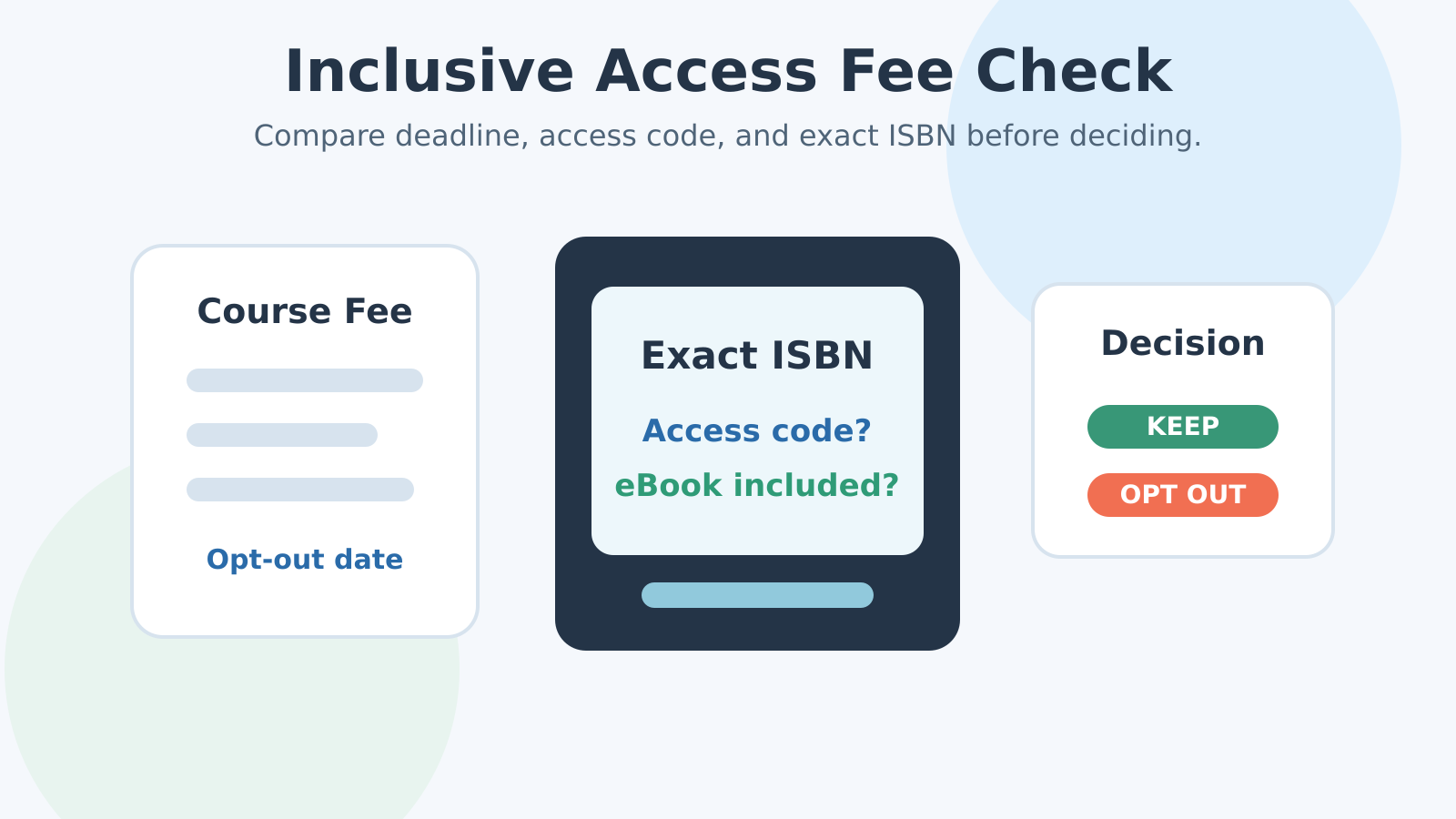
    The key is not to guess. Compare the exact material, the exact deadline, and the exact access requirements before the charge locks in.

    What Inclusive Access actually means on your bill

    Inclusive Access is also known as automatic textbook billing. In that model, the cost of digital course content is built into tuition and fees, and students are typically billed unless they opt out before the deadline. Programs often deliver access through the campus LMS on or near the first day of class, and access may end when the course ends. See the InclusiveAccess.org FAQ for the common program names and student-facing definition.

    That label can change from campus to campus. Common names include First Day, Follett ACCESS, All Access, All Students Acquire, Auto Access, Course Material Fee, Day One Access, Equitable Access, and Immediate Access.

    Federal aid rules also matter here. The current books-and-supplies provisions live in 34 CFR 668.164, and the Department of Education’s 2024 Federal Register notice kept those current requirements in place while emphasizing a clearly communicated, actionable opt-out policy.

    The 10-minute opt-out checklist

    Use this before the deadline hits.

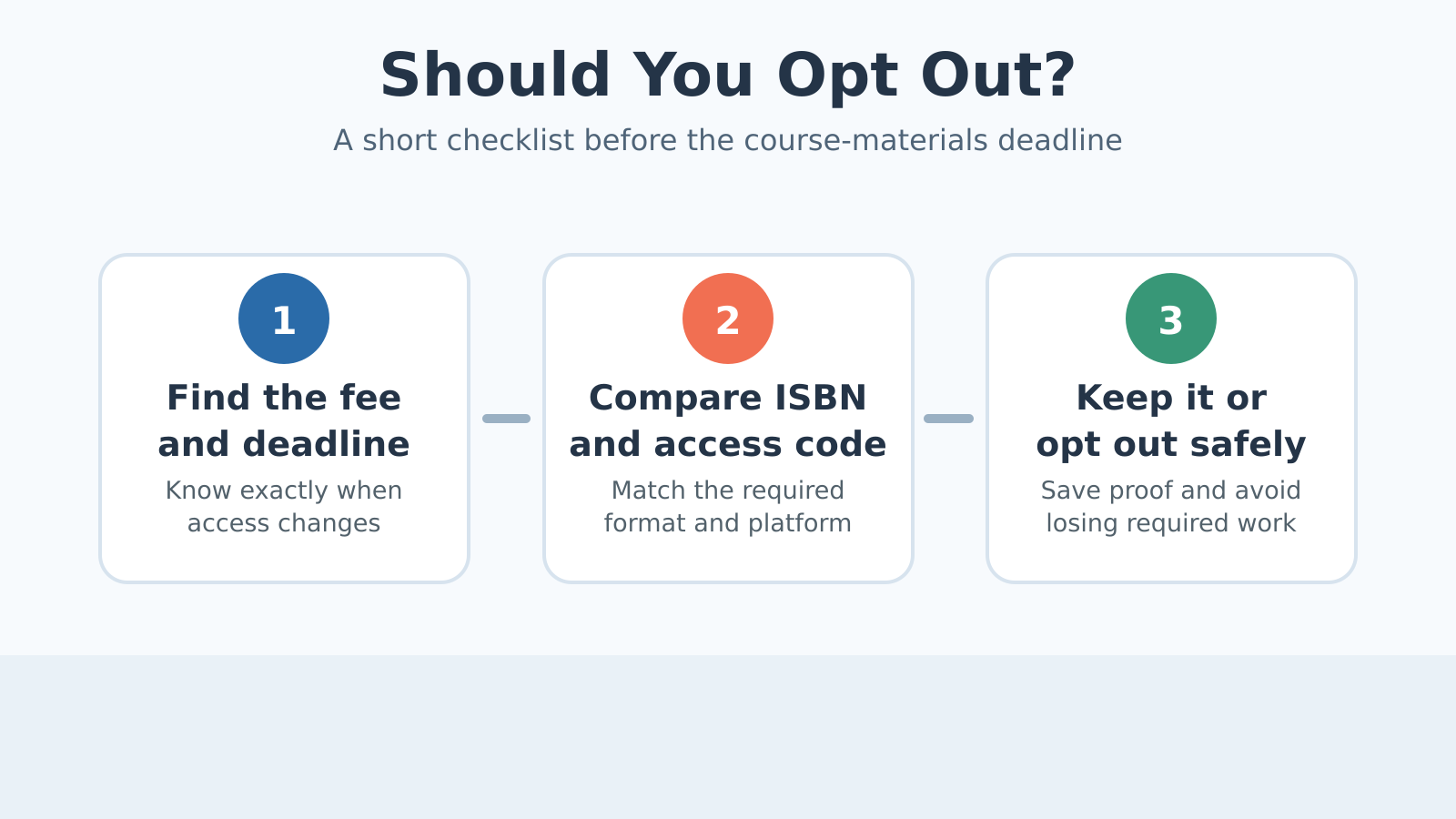
    Decision flow for whether to opt out of an inclusive access textbook fee.
    A quick decision flow: find the fee and deadline, compare exact access requirements, then keep the fee or opt out safely.
    Check What to verify Why it matters
    Fee name Is this Inclusive Access, First Day, Follett ACCESS, or just a bookstore charge? The billing model changes what happens if you do nothing.
    Deadline When is the opt-out cutoff, and where is it posted? Miss the deadline and you may be billed automatically.
    Required access Does homework, quizzes, or the gradebook require a code or LMS license? A used book may not help if the code is single-use.
    Exact alternative Can you buy the same ISBN, rental, ebook, or access code separately? You need a real apples-to-apples comparison, not a guess.
    After opt-out What happens to LMS access, and what do you still need to buy? Opting out does not erase course requirements.

    1. Find the exact fee and deadline

    Start with the course page, bookstore page, or LMS announcement. Look for the exact wording and the deadline. Some campuses make the opt-out button easy to find; others bury it. Don’t assume the first charge you see is the final answer.

    If the school uses a books-and-supplies arrangement under federal aid rules, it must provide a way for students to obtain those materials by the seventh day of the payment period in the situations covered by the rule. That timing is one reason deadlines matter so much. See 34 CFR 668.164 and the 2024 Federal Register notice.

    2. Check whether homework or quizzes require a code

    This is the big one. If the course uses a one-time access code, a used copy alone may not work. Check the syllabus, LMS, bookstore listing, or instructor note for words like access code, homework platform, courseware, license, or single-use registration.

    3. Compare the exact ISBN, rental, used, ebook, and access-code-only prices

    Do not compare a billed course fee to a random used copy of a different edition. Compare like with like:

    • exact ISBN
    • rental price
    • used print price
    • ebook price
    • access-code-only price
    • shipping or tax

    If the class only needs the text, a used copy or rental may be cheaper. If the grade depends on the platform, the real comparison may be between the program fee and the cost of buying the same digital access elsewhere.

    Textbook Nova is useful here because you can search by title, author, or ISBN and check exact-edition matches instead of trusting a vague bookstore listing. Use Textbook Nova to compare exact editions.

    4. Ask whether OER, library reserves, or an older edition is allowed

    If your class can use an open textbook, a library reserve copy, or an older edition, you may be able to skip the fee entirely. OpenStax makes its digital textbooks free to access online or as downloadable PDFs, and it also offers print options for many titles.

    For a broader OER search, the Open Textbook Library is a good place to check. If the course still needs publisher homework access, OER may help with reading but not with grading tools.

    5. Confirm what happens after opting out

    This is where people get burned. Opting out usually means you lose the automatically delivered content, and you are responsible for finding the required materials another way. OpenStax says that if a student opts out of an inclusive access program, the student is still responsible for obtaining required course materials through another method.

    So do not opt out until you know exactly what you still need.

    When keeping Inclusive Access is probably worth it

    Keep the fee when one or more of these are true:

    • the required access code costs about the same elsewhere
    • the course runs on a digital homework platform you must use
    • the school’s fee really is cheaper than buying print plus code separately
    • the deadline is near and you have not found a better option
    • the included access already matches the exact course version you need

    This is the one time where convenience can be rational. If the program fee is below the full cost of a separate ebook, code, and shipping, keeping it may be the cleanest choice.

    When opting out may save money

    Opt out when one of these is true:

    • the class does not actually require a code
    • you found a cheaper used, rental, or ebook path
    • the school’s fee is based on a newer version than your instructor will accept
    • the material is available through OpenStax, a library reserve, or another approved OER source
    • the included content is temporary, but you need the book longer than the access window

    Federal regulations allow institutions to include books and supplies in tuition and fees only when certain conditions are met, including below-market pricing, timely access, and an opt-out policy. That means the fee can be legitimate and still not be the best deal for you. See 34 CFR 668.164 for the rule text.

    Email scripts you can copy

    Professor email script

    Subject: Question about the required course materials

    Hi Professor [Name],

    I’m reviewing the course materials and saw an Inclusive Access / First Day / course materials fee. Before the opt-out deadline, could you confirm whether we need the digital access code for homework, quizzes, or grading?

    If there is a cheaper legal alternative, such as a used copy, rental, or open textbook version, would that still work for this class?

    Thanks, [Your Name]

    Bookstore/support email script

    Subject: Inclusive Access opt-out question

    Hi,

    I see a course materials fee listed for [Course/Section]. Can you confirm:

    1. the opt-out deadline,
    2. what materials I lose access to if I opt out,
    3. whether the required content includes a one-time code or LMS license,
    4. and whether the same materials can be purchased separately?

    Please send the opt-out instructions or direct link if available.

    Thank you, [Your Name]

    Bottom line: decide before the deadline, not after the charge posts

    Inclusive Access is not automatically good or bad. It is a billing method. Your job is to decide whether it is the cheapest required path to pass the class.

    If the fee covers the exact access you need for less than any realistic alternative, keep it. If a used book, rental, OER title, library reserve, or separately purchased code is cheaper and still valid for the course, opt out before the deadline.

    When in doubt, compare by exact ISBN and exact access requirement first. Textbook Nova makes that part easier.

  • How to Save Money on Textbooks in 2026: A Practical Student Checklist

    How to Save Money on Textbooks in 2026: A Practical Student Checklist

    If you want to spend less on textbooks in 2026, the fastest path is not a random coupon search. Start by comparing the exact ISBN, questioning whether you truly need the newest edition, and checking whether the class uses an access code or automatic billing. Those three decisions usually matter more than any one marketplace price.

    That advice is even more important now than it used to be. In its 2026 report, Student PIRGs says students are still dealing with access codes, automatic textbook billing, and other course-material traps even as open educational resources become more common. And the College Board’s 2025 Trends in College Pricing and Student Aid report reminds us that books and supplies are still part of the overall cost of attendance, including hardcopy textbooks, online textbooks, rentals, and other supplies.

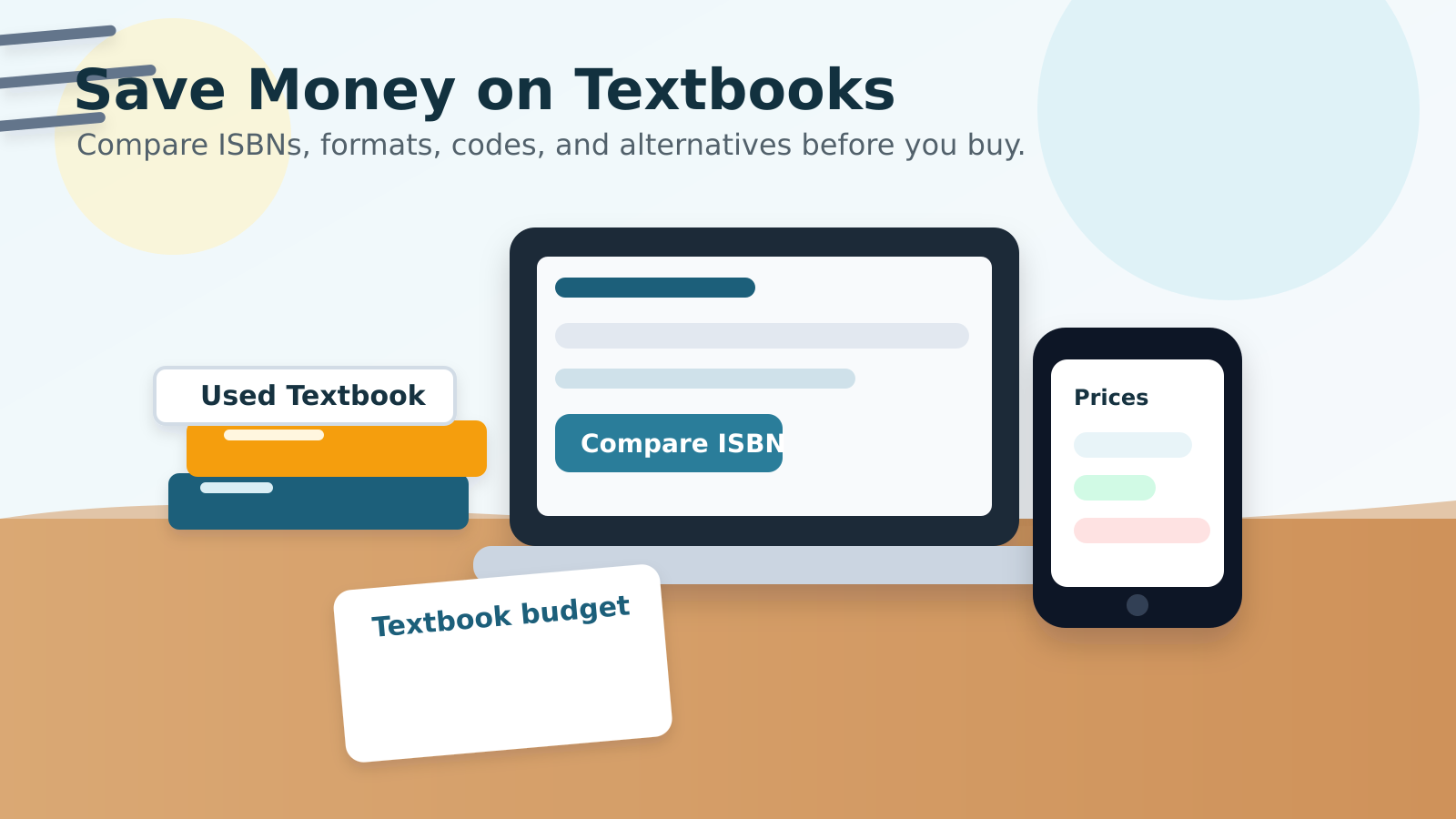
    Student desk with textbooks, laptop, notebook budget checklist, and phone price comparison for saving money on textbooks in 2026.
    A practical textbook plan starts before checkout: compare the ISBN, format, access-code rules, and total cost.

    So here’s the practical version: save where you actually have control, and don’t overpay for features you don’t need.

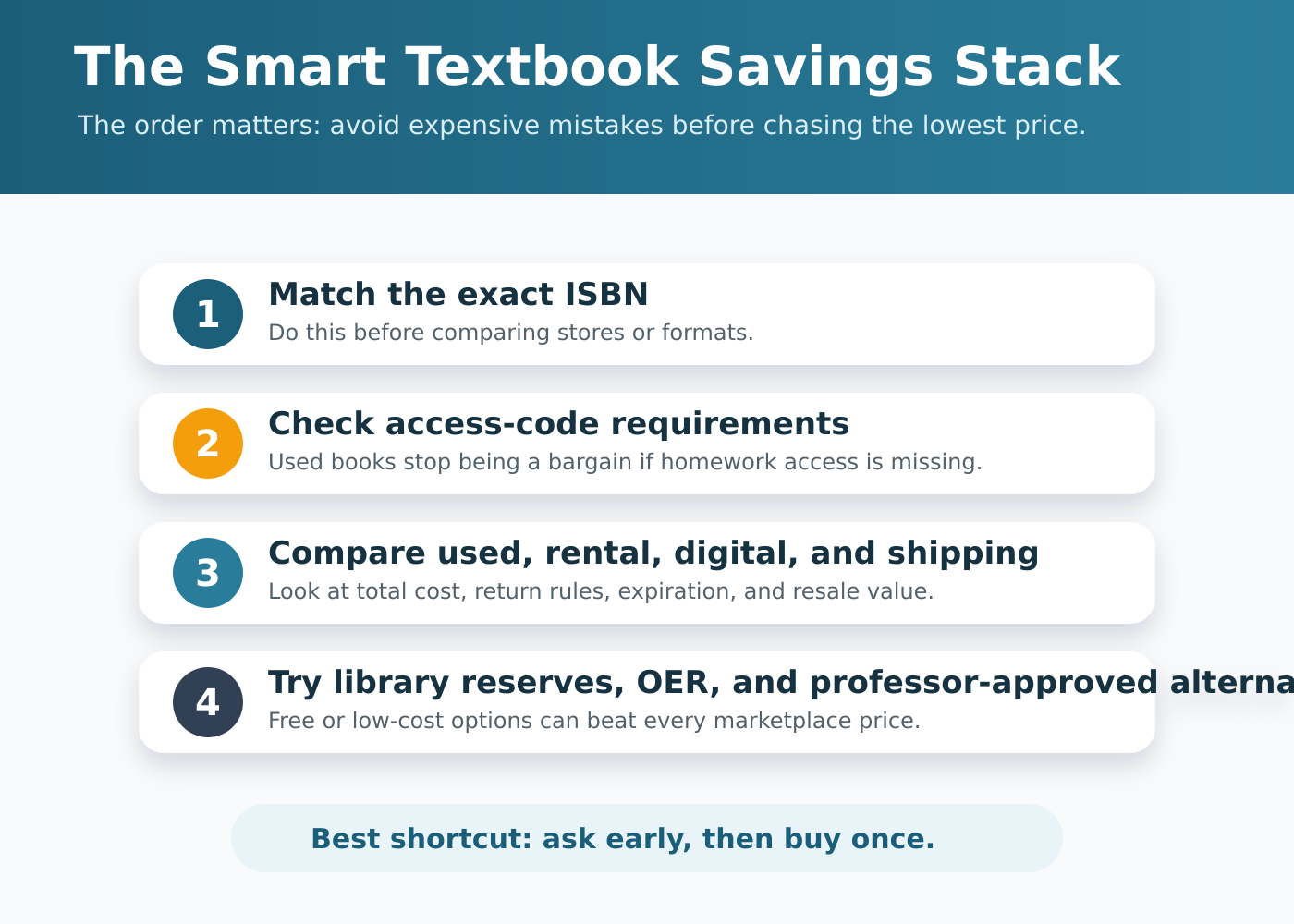
    Polished infographic showing a textbook savings stack: ISBN match, access-code check, format comparison, library and OER alternatives, and resale value.
    Use the savings stack in order: verify requirements first, then compare formats and free alternatives before buying.

    1) Start with the ISBN, not the bookstore listing

    The first step is boring, but it works. Search by ISBN, not just by title. A textbook title can hide multiple editions, bundled versions, and digital packages that look similar until checkout.

    Use this order:

    1. Copy the ISBN from the syllabus.
    2. Search that exact ISBN through Textbook Nova, your campus bookstore, used-book sellers, rental listings, and other marketplaces.
    3. Compare the total price, including shipping.
    4. Check whether the copy includes any online code or access portal.

    This matters because a “cheap” book can stop being cheap the second you learn it doesn’t include the code your class requires. If the professor only needs the text, you have more options. If the grade depends on the platform, the format matters more than the sticker price.

    If you want a broader strategy for this kind of comparison, our older guide on how to save money on textbooks still covers the basics. This update just adds the 2026 reality: the digital add-ons are often the trap.

    2) Don’t pay extra for the exact edition unless you have to

    Students get burned here all the time. A professor may say “latest edition required” when they really mean “the course will follow this text closely.” Those are not the same thing.

    Before you buy the newest version, ask:

    • Does the syllabus say the latest edition is required, or just recommended?
    • Are chapter numbers or page numbers used in assignments?
    • Will an older edition still match the homework well enough?
    • Is there a course pack or instructor notes that make the edition less important?

    If the answer is “recent edition is fine,” shop the used market first. Older editions are often dramatically cheaper, and they can be perfectly workable when the core concepts haven’t changed.

    This is one of the simplest ways to reduce costs without giving up the book itself.

    3) Buy used when the book is just a book

    Used textbooks still make sense when there’s no required code attached. That sounds obvious, but the fine print matters. A used copy is only a win if you can actually use it for the class.

    Used is usually your best move when:

    • the class uses the book for reading only,
    • homework is not tied to an online portal,
    • the professor allows an older edition,
    • and you plan to keep the book or resell it later.

    Used is a bad deal when:

    • the required access code is single-use,
    • the course is built around a digital homework system,
    • or the seller’s listing is vague about what’s included.

    If you buy used, check the condition notes carefully. “Good enough” can be fine for a reading-heavy class, but not if the pages are missing, highlighted to the point of distraction, or water-damaged.

    4) Choose rental or digital only when the math actually works

    Renting and digital access are not automatically cheaper. Sometimes they are. Sometimes they just move the cost around.

    Rent when:

    • you need the book for one term only,
    • you don’t care about keeping it,
    • and the rental total is clearly lower than used + resale risk.

    Choose digital when:

    • the class already requires a digital platform,
    • you prefer carrying less weight,
    • and the ebook price is meaningfully below print.

    But watch the hidden catches. A digital package might look cheaper until you realize it expires, locks you into a single device, or still requires a separate access code. That’s why the College Board’s 2025 report is useful here: it treats books and supplies as a budget category that can include hardcopy textbooks, online textbooks, rentals, and other supplies. In other words, your “book” cost may show up in more than one form.

    Rule of thumb: if you can resell a print book, include that in the comparison. If you can’t resell a rental or digital license, don’t pretend the up-front price tells the whole story.

    5) Watch for access codes and automatic billing before you click buy

    This is the biggest 2026 trap.

    Student PIRGs reports that access codes have become common in required coursework, and that many campuses now use automatic textbook billing. That means the cost can appear by default, not by choice.

    Before you pay, ask three questions:

    • Is the access code required for homework, quizzes, or grading?
    • Can I opt out of automatic billing?
    • Can I buy the material somewhere else and still complete the class?

    If the answer to the first question is yes, a used copy may not help unless it includes the code. If the answer to the second question is unclear, don’t assume the default charge is your only option. And if the bookstore or LMS is pushing an “inclusive access” style package, compare the real total before accepting it.

    A lot of students lose money here because they shop for the book first and discover the code problem later. Reverse that order.

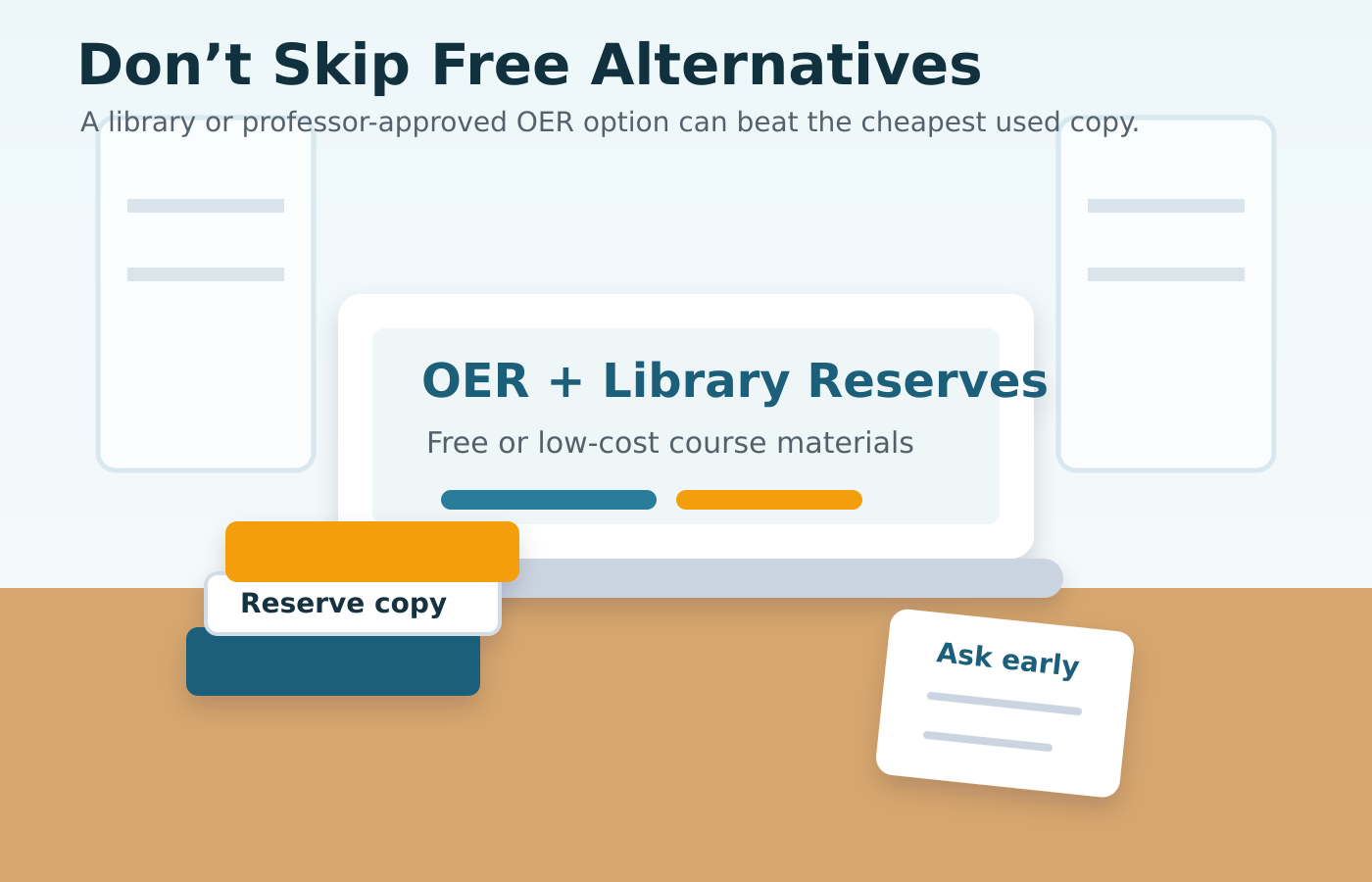
    Campus library study table with open educational resources on a laptop, reserve books, and course notes as textbook alternatives.
    Library reserves, ebooks, and OER can be just as important as used-book marketplaces when you are trying to lower course-material costs.

    6) Use library reserves, OER, and professor-approved alternatives

    This is where students can sometimes save the most.

    Start with your campus library. Some schools keep course reserves, ebook access, or short-term lending copies for high-demand classes. Those options are easy to miss, and they are often free.

    Next, look for open educational resources, or OER. Student PIRGs notes that growing awareness of open textbooks and other free materials has expanded access, even while the market has gotten more complicated. That means more courses may already have cheaper or free alternatives available.

    Here’s what to ask:

    • Does the library have a reserve copy or ebook license?
    • Is there an open textbook option for this course?
    • Will the professor accept a previous edition or alternate source?
    • Is the “required” book really required, or just recommended?

    If you’re stuck, ask early. Professors are usually much more flexible before the semester starts than after assignments are already underway.

    For context on why this problem keeps coming back, our post on why college textbooks are so expensive goes deeper on the publisher and bundling side.

    7) End the semester by deciding whether to resell, keep, or donate

    Saving money on textbooks does not end when you buy them. It ends when you decide what they’re worth to you after the class.

    Resell when:

    • the book is still current,
    • it’s a common title,
    • and you don’t need it for a later course.

    Keep when:

    • it’s a major reference for your field,
    • the content will matter in later classes,
    • or it’s a book you actually want on your shelf.

    Donate when:

    • resale value is basically gone,
    • another student can use it,
    • or your campus has a reuse program.

    Even a modest resale return changes the math on the next purchase. A $90 book that sells for $30 later is not the same as a $90 book that goes in the closet forever.

    The short version

    If you want the biggest savings, do these five things in order:

    1. Compare by ISBN.
    2. Verify whether the exact edition matters.
    3. Check for access codes before buying used.
    4. Compare rental, print, and digital on total cost.
    5. Use library reserves and OER whenever you can.

    That’s the 2026 textbook-saving playbook. The market is still messy, but students do have leverage when they shop in the right order.

    If you want more textbook-buying tips and learning-cost advice, start at Textbook Nova and work outward from there.