Category: Textbooks

  • Is a Textbook Subscription Worth It? Compare Before You Pay

    Is a Textbook Subscription Worth It? Compare Before You Pay

    Usually, a textbook subscription is worth it only when it replaces enough required material to beat the total cost of buying, renting, or using a used copy. That sounds obvious, but students get tripped up because they compare the subscription price to just one book price. The real comparison has to include how many courses the plan covers, whether the class needs graded homework access, how long you need the material, and whether you can resell anything later.

    If you think of it as “subscription vs. one book,” you can overpay fast. If you think of it as “total course-material cost for this term,” the answer gets much clearer.

    Quick answer: a textbook subscription is worth it only when it covers enough required material

    A subscription makes the most sense when all of these are true:

    • you have multiple required titles or platforms from the same publisher,
    • the subscription covers the exact books or courseware your classes need,
    • you will use the access long enough to justify the term price,
    • and you would otherwise have to buy several separate eBooks, rentals, or access codes.

    That is why a plan like Cengage Unlimited can be a smart deal for some students and a waste for others. Cengage says the plan covers its learning platforms and thousands of eBooks, but it is still only valuable if your courses are actually inside that ecosystem. Cengage offers term-based access, but prices, included products, and campus bookstore arrangements can change, so check the current checkout page before you decide.

    First, separate reading access from graded homework access

    This is the biggest mistake students make. Not every required digital product is just an eBook.

    Reading-only eTextbooks are easier to compare

    If you only need a reading copy, the comparison is straightforward: used book, rental, eBook, subscription, or free/open textbook. In that case, the cheapest option often wins as long as the edition matches what the instructor wants.

    Courseware and access codes can be mandatory even if you find the book cheaper

    Platforms like McGraw Hill Connect are not just books in digital form. They are complete course experiences with assignments, quizzes, and homework tools. If your grade depends on that platform, a used textbook does not replace it.

    That same logic applies to publisher bundles and access-code packages. A cheaper used copy can still leave you paying twice if the course requires separate digital access.

    Build a quick break-even table before you pay

    Before checkout, list the exact ISBN, platform, access length, and return window for every required item. Then compare the real totals, not the sticker prices.

    What to compare Subscription Used / rental / eBook
    Base price Flat term fee Single-item price
    Shipping / handling Sometimes extra Often extra
    Taxes Maybe Maybe
    Included access length Must cover the full course Must cover the full course
    Homework / courseware Sometimes included Often separate
    Resale value Usually none Used books may have some
    Extra rentals / extensions Can add up Can add up
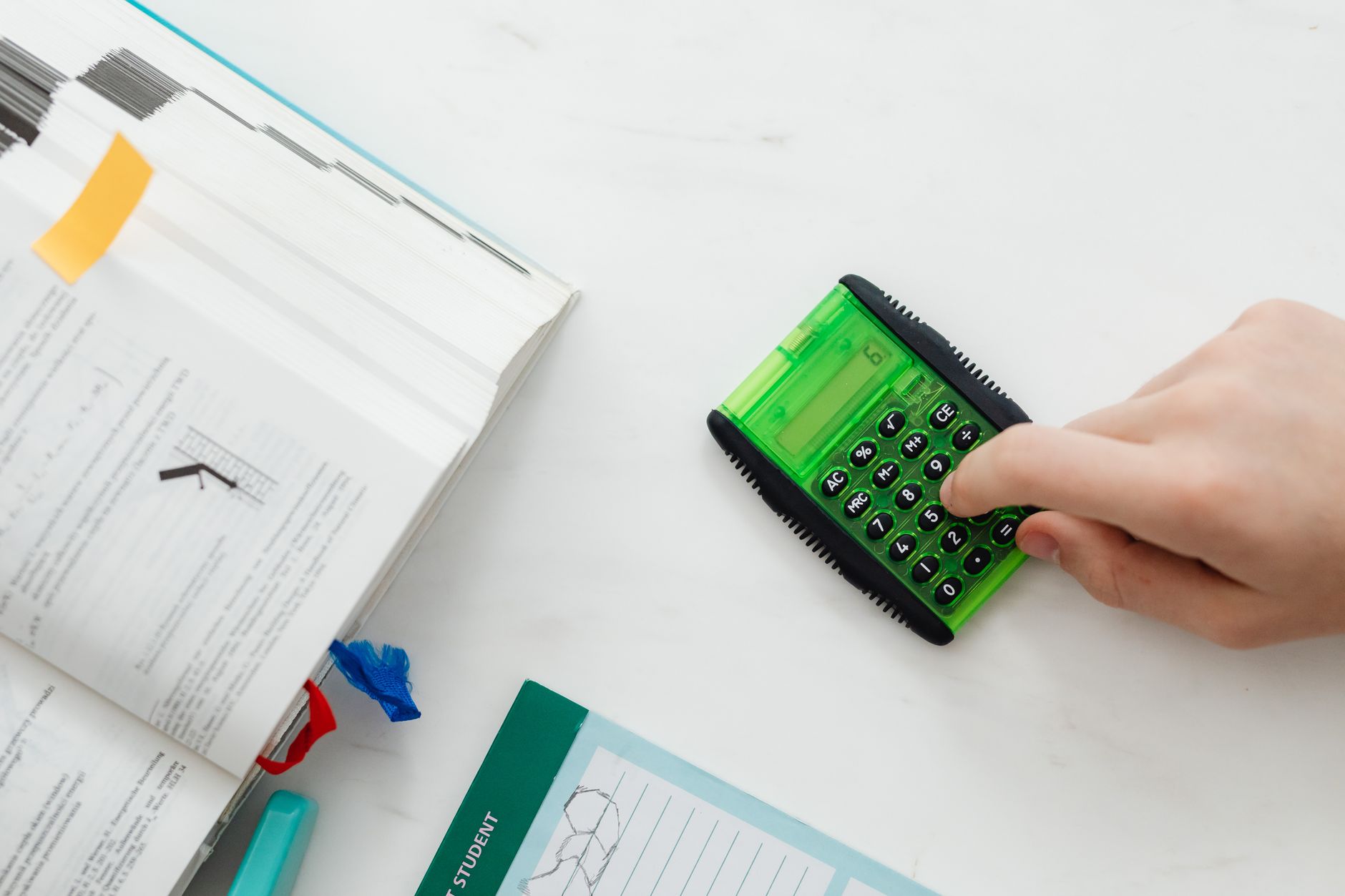
    Student studying with books and a laptop while comparing course material options.
    Compare textbook subscriptions against exact ISBN, rental, used, and eBook options before checking out.

    A simple break-even rule:

    If the subscription cost + fees is less than the total of the cheapest combination of required books/platforms minus any resale value you would keep, the subscription wins.

    That means you should compare against the full semester cost, not just one title. NerdWallet’s textbook guide gives the right shopping habit here: search by title, author, or ISBN, and include shipping, handling, taxes, and returns in the total cost. It also warns that older editions may not include everything your course needs, which is exactly how students end up buying the wrong “cheap” book.

    When Cengage Unlimited or a similar all-access plan can make sense

    A broad subscription can be a good deal when you have several covered courses in the same term.

    For example, if two or three classes all use Cengage materials, the subscription may beat buying each courseware package separately. Cengage also says included print rentals exist, which can help if you still prefer paper for reading. But the fine print matters: Cengage’s print-rental help says included print rentals are limited by subscription length, students still pay shipping and handling, and additional rentals after the allowance are priced separately. That is useful, but it is not the same as “unlimited physical books.” It is a capped perk, not a blank check.

    A Cengage-style plan is most attractive when:

    • several of your courses use the same publisher,
    • you need both the eBook and the homework platform,
    • and you will actually use the included rentals instead of letting them go to waste.

    When a single-title eTextbook subscription may be enough

    Not every student needs a giant bundle. Sometimes a single-title digital access plan is enough, especially if you only need one book for one class.

    Pearson’s Pearson+ is a good example. Pearson lists monthly and up-front payment options for Pearson+ eTextbooks, and fixed 6-month access can function like a digital rental. It also describes a longer “lifetime access” option as a one-time 5-year web access term, with app access if the book is downloaded before the term ends. Extension charges can continue monthly until you cancel.

    That makes Pearson+ a different kind of decision than an all-access subscription. If you need one Pearson title for one term, a fixed access window may be perfect. If you need long-term reference access, or if the class runs longer than the access period, buying a different format may be smarter.

    When buying used, renting, or using free options is smarter

    Sometimes the subscription answer is simply no.

    Buy used, rent, or go open when:

    • you only need a reading copy,
    • the class does not require a proprietary platform,
    • the book has solid resale value,
    • or the professor allows an open resource.

    OpenStax is the cleanest reminder that not every class needs a paid publisher platform. OpenStax says its digital textbooks are free online or downloadable as PDFs, which can save a ton of money when the course allows it.

    That said, free does not always mean complete for every class. If the syllabus requires a branded homework system, an open textbook may cover the reading but not the graded assignments.

    Student PIRGs’ 2026 report on textbook market problems also makes the broader point that students often get squeezed by access codes and automatic billing. It is advocacy research, so treat it as a consumer warning rather than a neutral publisher guide, but the underlying lesson is useful: always confirm what is truly required before paying for a bundle you may not need.

    Subscription red flags and the final checklist

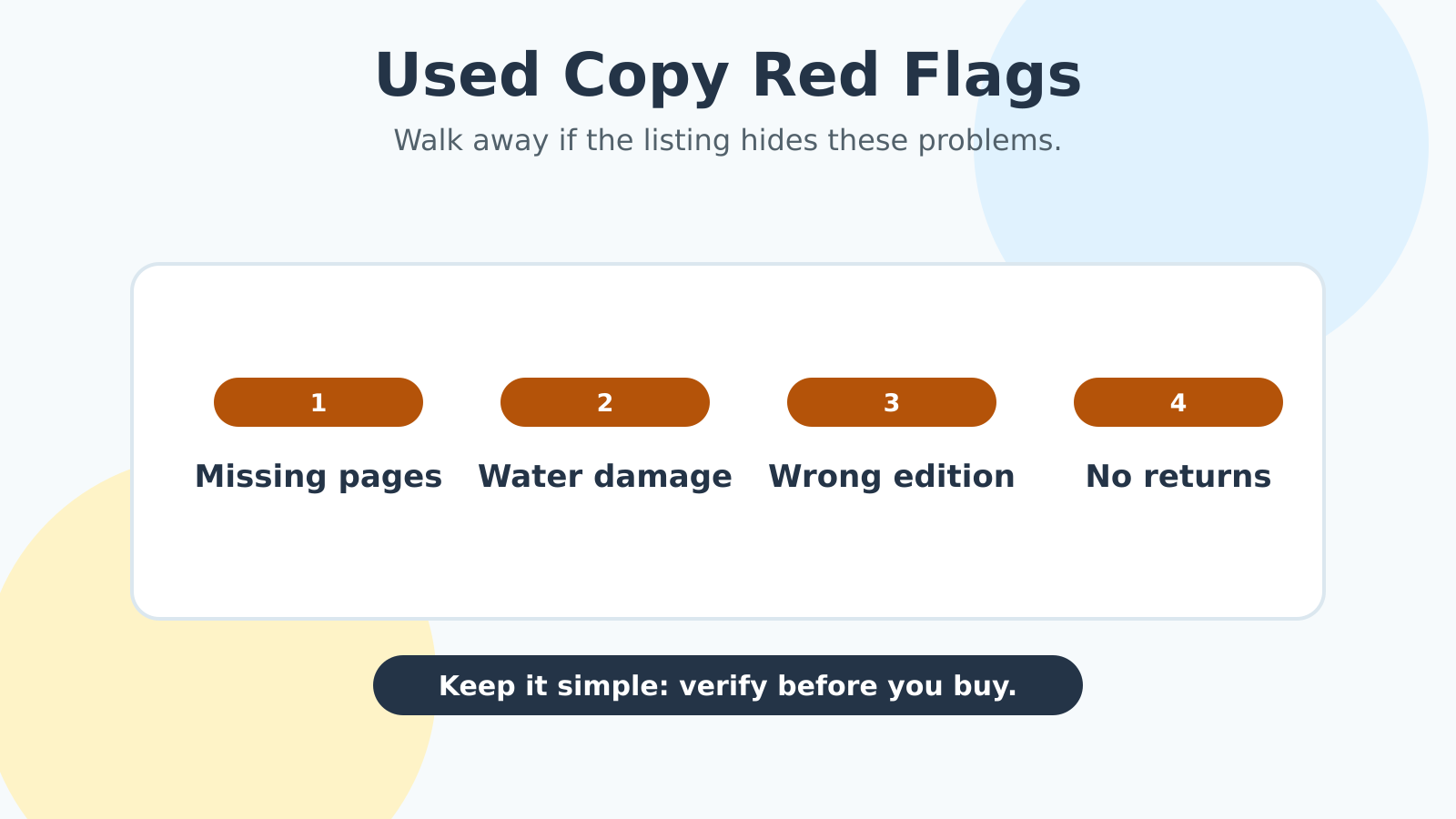
    Watch for these warning signs before checkout:

    • The subscription covers only some of your required courses.
    • The class needs a platform, not just a book.
    • The access term ends before finals.
    • The “included” rentals still charge shipping or come with strict limits.
    • The book is cheaper used, but the platform still costs extra.
    • You could use a resale-friendly print copy and recover part of the cost later.
    • The plan’s terms say products or ancillaries may change.

    That last one matters. Cengage’s legal terms note that Cengage Unlimited products can change and that not all materials or ancillaries are guaranteed. In plain English: do not assume every future course will be covered exactly the way the sales page makes it sound today.

    So the final call is simple:

    • Subscribe if multiple required courses are covered and the total is lower than buying each item separately.
    • Rent if you only need one book for one term and resale does not matter.
    • Buy used if the class only needs a reading copy and the edition matches.
    • Use open/free resources if the instructor allows them and the assignment requirements are covered.
    • Ask first if the syllabus mentions access codes, courseware, or inclusive-access billing.

    If you want the safest move, compare exact ISBNs and platform names before you pay; a quick search on Textbook Nova can help you sanity-check used, rental, and edition options before you commit to a subscription. The best deal is not the lowest price on the screen; it is the lowest total cost for the actual course requirements.

  • How to Tell If an Online Textbook Seller Is Legit Before You Buy

    How to Tell If an Online Textbook Seller Is Legit Before You Buy

    If you are about to buy a textbook online, the safest move is simple: trust the seller only after you verify the seller, the exact book, and the checkout terms. A listing can look polished and still be wrong, fake, or risky. The good news is that you can spot most bad listings in a few minutes if you know what to check.

    The short version: verify the seller, the exact ISBN and edition, and the checkout terms. If you want to compare exact editions after you verify the listing, search by ISBN or title on Textbook Nova and compare your options before you buy.

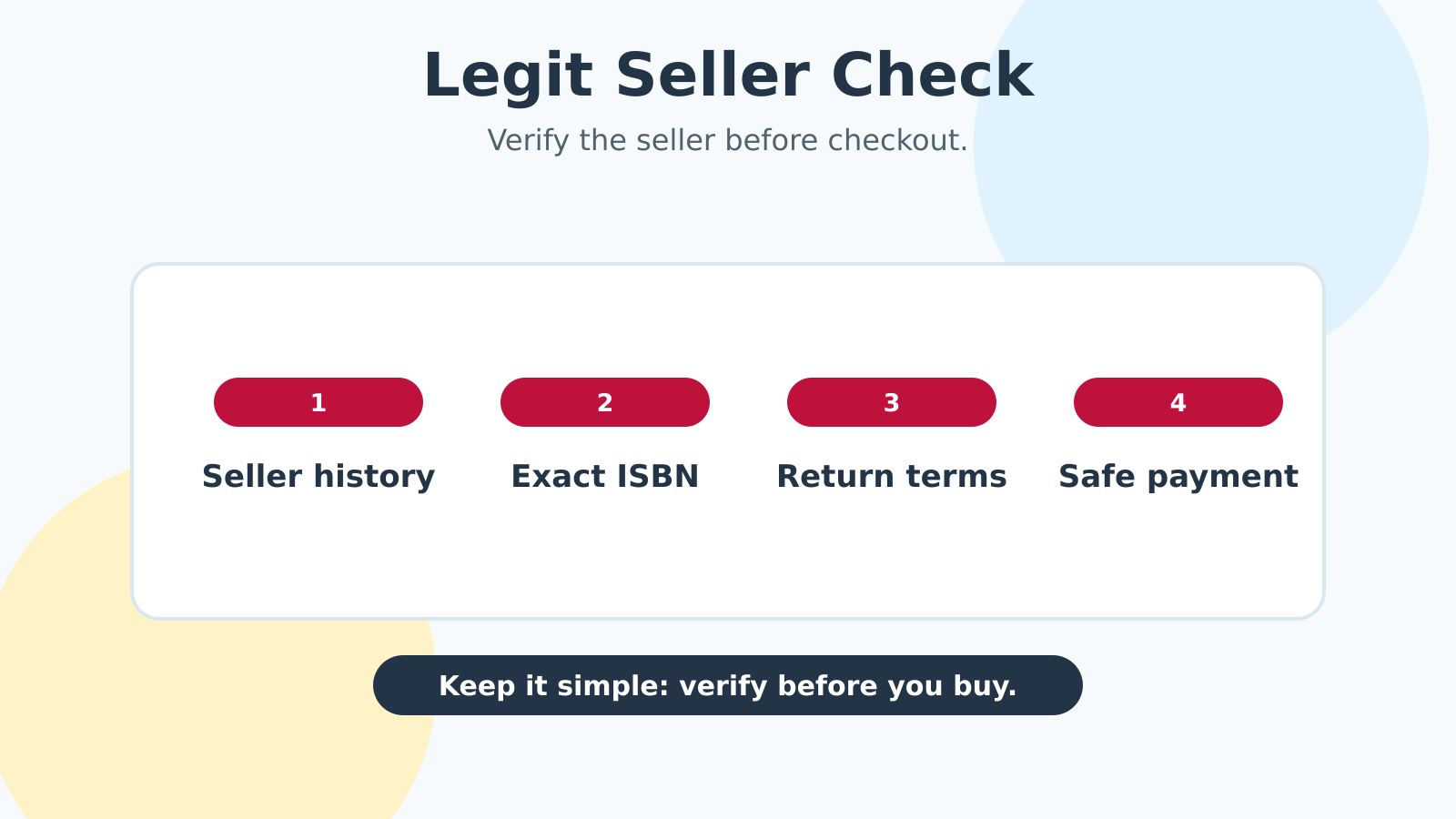
    Legit seller checklist for checking an online textbook listing before buying.
    A safe textbook listing should have a verifiable seller, exact ISBN details, clear return terms, and protected payment.

    Quick answer: the safest textbook listing is the one you can verify

    The fastest legitimacy check is this:

    • Seller identity: Can you find a real seller name, history, and contact path?
    • Listing accuracy: Does the ISBN, edition, format, and bundle/access-code wording match your class?
    • Photos and description: Are there original photos and specific condition notes, not just vague sales copy?
    • Payment and returns: Are you paying through a protected checkout with a return policy you can actually use?

    That lines up with the FTC’s advice on online shopping and buying from an online marketplace. The BBB’s online shopping scam warnings make the same point: if a deal looks too easy and the seller is hard to pin down, slow down.

    Check the seller before you trust the listing

    Search the seller name, reviews, and complaint history

    Start with the seller, not the price. Search the seller name plus words like scam, complaint, fake, review, refund, or marketplace. You are looking for a pattern, not a single grumpy comment. Repeated stories about wrong items, missing shipments, or no refunds are different.

    On marketplaces, pay attention to seller age, completed sales, and response history. A seller with a long track record and consistent feedback is usually safer than a brand-new account with a “too good to miss” price. The FTC and BBB both push buyers toward this kind of basic due diligence because it catches the obvious trouble before money changes hands.

    Look for real contact info and marketplace protection

    A legitimate seller should not feel anonymous. At minimum, you want a real seller profile, a platform checkout path, and a way to contact support if the item never arrives or turns out wrong. If the seller wants to move the deal off-platform right away, that is a warning sign.

    Protected marketplaces give you a trail: order history, messages, receipts, and dispute tools. The FTC specifically recommends keeping records and using payment methods that give you recourse if the transaction goes sideways.

    Check the listing details, not just the headline price

    Match the ISBN, edition, format, and access-code wording

    For textbooks, the headline title is not enough. The ISBN is the fastest way to identify the exact book, edition, publisher, and format. ISBN.org’s explanation of the ISBN standard is clear on that point.

    That matters because two listings can share a title and still be wrong for your class. One might be a previous edition. Another might be international. Another might be a paperback when your course needs a hardcover or digital code bundle. Read the words around the title carefully:

    • Edition: First, second, revised, international, loose-leaf, or instructor edition all matter.
    • Format: Hardcover, paperback, loose-leaf, rental, eBook, or bundle are not interchangeable.
    • Access code wording: “Code included” is not the same as “code may have been redeemed.”

    If the listing does not make these details obvious, assume you have work to do before checkout.

    Prefer actual photos and specific condition notes over stock images. Stock photos are fine for marketing. They are not enough for verification. Real photos of the actual copy tell you much more: cover condition, spine wear, highlighting, writing, water damage, or missing pages.

    Good listings also use specific language. “Some wear” is not great, but it is better than “great condition” with no details. If the seller can tell you whether there is highlighting, a name written inside the front cover, bent corners, or cover damage, that is a better sign than a slick headline and a fuzzy image.

    Red flags that should make you walk away

    Prices that are wildly below market are often bait

    A textbook that is priced far below every comparable listing can be a bargain. It can also be bait, a counterfeit, the wrong edition, or a listing that hides missing materials. If the discount feels unreal, compare a few other sources before you bite.

    Other red flags include copied product descriptions, broken English that does not fit the rest of the listing, seller names that look randomly generated, and a refusal to answer straightforward questions. The BBB’s scam guidance repeatedly points to this pattern: fake retailers often lean on urgency, too-good pricing, and weak seller identity.

    Pushy payment methods and vague return policies are bad signs. Be careful if the seller pushes you toward wire transfers, gift cards, person-to-person payments with no protection, or any method that removes your ability to dispute a bad transaction.

    The same goes for return policy language that is hard to find, too short to be useful, or written so broadly that it could be denied for anything. A legit seller should be comfortable stating how long you have to return the book, who pays return shipping, and what counts as a valid problem.

    If you cannot understand the return policy in one reading, that policy may be doing that on purpose.

    How counterfeit, wrong-edition, and access-code traps show up

    Why ISBN and edition mismatches matter so much

    Textbook scams are not always dramatic. Sometimes the seller simply lists the wrong version and hopes you do not notice until it is too late. That is why ISBN checking matters so much. It is the quickest way to confirm you are buying the exact version your class expects.

    This is also where counterfeit books can slip in. If a seller is vague about the edition, the publisher, or the format, you have less to compare against. A counterfeit can look close enough in a listing photo to fool a rushed buyer, but the details often give it away: blurry printing, odd cover color, mismatched publisher info, or a title page that does not line up with the ISBN.

    If the book is for a technical class or a professor who assigns specific page numbers, the wrong edition can mean missed homework, wrong problem sets, and avoidable stress.

    Why a used textbook may not include a usable access code. This is one of the most expensive surprises for students. Many textbooks come with digital homework or eText access, and those codes are often one-time use only. Pearson’s eTextbook support notes that access codes are tied to redemption, and McGraw Hill’s Connect access code FAQ makes the same basic point: a code is not automatically reusable just because the book is.

    So if the course requires a platform for homework, do not assume a used book solves the whole problem. A used copy may still be fine for reading, but it may not unlock quizzes, assignments, or eBook access. Check the syllabus before you buy.

    Safer ways to buy if the listing still looks tempting

    Use a protected payment method and save proof

    If the listing passes the basic smell test but you still feel uneasy, give yourself a paper trail. Use a credit card or a marketplace checkout with buyer protection when possible. Save screenshots of the listing, seller profile, return policy, and any messages about edition, condition, or access codes.

    That is what you do when the upside is saving money and the downside is buying the wrong textbook twice.

    If the seller later claims the listing said something different, your screenshots matter. If the item arrives damaged or incomplete, your records matter. If the seller disappears, your payment trail matters.

    Ask one last question before you click buy. If you are still unsure, ask this: “Would I still be happy with this purchase if the book arrived exactly as described?” That question cuts through the impulse to chase the lowest price.

    If the answer is no, keep shopping. If the answer is yes, and the seller, ISBN, photos, return policy, and payment method all check out, you are probably in safe territory.

    Bottom line checklist before you click buy

    Use this final check:

    • Search the seller name plus scam, review, or complaint.
    • Confirm the exact ISBN and edition.
    • Make sure the format matches your class.
    • Read the listing for access-code, bundle, or supplement wording.
    • Prefer actual photos over stock images.
    • Skip vague condition notes and copied descriptions.
    • Avoid off-platform payment requests.
    • Check the return policy before checkout.
    • Save screenshots and receipts.

    If you can verify all of that, the seller is much more likely to be legit. If not, walk away and compare other options. For the rest of the semester-buying strategy, pair this legitimacy check with the broader textbook savings guide.

    The best textbook deal is the one that gets you the right book, from a real seller, with no unpleasant surprises.

  • How to Find Free Textbooks Legally: OER, Library, and Public Domain Options

    How to Find Free Textbooks Legally: OER, Library, and Public Domain Options

    If you’re hunting for free textbooks, start with the assigned ISBN—not a random PDF search. That one habit saves time, avoids sketchy download sites, and keeps you from grabbing a book that looks right but fails the class requirements. The honest goal is not “find any free book.” It’s “find a legal free option that actually matches the course, or quickly confirm that you should move on to the best paid fallback.”

    That distinction matters because free can mean very different things. Some books are openly licensed and designed to be shared. Some are in the public domain. Some are free only through a library license or course reserve. And some are just pirated scans with a nice-looking download button. The first three can be useful. The last one is not worth the risk.

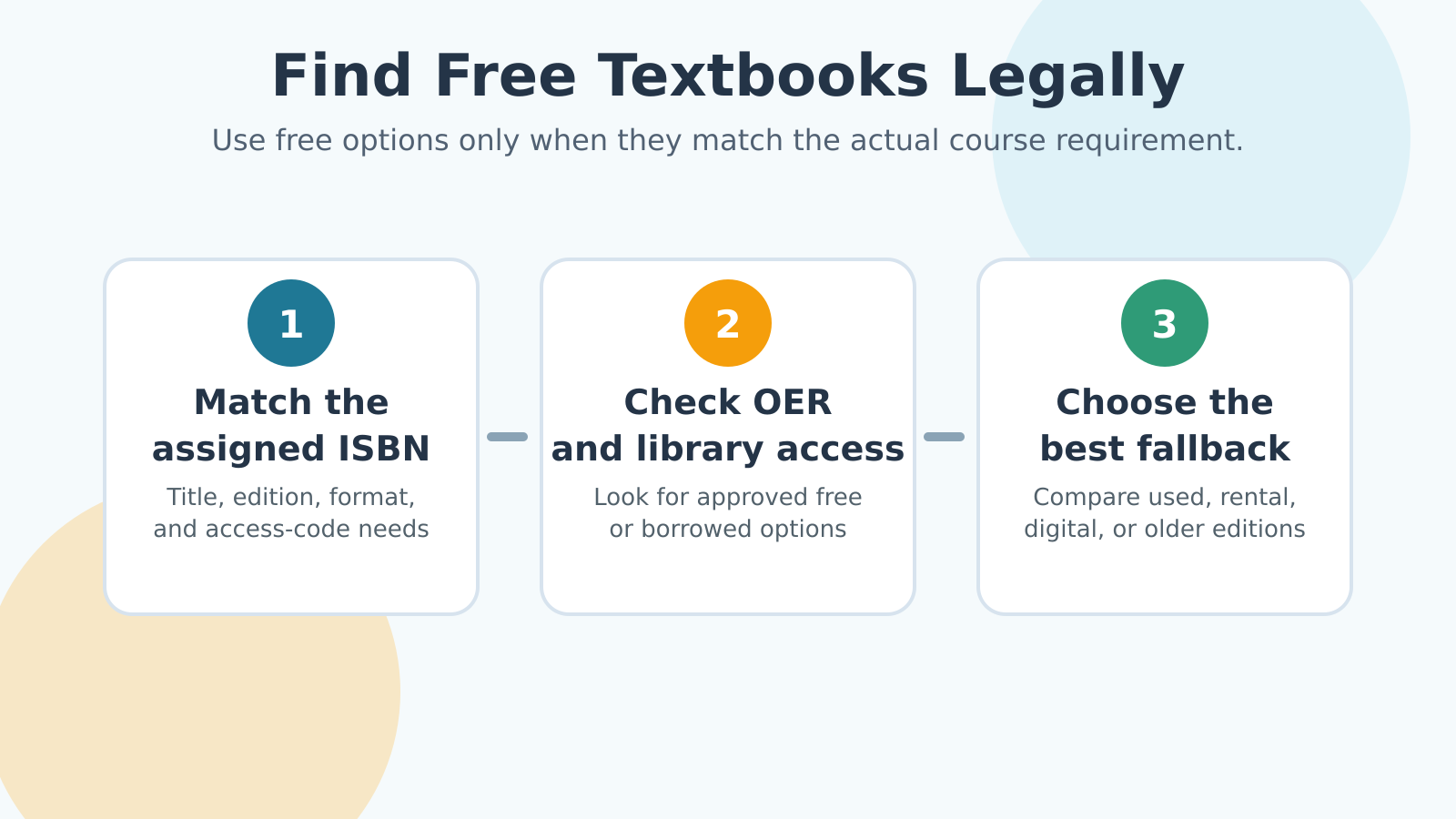
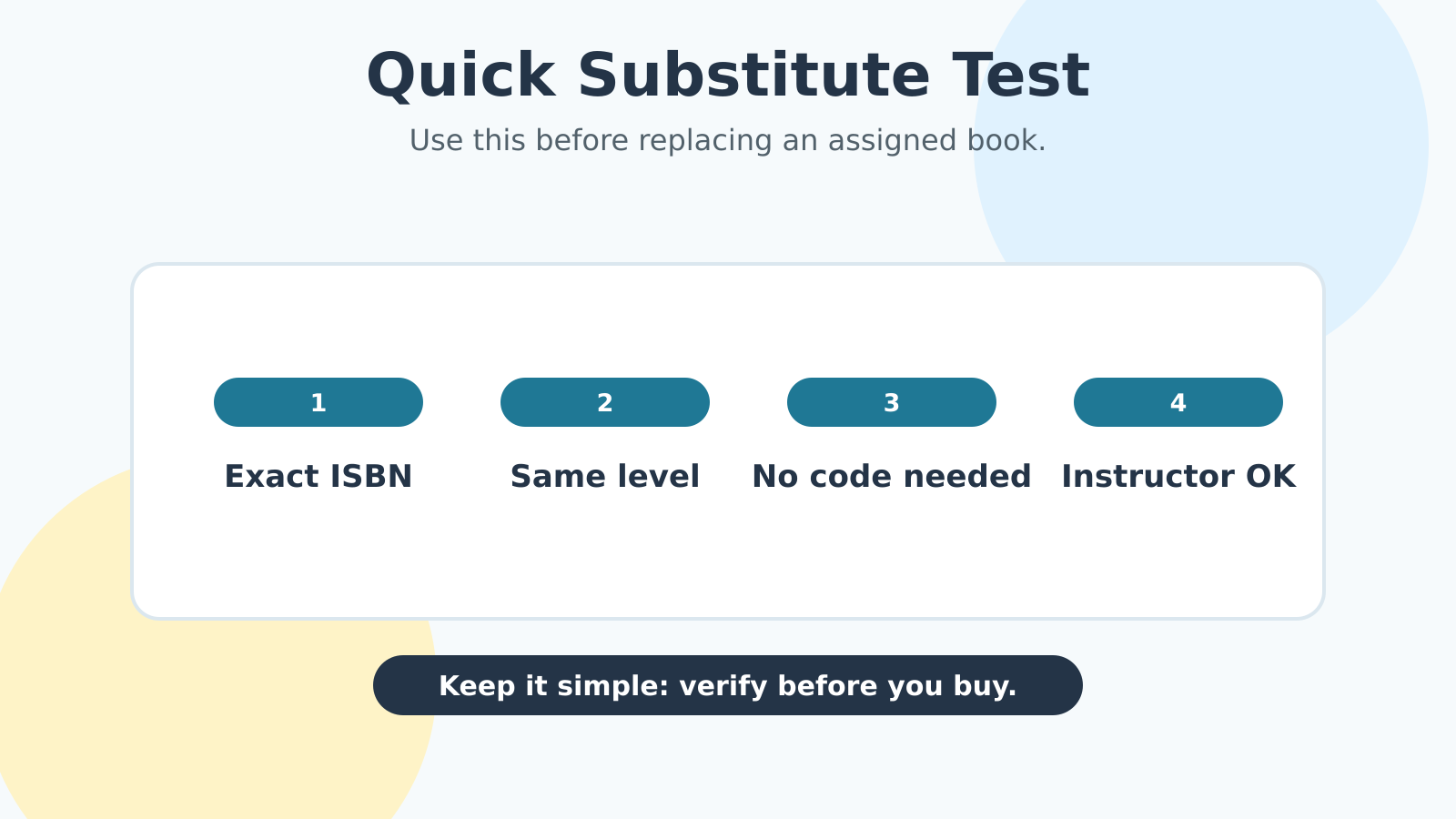
    Quick substitute test for deciding whether a free textbook option can replace an assigned book.
    A free textbook is only useful if it matches the class closely enough to use safely.

    Start with the assigned ISBN, not a random title search

    The syllabus is your best starting point. Copy the exact ISBN, edition, and author name before you compare anything else. A lot of textbook frustration comes from treating similar-looking editions as interchangeable when they are not.

    Once you have the ISBN, search it on Textbook Nova first so you can verify the exact book, edition, and title before you decide whether a free alternative is good enough. If you need a quick refresher on that workflow, How to use Textbook Nova explains the ISBN/title search approach in plain language.

    This step is useful even if you ultimately want a free option, because the free option only matters if it matches what the class actually needs.

    What counts as a legal free textbook?

    A legal free textbook is one you can access without paying and without breaking copyright.

    The cleanest examples are open educational resources, or OER. Creative Commons explains that OER are teaching and learning materials released with open permissions, so they can usually be kept, reused, revised, remixed, and redistributed under the license terms.

    That is very different from “free on a file-sharing site.” If a book is still under copyright, the fact that someone uploaded a scan does not make it legal. For a recent reminder of why that matters, the AP News coverage of the Internet Archive e-book copyright case is a useful cautionary backdrop: not every free-looking ebook is a safe or legitimate source.

    OER, public domain, and library access are not the same thing

    • OER are openly licensed and meant to be shared.
    • Public domain works are old enough, or otherwise eligible, to be free of copyright restrictions.
    • Library access may be free to you, but the library is licensing the content for its users.

    That difference matters because a library ebook can be legal and free for you without being a universal free download. It also matters because a public-domain classic can be a great reading resource while still being a poor substitute for a modern biology or chemistry textbook.

    Where to look first: OER textbook libraries

    If you want the most practical free-textbook search path, begin with vetted OER collections. They are built for exactly this problem.

    Start with OpenStax

    OpenStax is the easiest place to start for students because it publishes free textbooks in major college subjects and presents them in student-friendly formats. If your course lines up with one of its titles, you may already have a strong legal free option.

    Then check discovery libraries

    Open Textbook Library is a strong discovery tool because it lets you browse open textbooks by subject instead of making you guess which publisher or random site might have the right match. That makes it especially helpful when you know the course area but not the exact free title.

    LibreTexts Commons is also worth checking. It spans a broad range of disciplines and can surface open textbook content, modular chapters, and course-ready material that is useful when a full one-to-one replacement does not exist.

    What to check before you trust an OER match: a free textbook is only a real substitute if it lines up with the course. Look for subject fit, edition or revision date, chapter coverage, whether the instructor uses the same topic order, and whether homework depends on a separate platform. If the course uses a very specific edition for page references, a close OER title may still be helpful—but it may function more like a study support book than a drop-in replacement.

    Use your library and public-domain collections before you pay

    Before you buy anything, check your campus library.

    Many libraries provide course reserves, ebook access, or short-term borrowing for high-demand titles. Some also maintain interlibrary options that can cover a course book for at least part of the term. Those resources are often overlooked because students assume the bookstore is the only official source.

    A good library search can save you from paying full price for a book you only need for a few weeks. It can also help you separate “required” from “required to own.” Those are not always the same thing.

    If your professor or department allows it, ask whether the library’s version is acceptable for your assignments. A reserve copy may not be convenient for every class, but it can be enough for reading-heavy courses or short-term use.

    Public-domain collections are the other big free option, especially for classics. Project Gutenberg is the classic example. It is especially useful for older works that are no longer under copyright, which makes it a strong legal source for classics and historical reading. It is not, however, where you should expect to find the latest commercial nursing, accounting, calculus, or psychology text.

    That is the simplest rule here: public domain is a big win for old books and a weak bet for current textbooks.

    Decide whether a free option is a safe substitute

    This is the part that saves you from false hope.

    A free option is probably a safe substitute when it matches the exact course goal and the professor is not relying on a platform, code, or special edition features. It is less likely to work when the class uses chapter-specific homework, embedded quizzes, or tightly matched page references.

    Quick substitute test

    Ask four questions:

    1. Does it cover the same subject at the same level?
    2. Does it match the edition closely enough for class work?
    3. Does the course require any access code, lab platform, or digital homework system?
    4. Has the instructor said an alternate version is okay?

    If you get a clean yes on the first two and no on the third, you may have a real free substitute. If the homework system is separate, the free text may still help—but it probably will not replace everything you need for the class.

    That is the key boundary this article is trying to make clear: a free book can be a great resource without being the assigned textbook.

    If there is no true free match, compare paid options

    When the free path does not produce a true substitute, don’t waste another hour clicking random download sites. Move to the best legitimate paid option and compare it on total cost.

    Usually that means looking at:

    • used copies,
    • rental options,
    • digital editions,
    • or an older edition that still fits the class.

    If you want a broader comparison framework, how to save money on textbooks in 2026 walks through the paid-side decision tree in more detail.

    The goal is to avoid paying for features you do not need. Sometimes the right answer is a free OER. Sometimes it is a library copy. Sometimes it is a cheaper used edition. And sometimes the assigned text is so specific that there is no legal free replacement at all.

    That is normal. It is not a failure.

    The smart move is to verify the ISBN, check the legal free sources, and then choose the cheapest option that still lets you do the course well.

    If you want free textbooks legally, use this order:

    1. Verify the exact ISBN and edition.
    2. Check OER sources like OpenStax, the Open Textbook Library, and LibreTexts Commons.
    3. Search your library for reserves, ebooks, and borrowing options.
    4. Use Project Gutenberg for public-domain classics.
    5. Only treat a free option as a substitute if it actually matches the course.
    6. If it does not, compare used, rental, digital, and older-edition options instead.

    That approach is slower than clicking the first “free PDF” result you see, but it is the path that actually works.

  • Inclusive Access Textbooks: Should You Opt Out of Your Course Materials Fee?

    Inclusive Access Textbooks: Should You Opt Out of Your Course Materials Fee?

    If you see an Inclusive Access, First Day, Follett ACCESS, or course materials fee on your bill, the safest default is simple: keep it only if it is the cheapest required way to complete the class. If you can replace it with a cheaper legal alternative before the deadline, opt out. If you cannot, paying the fee may be the practical move.

    The key is not to guess. Compare the exact material, the exact deadline, and the exact access requirements before the charge locks in.

    What Inclusive Access actually means on your bill

    Inclusive Access is also known as automatic textbook billing. In that model, the cost of digital course content is built into tuition and fees, and students are typically billed unless they opt out before the deadline. Programs often deliver access through the campus LMS on or near the first day of class, and access may end when the course ends. See the InclusiveAccess.org FAQ for the common program names and student-facing definition.

    That label can change from campus to campus. Common names include First Day, Follett ACCESS, All Access, All Students Acquire, Auto Access, Course Material Fee, Day One Access, Equitable Access, and Immediate Access.

    Federal aid rules also matter here. The current books-and-supplies provisions live in 34 CFR 668.164, and the Department of Education’s 2024 Federal Register notice kept those current requirements in place while emphasizing a clearly communicated, actionable opt-out policy.

    The 10-minute opt-out checklist

    Use this before the deadline hits.

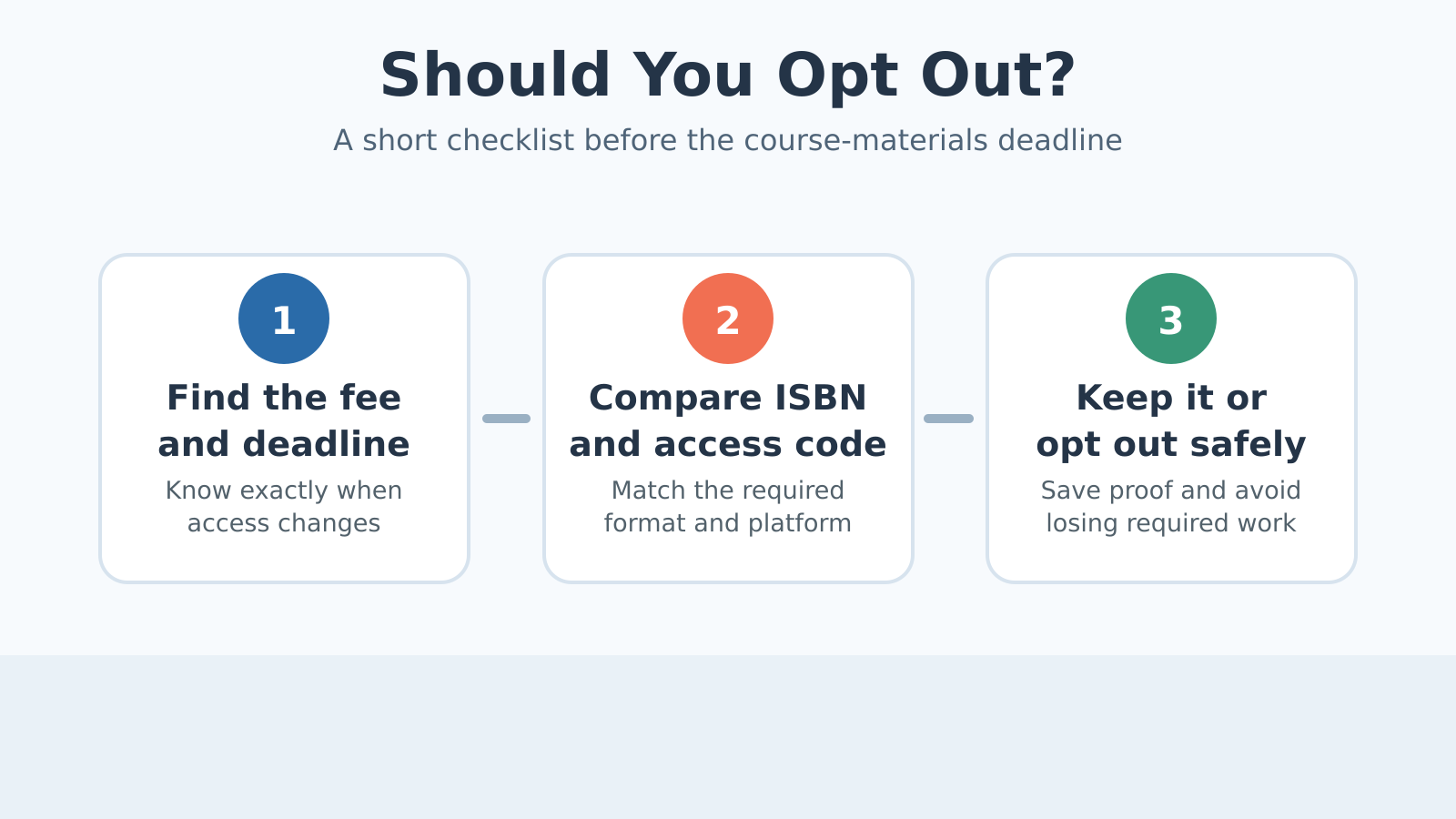
    Decision flow for whether to opt out of an inclusive access textbook fee.
    A quick decision flow: find the fee and deadline, compare exact access requirements, then keep the fee or opt out safely.
    Check What to verify Why it matters
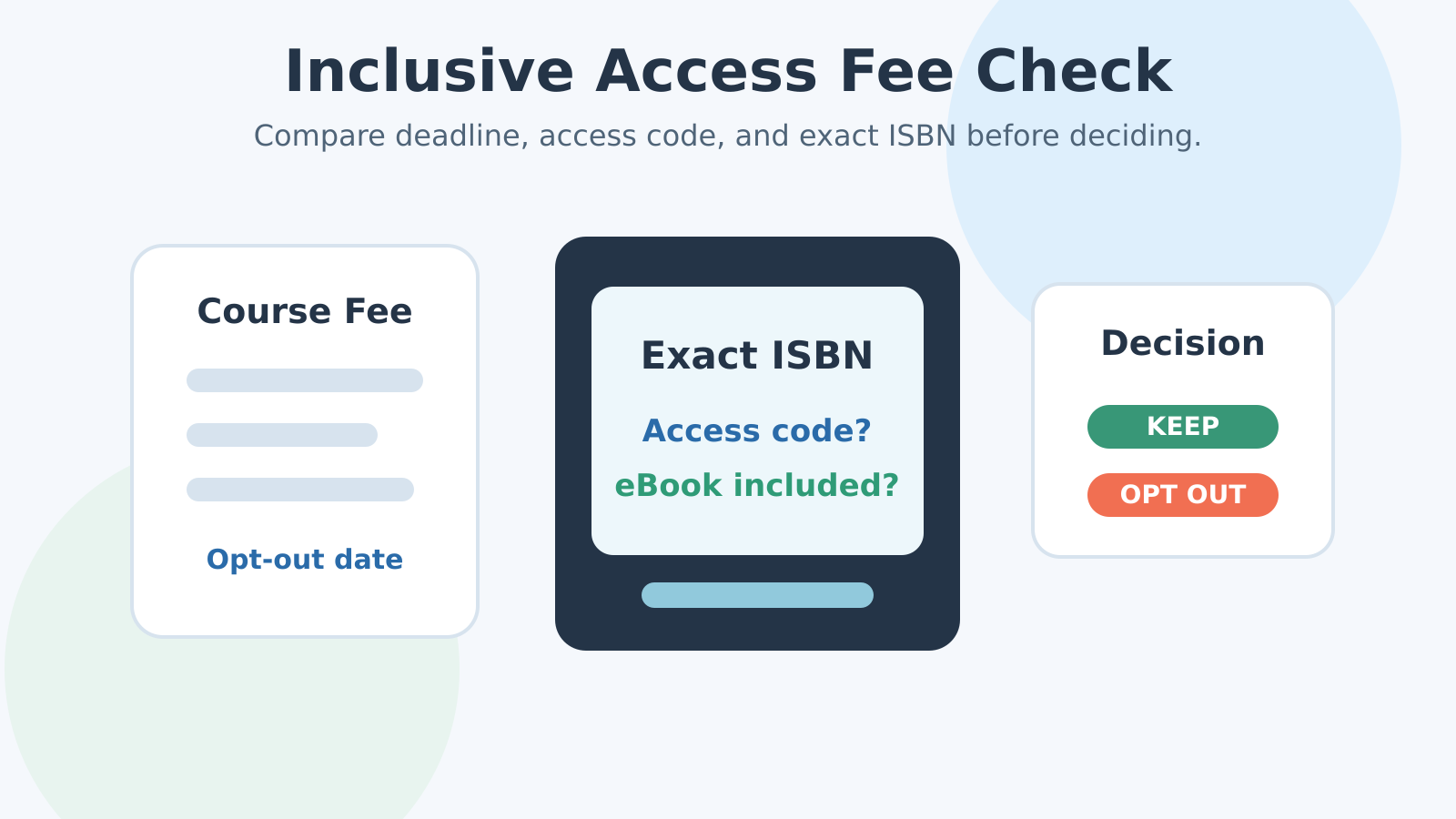
    Fee name Is this Inclusive Access, First Day, Follett ACCESS, or just a bookstore charge? The billing model changes what happens if you do nothing.
    Deadline When is the opt-out cutoff, and where is it posted? Miss the deadline and you may be billed automatically.
    Required access Does homework, quizzes, or the gradebook require a code or LMS license? A used book may not help if the code is single-use.
    Exact alternative Can you buy the same ISBN, rental, ebook, or access code separately? You need a real apples-to-apples comparison, not a guess.
    After opt-out What happens to LMS access, and what do you still need to buy? Opting out does not erase course requirements.

    1. Find the exact fee and deadline

    Start with the course page, bookstore page, or LMS announcement. Look for the exact wording and the deadline. Some campuses make the opt-out button easy to find; others bury it. Don’t assume the first charge you see is the final answer.

    If the school uses a books-and-supplies arrangement under federal aid rules, it must provide a way for students to obtain those materials by the seventh day of the payment period in the situations covered by the rule. That timing is one reason deadlines matter so much. See 34 CFR 668.164 and the 2024 Federal Register notice.

    2. Check whether homework or quizzes require a code

    This is the big one. If the course uses a one-time access code, a used copy alone may not work. Check the syllabus, LMS, bookstore listing, or instructor note for words like access code, homework platform, courseware, license, or single-use registration.

    3. Compare the exact ISBN, rental, used, ebook, and access-code-only prices

    Do not compare a billed course fee to a random used copy of a different edition. Compare like with like:

    • exact ISBN
    • rental price
    • used print price
    • ebook price
    • access-code-only price
    • shipping or tax

    If the class only needs the text, a used copy or rental may be cheaper. If the grade depends on the platform, the real comparison may be between the program fee and the cost of buying the same digital access elsewhere.

    Textbook Nova is useful here because you can search by title, author, or ISBN and check exact-edition matches instead of trusting a vague bookstore listing. Use Textbook Nova to compare exact editions.

    4. Ask whether OER, library reserves, or an older edition is allowed

    If your class can use an open textbook, a library reserve copy, or an older edition, you may be able to skip the fee entirely. OpenStax makes its digital textbooks free to access online or as downloadable PDFs, and it also offers print options for many titles.

    For a broader OER search, the Open Textbook Library is a good place to check. If the course still needs publisher homework access, OER may help with reading but not with grading tools.

    5. Confirm what happens after opting out

    This is where people get burned. Opting out usually means you lose the automatically delivered content, and you are responsible for finding the required materials another way. OpenStax says that if a student opts out of an inclusive access program, the student is still responsible for obtaining required course materials through another method.

    So do not opt out until you know exactly what you still need.

    When keeping Inclusive Access is probably worth it

    Keep the fee when one or more of these are true:

    • the required access code costs about the same elsewhere
    • the course runs on a digital homework platform you must use
    • the school’s fee really is cheaper than buying print plus code separately
    • the deadline is near and you have not found a better option
    • the included access already matches the exact course version you need

    This is the one time where convenience can be rational. If the program fee is below the full cost of a separate ebook, code, and shipping, keeping it may be the cleanest choice.

    When opting out may save money

    Opt out when one of these is true:

    • the class does not actually require a code
    • you found a cheaper used, rental, or ebook path
    • the school’s fee is based on a newer version than your instructor will accept
    • the material is available through OpenStax, a library reserve, or another approved OER source
    • the included content is temporary, but you need the book longer than the access window

    Federal regulations allow institutions to include books and supplies in tuition and fees only when certain conditions are met, including below-market pricing, timely access, and an opt-out policy. That means the fee can be legitimate and still not be the best deal for you. See 34 CFR 668.164 for the rule text.

    Email scripts you can copy

    Professor email script

    Subject: Question about the required course materials

    Hi Professor [Name],

    I’m reviewing the course materials and saw an Inclusive Access / First Day / course materials fee. Before the opt-out deadline, could you confirm whether we need the digital access code for homework, quizzes, or grading?

    If there is a cheaper legal alternative, such as a used copy, rental, or open textbook version, would that still work for this class?

    Thanks, [Your Name]

    Bookstore/support email script

    Subject: Inclusive Access opt-out question

    Hi,

    I see a course materials fee listed for [Course/Section]. Can you confirm:

    1. the opt-out deadline,
    2. what materials I lose access to if I opt out,
    3. whether the required content includes a one-time code or LMS license,
    4. and whether the same materials can be purchased separately?

    Please send the opt-out instructions or direct link if available.

    Thank you, [Your Name]

    Bottom line: decide before the deadline, not after the charge posts

    Inclusive Access is not automatically good or bad. It is a billing method. Your job is to decide whether it is the cheapest required path to pass the class.

    If the fee covers the exact access you need for less than any realistic alternative, keep it. If a used book, rental, OER title, library reserve, or separately purchased code is cheaper and still valid for the course, opt out before the deadline.

    When in doubt, compare by exact ISBN and exact access requirement first. Textbook Nova makes that part easier.

  • How to Read a College Textbook Without Wasting Hours

    How to Read a College Textbook Without Wasting Hours

    If you treat every page of a textbook like it deserves the same attention, you will waste time fast. The smarter move is triage: figure out what the chapter is trying to teach, what your instructor is likely to care about, and where you actually need slow reading. That approach turns a long assignment from an all-night slog into a repeatable workflow.

    The goal is not to read harder. It is to read with purpose, in a way that leaves you with a few ideas you understand and a few terms you can explain. Cornell’s reading strategies and Oregon State’s before-you-read guide both point to the same reality: textbooks reward structure-aware reading, not speed for its own sake.

    Open textbooks and study materials arranged for efficient college reading.
    A focused reading plan helps students get more out of assigned textbook chapters without rereading every page.

    First, make sure you are reading the right book and chapter

    Before you worry about speed, confirm the basics. If you are working from the wrong edition, the wrong chapter, or the wrong platform, your effort will be pointed in the wrong direction. That sounds obvious until you’ve spent an hour on a section that doesn’t match the syllabus.

    Use the assigned title, author, chapter number, and ISBN to verify the match. If you need to check by title, author, or ISBN, start at Textbook Nova so you are working from the exact assigned text instead of a vague bookstore listing. If you want a quick refresher on that search process, this guide to using Textbook Nova is the cleanest place to start.

    Once the book is right, check whether the chapter is actually required for this week or just listed as background.

    Preview before you commit to close reading

    A chapter gives away a lot before you read a single paragraph. Previewing tells you where to spend your time.

    Check headings, summaries, figures, bold terms, review questions

    Start with the title, headings, subheadings, summary, figures, bold terms, and end-of-chapter questions. Oregon State’s reading-process guidance recommends this kind of preview, and the University of Cincinnati’s SQ4R guide makes the same point: survey the chapter first, then work section by section.

    While previewing, ask three questions:

    • What is the chapter probably trying to explain?
    • Which terms or concepts look unfamiliar?
    • Which parts are likely to show up on homework, quizzes, or discussion?

    That last question is where triage starts. Not every paragraph deserves the same level of attention.

    Decide what deserves slow reading

    Slow down for definitions, examples, diagrams, worked problems, and concepts that connect directly to class assignments. Skim more lightly when the section repeats something you already understand. If you cannot explain what a section is doing after previewing, it probably deserves more time.

    Turn headings into questions

    This is the step that makes the chapter easier to remember. Instead of reading headings as labels, convert them into prompts your brain can answer.

    If the heading says “Types of Chemical Bonds,” turn it into “What are the types of chemical bonds, and how are they different?” If the heading says “Causes of Inflation,” turn it into “What causes inflation, and what evidence supports each cause?”

    That shift gives your reading a job. Cornell’s textbook reading systems describes SQ3R in a similar way: survey, turn headings into questions, read to answer, recite in your own words, and review what you learned. If a heading is vague, make the question more specific.

    Read in small sections, not marathon chapters

    Long chapters are where students lose time. The fix is smaller chunks.

    Read one section, pause, and say what it meant in your own words before moving on. The University of Cincinnati’s SQ4R approach recommends breaking text into reasonable sections and writing notes only after you can recall the key idea yourself.

    Aim for this rhythm:

    1. Read a short section.
    2. Stop and recall the main point.
    3. Check the book only if you blank.
    4. Move on once the idea is clear enough to explain.

    That loop is slower than skimming, but it is much faster than rereading the whole chapter later because nothing stuck.

    Annotate lightly

    Highlighting should be a signal, not decoration. Use it sparingly: key terms, main claims, a formula, or one sentence that really carries the section. Oregon State’s guided reading advice favors efficient annotation rather than marking everything in sight.

    Stop when you lose the thread

    If you get to the end of a paragraph and cannot say what it was for, stop. Back up one chunk, reread with the heading-question in mind, and pull out the main idea again.

    That is the moment you catch confusion before it spreads.

    Recall before you take more notes

    Most students take notes too early. A better sequence is: read, close the book, and try to explain the section in your own words first. Cornell’s reading guidance and UC’s SQ4R sequence both lean toward that kind of active recall.

    Use prompts like these:

    • What was the section trying to prove or describe?
    • What are the two or three most important terms?
    • How would I explain this to a classmate?
    • What example from the chapter actually matters?

    Only after that should you add notes. Your notes should capture what you could not already hold in working memory, not everything you saw on the page.

    A useful test is whether your notes would help you answer a real question later. If a line only repeats the textbook sentence in slightly shorter form, skip it or rewrite it as a question. If it explains a relationship, names a common mistake, or connects the chapter to lecture, keep it. That filter keeps your notes short enough to review instead of becoming a second textbook.

    Build a one-page review sheet

    You do not need a giant outline for every chapter. You need a compact review page that makes later studying easier.

    For each chapter, collect:

    • the chapter’s main purpose in one sentence
    • five to eight key terms with plain-language meanings
    • two or three major concepts or relationships
    • one example, diagram, or formula you may need to revisit
    • any questions you still cannot answer confidently

    This page becomes your quick review tool before class, before a quiz, or before exam week. It also gives you a clean place to turn messy reading into usable study material.

    When to skim, when to slow down, and when to ask for help

    Skim when the section is clearly review, background, or repetition of something you already know. Slow down when the chapter introduces a new framework, technical vocabulary, a diagram you will need later, or a process that builds on earlier sections. Ask for help when you have previewed, questioned, read, and recalled, but the chapter still feels like noise.

    Help can mean different things:

    • office hours
    • a study group
    • a tutor
    • a classmate who can translate the chapter into simpler language
    • a professor question about what to prioritize

    If the chapter is dense enough that you keep reading the same paragraph without getting anywhere, the issue may not be your attention span. It may be that you need a faster explanation before the text makes sense.

    A repeatable 30-minute textbook-reading loop:

    Here is the compact version:

    1. Confirm you have the correct book and chapter.
    2. Preview headings, summaries, figures, and questions.
    3. Turn headings into questions.
    4. Read one small section at a time.
    5. Recall the idea in your own words before taking notes.
    6. Add only the notes that help you review later.
    7. Stop where the chapter stops being useful and get help if needed.

    Do that consistently and reading stops feeling like a vague endurance test. You start each chapter with a purpose and finish with something you can actually use.

  • What to Do When Your Textbook Requires an Access Code

    What to Do When Your Textbook Requires an Access Code

    If your syllabus says you need a textbook access code, the most important thing to know is this: the code may matter more than the book. A used or rental copy can still be a smart buy, but only if your class does not require a one-time login for homework, quizzes, or an eBook platform.

    That is why the first move is not hunting for the cheapest copy. It is figuring out exactly what your class actually requires. Publisher help pages for Pearson access code help, Cengage MindTap access code registration, and McGraw Hill Connect access code and purchase options all point to the same basic reality: access codes are tied to courseware, and not every book you buy secondhand will unlock that courseware.

    Student checking online course materials beside an open textbook.
    Before buying used, confirm whether the course requires a fresh access code for homework, quizzes, or graded online work.

    Quick answer: if homework is in the platform, the code matters more than the book

    If your grade depends on MyLab, MindTap, Connect, WebAssign, ALEKS, or another homework platform, treat the access code as the real requirement and the print book as a separate decision. If the course only uses the book for reading, note-taking, or reference, you have much more flexibility.

    That distinction is the whole game. Students often buy a cheap used copy first and only later discover that the homework portal is where the assignments live. By then, they have paid twice.

    The safest default is simple:

    • if the platform is required for graded work, verify the code first;
    • if the code is optional, compare used, rental, and digital copies like normal;
    • if you are unsure, ask before checkout.

    Textbook Nova is useful here because you can compare exact ISBNs and editions before you commit. Search Textbook Nova by title or ISBN, then check whether the print book is really separate from the courseware.

    Step 1 — Identify what is actually required

    Check the syllabus and bookstore listing for platform names

    Look for words like access code, eBook, courseware, homework manager, license, digital homework, or registration. The exact brand name matters too. A class might use Pearson, McGraw Hill, Cengage, or a school-specific portal, and each one has its own buying path.

    If the syllabus only names the print textbook, you may not need a code at all. If it names both the textbook and the platform, the platform is probably part of the class requirement.

    Confirm whether the code is for reading only or graded work

    Some access codes unlock an eBook. Others unlock graded assignments, quizzes, or adaptive practice. Those are not equally optional.

    A code that only unlocks reading is easier to replace than a code that controls your homework grade. If the assignment system is built into the class, plan around that early so you do not get stuck waiting on shipping or bookstore support in week one.

    Step 2 — Do not assume a used textbook includes a usable code

    Why most codes are one-use

    Publisher support pages are very clear that access codes are generally tied to a single student account. Pearson’s access-code help warns that codes from used books have probably already been redeemed. Cengage explains that an access code acts as proof of purchase for MindTap courseware or eBook access.

    In plain English: a used book can still be a good buy, but the code inside it may be worthless.

    When a sealed access card or new bundle might still be valid

    A sealed access card, a fresh bookstore bundle, or a new copy that clearly includes unused access may still solve the problem. The key word is unused. If the seller cannot verify that the code is still valid, assume it is not.

    That is especially important if you are buying from a marketplace listing that does not clearly separate the book from the access package.

    Step 3 — Compare the real options before you buy

    Standalone access code or direct course purchase

    Sometimes the cheapest path is to buy access without the print book at all. If you already have a book or only need the platform, this can be the cleanest move. McGraw Hill’s Connect access code and purchase FAQ lays out multiple purchase paths, including direct purchase and bookstore options.

    Campus bookstore bundle, inclusive access, or temporary access

    Sometimes the bookstore bundle is the better value. Sometimes the school has already added the content through inclusive access or day-one access, which means the cost may already be embedded in your course bill. Student PIRGs’ 2026 report, Fixing the Broken Textbooks Market, Fourth Edition, explains how access codes and automatic billing can narrow student choice, so it is worth checking whether you are already paying for access before you buy anything extra.

    Some platforms also offer temporary access or a short trial period. That can be a useful bridge if you are waiting on financial aid, a bookstore order, or instructor confirmation. Just do not mistake temporary access for a full-term solution.

    The decision should be based on the total cost and the actual course requirement, not the first price you see.

    Step 4 — Questions to ask before you spend money

    Ask the instructor about older editions, optional print, and OER

    This is where you can sometimes save the most. Ask whether an older edition is acceptable, whether the print book is optional, or whether a free/open alternative would work for the reading portion of the class.

    OpenStax’s student book access help is a good reminder that some textbooks are available free online or as PDFs. That will not replace every required homework platform, but it can sometimes cover the reading requirement while you sort out the rest.

    Ask the bookstore or publisher support about refunds, duration, and course-section match

    Before you buy, confirm three things:

    1. Does the code match my exact course section?
    2. What happens if I buy the wrong version?
    3. Is there any refund policy or replacement policy if the access does not work?

    Do not rely on assumptions here. A code for the right title but the wrong section can still fail when you try to register it. And access terms can vary by publisher, school, and platform.

    Common mistakes that make students buy twice

    The most common mistake is buying the cheapest book first and asking about access later. The second mistake is assuming any used copy will include a working code. The third is mixing up a reading requirement with a graded homework requirement.

    A few more expensive mistakes:

    • buying the wrong edition because the title looked close enough;
    • assuming the bookstore bundle is automatically the cheapest option;
    • ignoring temporary access when you need a short bridge;
    • waiting until the night before class to sort out registration.

    Bottom line checklist before checkout

    Use this before you click buy:

    • Is the access code required for graded homework or just for reading?
    • Does the syllabus name a specific platform like MyLab, MindTap, Connect, WebAssign, or ALEKS?
    • Are you sure the used or rental copy includes unused access, if needed?
    • Have you compared standalone access, a bookstore bundle, and any school-billed access?
    • Have you asked whether an older edition, OER, or a free library option would work?
    • Have you verified the exact ISBN and course section?

    If you can answer those questions clearly, you are in good shape. If you cannot, pause before paying.

    The short version is this: do not treat the book and the code as the same purchase. Figure out what the class actually needs, compare the real options, and then buy only once.

    When you want to compare exact editions or search for a better print copy after you have sorted out the access code question, Textbook Nova is a good place to start.

  • How to Save Money on Textbooks in 2026: A Practical Student Checklist

    How to Save Money on Textbooks in 2026: A Practical Student Checklist

    If you want to spend less on textbooks in 2026, the fastest path is not a random coupon search. Start by comparing the exact ISBN, questioning whether you truly need the newest edition, and checking whether the class uses an access code or automatic billing. Those three decisions usually matter more than any one marketplace price.

    That advice is even more important now than it used to be. In its 2026 report, Student PIRGs says students are still dealing with access codes, automatic textbook billing, and other course-material traps even as open educational resources become more common. And the College Board’s 2025 Trends in College Pricing and Student Aid report reminds us that books and supplies are still part of the overall cost of attendance, including hardcopy textbooks, online textbooks, rentals, and other supplies.

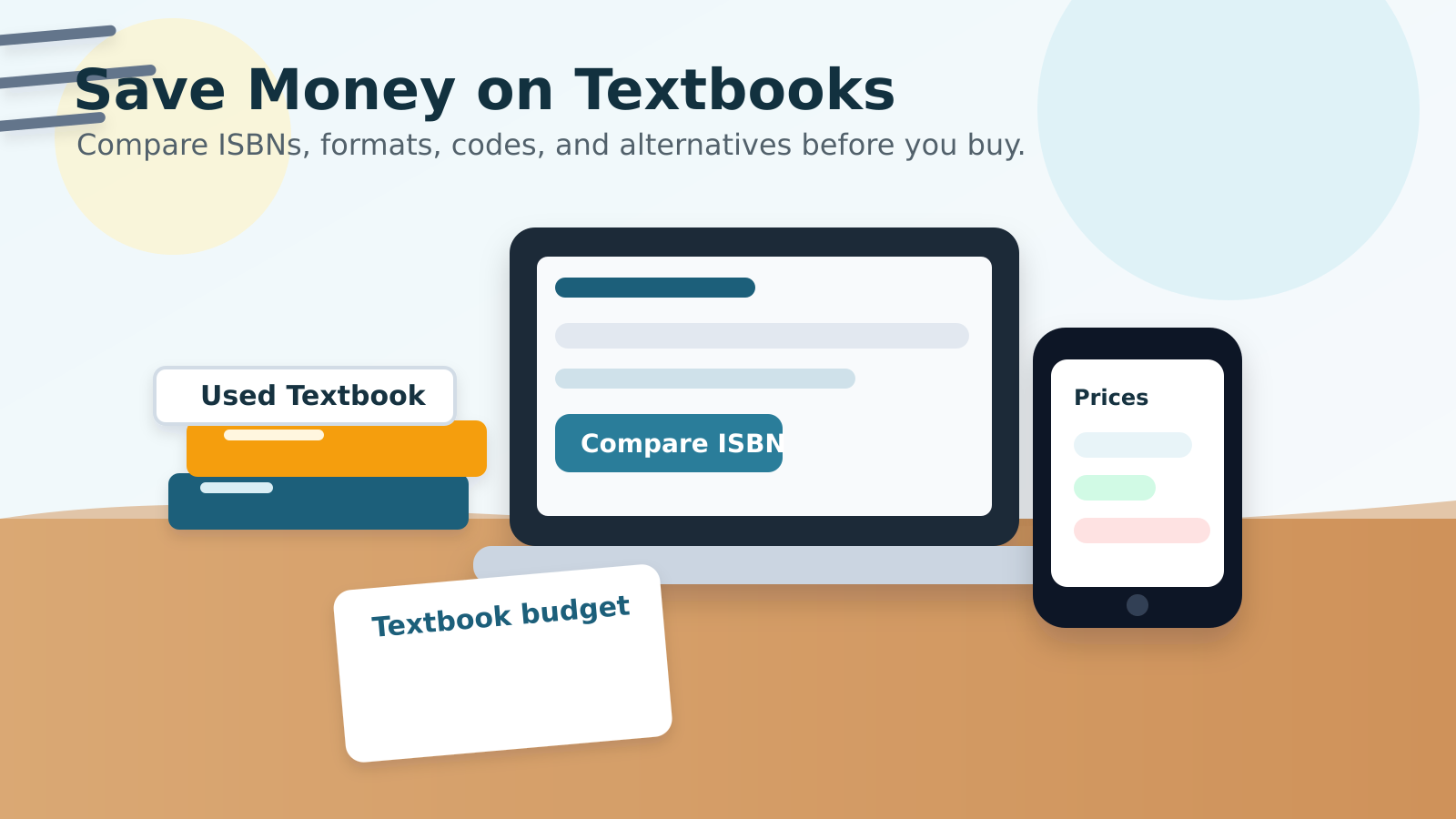
    Student desk with textbooks, laptop, notebook budget checklist, and phone price comparison for saving money on textbooks in 2026.
    A practical textbook plan starts before checkout: compare the ISBN, format, access-code rules, and total cost.

    So here’s the practical version: save where you actually have control, and don’t overpay for features you don’t need.

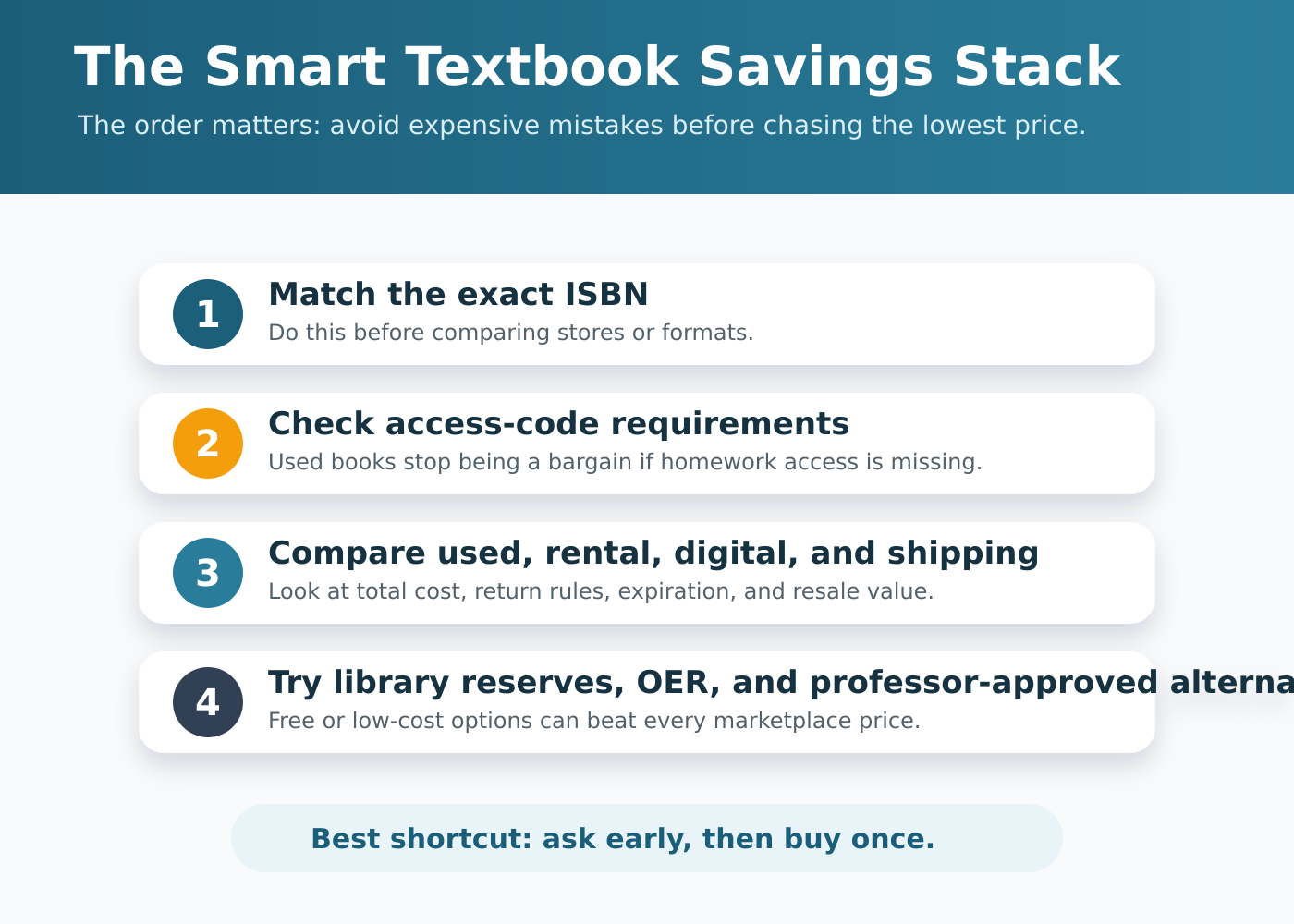
    Polished infographic showing a textbook savings stack: ISBN match, access-code check, format comparison, library and OER alternatives, and resale value.
    Use the savings stack in order: verify requirements first, then compare formats and free alternatives before buying.

    1) Start with the ISBN, not the bookstore listing

    The first step is boring, but it works. Search by ISBN, not just by title. A textbook title can hide multiple editions, bundled versions, and digital packages that look similar until checkout.

    Use this order:

    1. Copy the ISBN from the syllabus.
    2. Search that exact ISBN through Textbook Nova, your campus bookstore, used-book sellers, rental listings, and other marketplaces.
    3. Compare the total price, including shipping.
    4. Check whether the copy includes any online code or access portal.

    This matters because a “cheap” book can stop being cheap the second you learn it doesn’t include the code your class requires. If the professor only needs the text, you have more options. If the grade depends on the platform, the format matters more than the sticker price.

    If you want a broader strategy for this kind of comparison, our older guide on how to save money on textbooks still covers the basics. This update just adds the 2026 reality: the digital add-ons are often the trap.

    2) Don’t pay extra for the exact edition unless you have to

    Students get burned here all the time. A professor may say “latest edition required” when they really mean “the course will follow this text closely.” Those are not the same thing.

    Before you buy the newest version, ask:

    • Does the syllabus say the latest edition is required, or just recommended?
    • Are chapter numbers or page numbers used in assignments?
    • Will an older edition still match the homework well enough?
    • Is there a course pack or instructor notes that make the edition less important?

    If the answer is “recent edition is fine,” shop the used market first. Older editions are often dramatically cheaper, and they can be perfectly workable when the core concepts haven’t changed.

    This is one of the simplest ways to reduce costs without giving up the book itself.

    3) Buy used when the book is just a book

    Used textbooks still make sense when there’s no required code attached. That sounds obvious, but the fine print matters. A used copy is only a win if you can actually use it for the class.

    Used is usually your best move when:

    • the class uses the book for reading only,
    • homework is not tied to an online portal,
    • the professor allows an older edition,
    • and you plan to keep the book or resell it later.

    Used is a bad deal when:

    • the required access code is single-use,
    • the course is built around a digital homework system,
    • or the seller’s listing is vague about what’s included.

    If you buy used, check the condition notes carefully. “Good enough” can be fine for a reading-heavy class, but not if the pages are missing, highlighted to the point of distraction, or water-damaged.

    4) Choose rental or digital only when the math actually works

    Renting and digital access are not automatically cheaper. Sometimes they are. Sometimes they just move the cost around.

    Rent when:

    • you need the book for one term only,
    • you don’t care about keeping it,
    • and the rental total is clearly lower than used + resale risk.

    Choose digital when:

    • the class already requires a digital platform,
    • you prefer carrying less weight,
    • and the ebook price is meaningfully below print.

    But watch the hidden catches. A digital package might look cheaper until you realize it expires, locks you into a single device, or still requires a separate access code. That’s why the College Board’s 2025 report is useful here: it treats books and supplies as a budget category that can include hardcopy textbooks, online textbooks, rentals, and other supplies. In other words, your “book” cost may show up in more than one form.

    Rule of thumb: if you can resell a print book, include that in the comparison. If you can’t resell a rental or digital license, don’t pretend the up-front price tells the whole story.

    5) Watch for access codes and automatic billing before you click buy

    This is the biggest 2026 trap.

    Student PIRGs reports that access codes have become common in required coursework, and that many campuses now use automatic textbook billing. That means the cost can appear by default, not by choice.

    Before you pay, ask three questions:

    • Is the access code required for homework, quizzes, or grading?
    • Can I opt out of automatic billing?
    • Can I buy the material somewhere else and still complete the class?

    If the answer to the first question is yes, a used copy may not help unless it includes the code. If the answer to the second question is unclear, don’t assume the default charge is your only option. And if the bookstore or LMS is pushing an “inclusive access” style package, compare the real total before accepting it.

    A lot of students lose money here because they shop for the book first and discover the code problem later. Reverse that order.

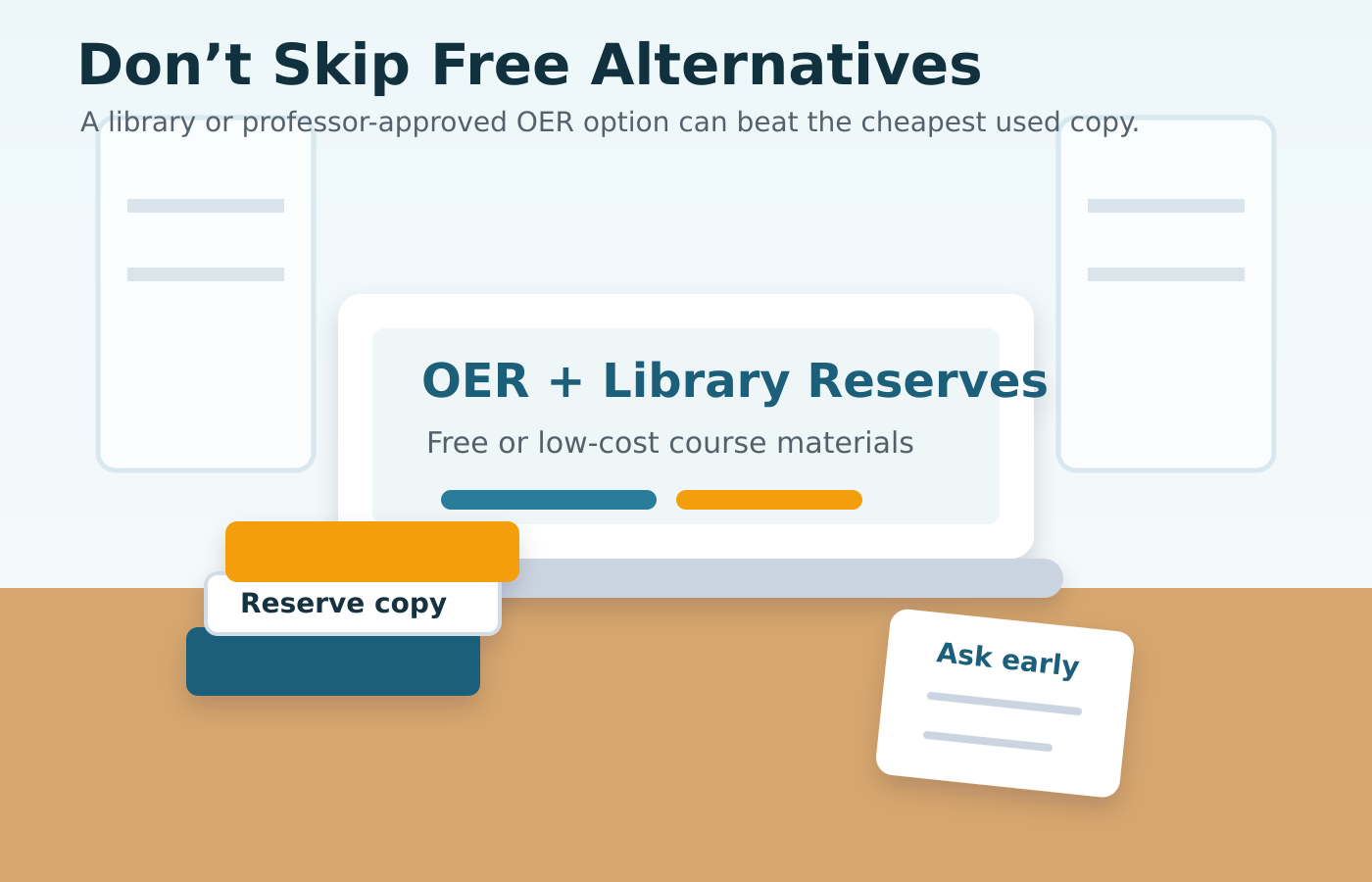
    Campus library study table with open educational resources on a laptop, reserve books, and course notes as textbook alternatives.
    Library reserves, ebooks, and OER can be just as important as used-book marketplaces when you are trying to lower course-material costs.

    6) Use library reserves, OER, and professor-approved alternatives

    This is where students can sometimes save the most.

    Start with your campus library. Some schools keep course reserves, ebook access, or short-term lending copies for high-demand classes. Those options are easy to miss, and they are often free.

    Next, look for open educational resources, or OER. Student PIRGs notes that growing awareness of open textbooks and other free materials has expanded access, even while the market has gotten more complicated. That means more courses may already have cheaper or free alternatives available.

    Here’s what to ask:

    • Does the library have a reserve copy or ebook license?
    • Is there an open textbook option for this course?
    • Will the professor accept a previous edition or alternate source?
    • Is the “required” book really required, or just recommended?

    If you’re stuck, ask early. Professors are usually much more flexible before the semester starts than after assignments are already underway.

    For context on why this problem keeps coming back, our post on why college textbooks are so expensive goes deeper on the publisher and bundling side.

    7) End the semester by deciding whether to resell, keep, or donate

    Saving money on textbooks does not end when you buy them. It ends when you decide what they’re worth to you after the class.

    Resell when:

    • the book is still current,
    • it’s a common title,
    • and you don’t need it for a later course.

    Keep when:

    • it’s a major reference for your field,
    • the content will matter in later classes,
    • or it’s a book you actually want on your shelf.

    Donate when:

    • resale value is basically gone,
    • another student can use it,
    • or your campus has a reuse program.

    Even a modest resale return changes the math on the next purchase. A $90 book that sells for $30 later is not the same as a $90 book that goes in the closet forever.

    The short version

    If you want the biggest savings, do these five things in order:

    1. Compare by ISBN.
    2. Verify whether the exact edition matters.
    3. Check for access codes before buying used.
    4. Compare rental, print, and digital on total cost.
    5. Use library reserves and OER whenever you can.

    That’s the 2026 textbook-saving playbook. The market is still messy, but students do have leverage when they shop in the right order.

    If you want more textbook-buying tips and learning-cost advice, start at Textbook Nova and work outward from there.