Tag: Student Life

  • 6 Awesome Hobbies for College Students to Take Up This Semester

    6 Awesome Hobbies for College Students to Take Up This Semester

    6 New Hobbies for College Students to Take Up This Semester

    Do you have any hobbies outside of school? If you’re like most of us, our hobbies include Netflix and killing time online But what if there was a better way to relieve stress on the weekends?

    It’s important to pursue your own interests outside of the classroom. Hobbies not only add joy to your life but they make you a more interesting person. And if you’re worried you can’t afford to start a hobby, don’t let the student budget get in your way.

    Check out these 6 affordable and fun hobbies for college students…give one a try. What’s the worst that could happen? You might even find your life’s passion. đŸ˜Š


    1. Start a Blog

    Instead of spending your weekends mindlessly scrolling on social media (we all do it), what about starting a personal blog? There are two major benefits to blogging while you’re still in school.

    First of all, if your future job interviewer sees you’ve taken the time to build your own website, they’re going to be impressed. It takes initiative, creativity, and perseverance to run a blog. You can also earn some money on the side!

    Blogging lets you have an outlet to express yourself, but you also have the chance to get direct feedback from people who have the same interests as you. Ultimately, it’s a growing experience. And if you’re thinking about how you can’t start a blog because you don’t enjoy writing? I get it. You don’t have to write. You can start a vlog on YouTube or a micro-blog in the form of Instagram. Pick one and go for it — you can start in less than 1 hour!

    6 Fun and Interesting Hobbies for College Students - Start a Blog in 1 Hour

    How To Start A Profitable Authority Blog In Under One Hour: Write About What You Love, Create A Website, And Make Money


    2. Cooking for Newbies

    Why should you learn how to cook? After all, you have a dining plan and instant noodles to get by on, right? Here’s the truth. Once you graduate, you’re going to be on your own in the world. There are plenty of people who get by on takeout and frozen convenience food. While you have the option to eat any food you enjoy, you’ll get a lot more out of learning how to cook for yourself.

    For one, it’s WAY cheaper. Second, we don’t have to tell you how much healthier it is for you. And lastly, once you learn how to become a decent cook, you’ll find out it tastes so much better than fast food!

    I know it’s tough to cook in college, where both the space to cook and the funds are limited. Check out this 5-ingredient cookbook created just for students who are new to the kitchen:

    6 Fun and Interesting Hobbies for College Students to Take Up This Semester - Learning to Cook

    The 5-Ingredient College Cookbook: Easy, Healthy Recipes for the Next Four Years & Beyond


    3. Brush Up on Your Trivia

    Have you always been naturally curious? Then trivia is the perfect hobby for you; people who are great at trivia have a deep love of learning. They never stop absorbing knowledge. Likewise, you’ll become awesome at winning Jeopardy.

    There are trivia nights on campus but you’ll find them at bars off campus too — these are usually themed AND offer prizes.

    6 Fun and Interesting Hobbies for College Students to Take Up This Semester - Trivia Night

    Ultimate Book of Trivia: The Essential Collection of over 1,000 Curious Facts to Impress Your Friends and Expand Your Mind

    4. Camping for College Students

    Camping is the ultimate hobby for students. Why’s that? It’s an affordable way to get an escape. Quality time with your friends + relief from the hectic life on campus = win-win vacation. Not only do you get a chance to learn new skills, but you gain an appreciation for nature. Nothing brings you more peace than gazing at a star-studded sky with your friends by your side.


    Likewise, you’ll have an excuse to chow down on amazing campfire treats… like s’mores. This cookbook below has incredible recipes for cooking outdoors (and sections that let you choose recipes by your cooking style).

    6 Fun and Interesting Hobbies for College Students to Take Up This Semester - Camping

    The New Camp Cookbook: Gourmet Grub for Campers, Road Trippers, and Adventurers

    5. Pick Up an Instrument

    If you’re a music lover, then this hobby is definitely worth giving it a shot. You don’t need to hire a teacher or buy a brand spanking new instrument either. You can teach yourself! In fact, some of the worlds greatest musicians were self-taught, like Jimi Hendrix and Prince. Even Paul McCartney was mostly self-taught.

    And now we have YouTube to help us out. You can choose any instrument out there, but the guitar is a good place to start when you’re a student living in a small space. You can easily get a used guitar at a music store or off Craigslist.

    6 Fun and Interesting Hobbies for College Students to Take Up This Semester - Learn an Instrument

    Guitar: The First 100 Chords for Guitar: How to Learn and Play Guitar Chords: The Complete Beginner Guitar Method


    6. Learn a New Language

    Whether you’re already learning a foreign language in school — or studied one in high school — there are tons of benefits to taking up a new language! For starters, bilingual graduates gain a more competitive edge in the job industry.

    And if you think you’re no good at linguistics? You can still learn. A friend of mine became determined to teach herself Japanese. Most of us didn’t take her seriously until she switched her major to Japanese studies. Today, she’s a full-time teacher who lives in Toyko, Japan.

    Plus, studying a new language can actually make your brain sharper. And like everything else, you’ll only get better with practice. If you’ve been thinking about learning a new language, try to teach yourself the very basics before committing to a full course. You can use one of the Living Language books for a jumpstart.


    6 Fun and Interesting Hobbies for College Students to Take Up This Semester

    Living Language Italian: Beginner to Advanced Course

  • How to Enjoy Your General Education Classes in College

    How to Enjoy Your General Education Classes in College

    How to Actually Enjoy Your General Education Classes in College

    Kinda sucks, doesn’t it?

    You enter college thinking it’s about taking courses on topics you want to study, not more general education requirements.

    In reality, most of your first two years of college are spent taking these mandatory classes (aka your “gen ed” courses). Like most things in life, there are pros and cons when it comes to these required subjects.

    For example, when you’re undecided on your major general education can help you figure out what classes interest you. Sometimes the topics we think we’re passionate about–or think we should be passionate about–don’t really interest us at all.

    Either way, since gen eds are a must-do for graduating from college let’s talk about what you can do to make the most of them.


    How to Enjoy Your General Education Classes in College

    How to Actually Enjoy Your General Education Classes in College


    Find Out Who Teaches the Class (Before You Sign Up)

    If you haven’t already heard of it, Rate My Professors is the website that will become the game-changer to your college experience. You just plug in the name of a professor into their search box (or the name of your school) and you’ll find reviews/ratings of their classes from your fellow students.

    Obviously, you should use your best judgment with the reviews. Not every review is reflective of the professor. The students’ effort affects their experience in class too. However, it’s great for getting a rough idea of the experience. If every single rating for a professor is 1 out of 5 or you discover all of the reviews mention an impossible grading system, you probably don’t want to take that class.

    I always used Rate My Professors when it came to my gen eds. What did I get out of it? I met some professors that I genuinely loved learning from because they made the class fun.  


    Choose Topics that Grab Your Attention

    Even though they’re required courses, you get to choose which classes to take. There is still a lot of wiggle room when it comes to general education. Not a fan of geometry? Take a statistics class to fulfill your math requirement. Don’t want to take another American History 100 class? Consider a class in art history or an area of history that interests you.

    The more engaged you are in the topic, the better you’ll do in class. It’s just easier when you like what you’re learning. Who knows, you might even decide to switch majors after taking. That’s why colleges recommend you don’t put off these courses. You might discover a new opportunity or passion in life…or discover your current major isn’t the path you wanted to take after all.

    If you take these classes early on, there’s still plenty of time left to change your major or figure out what industry excites you.


    Don’t Make it Too Hard on Yourself

    Not a morning person? Think carefully before you sign up for that 8 am MWF class. Like I mentioned earlier, you should choose your classes based on what subject matter interests you. Not on the convenience, availability, or how easy you think it will be.

    Some courses might fit better into your schedule, but that doesn’t mean they’re a good fit. If you think about it, each class costs you hundreds of dollars in tuition. Why take something that is a total bore and waste of your time?

    In order to make the most of your general education, don’t take a class that will make you miserable. Or if you take the class and realize it’s not for you, drop it ASAP before the cutoff date.


    Talk to Your Classmates

    Your gen eds are a great place to meet people outside your major. Engage with your classmates!

    You can find amazing new friends and create relationships with people. Once you get to your junior year of college, the rest of your classes will mostly be with the same group of people. General education courses can introduce you to cool friends you may not have met on campus otherwise.

  • Is College Worth the Cost in 2018?

    Is College Worth the Cost in 2018?

    Is College Worth the Cost in 2018?


    Want to know whether college is still worth it in 2018?

    Here’s a crazy fact: If you add up all of the student loan debt in the US, it reaches over $1.4 trillion dollars. It’s hard to visualize just how much a trillion dollars is.

    But here’s an idea:

    A trillion dollars laid out next to each other would reach the sun. Likewise, a trillion dollars is nearly the amount of money currently in circulation in the entire country.

    Currently, the average college student graduates with $31,000. Paying off the burden of student loans can take decades, depending on what field you work in post-college and how much total debt you take on. For one thing, graduate, law, and medical degrees rack up significantly more tuition than a 4-year undergraduate degree.

    If you add up the costs, is college really worth the debt today? Let’s weigh in.

    College is Expensive

    While the costs for tuition and books have steadily increased over the last 30 years, so has the value of a college degree.

    How so?

    Well, the average starting salary for a college grad has never been higher. According to Time, the average pay for new college graduates is right around $50,000.

    (Want to find out how much the Class of 2018 is really earning? Click here to find out.)

    So this means that yes, we’re paying more to attend college. But we’re also getting more opportunity from it than our parents or the generations before us.

    A recent study conducted by Georgetown University found that people who graduate from college earn around $17,000 more per year than high school graduates. That adds up to a million more over your lifetime. Considering we need between $1 million to $1.5 million saved up to retire, attending college can help secure your future.

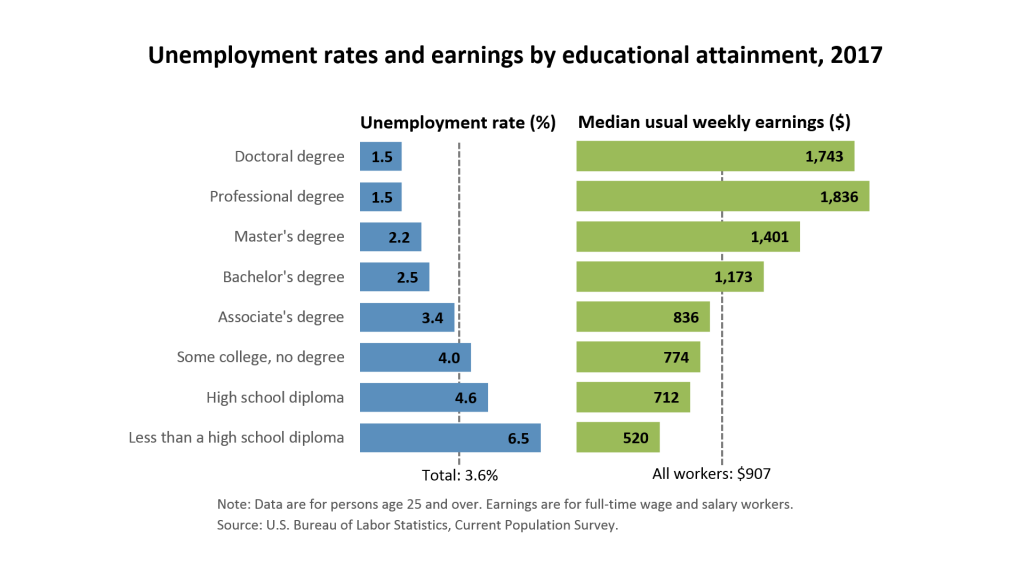
    Is College Worth the Cost in 2018? Unemployment rate chart by level of education.

    This graph from the Bureau of Labor Statistics compares the average weekly pay and unemployment rates based on your level of education.

    College is a Gamble

    We already know that some college degrees will pay off faster than others. The average salary in technology, medicine, or science is going to much higher than a starting salary in arts or humanities.

    That doesn’t mean we shouldn’t pursue arts if that’s our passion. But should we go the route of student loans in that case?

    It’s a gamble.

    If you decide to pursue one of these routes–like sociology, arts, psychology, or political science–consider how much you’ll realistically earn in 5-10 years before you take out student loans. In this case, it’s probably wiser to seek financial aid in the form of scholarships. The debt isn’t worth it.  


    Not All Debt is Bad

    Having a little bit of debt can actually be beneficial.

    After all, taking out student loans, car payments, or credit cards is how you start to build your credit history.

    If you’ve never borrowed money, you don’t have any credit. This makes it harder to take out a loan for large purchases in the future–like when you’re ready to buy a house

    When you make on-time payments on your debt, you’re demonstrating you can borrow money responsibly and pay it off. I saw this happen first hand when I paid off my first car and my credit score jumped up to excellent!

    I still have a significant amount left on my student loans, but my credit has never looked better.   

    However, I wish I had known exactly what I was getting myself into when I borrowed money in college. Nobody really explained student loans to me, they just let me rack up debt with no questions asked. The Graduate Survival Guide: 5 Mistakes You Can’t Afford To Make In College is a fantastic resource for high school seniors or any students who want to understand their financial decisions better.


    In Conclusion

    Is college worth it today? That is ultimately your call to make, but I think it’s absolutely worth every penny. If I could do it all over again, I’d still go back to college.

    What do you think? Let us know in the comments below.

    Resources

    The Graduate Survival Guide: 5 Mistakes You Can’t Afford To Make In College by Anthony O’Neal

    Student Loan Planning: A Borrower’s Guide to Understanding and Repaying Student Loan Debt by Ryan H Law

    Paying for College Without Going Broke, 2018 Edition: How to Pay Less for College (College Admissions Guides) by Princeton Review


  • When Is It Too Late to Change Your College Major?

    When Is It Too Late to Change Your College Major?

    Is It Too Late to Change My College Major?

    So you want to study a different field. When is it too late to change your college major?

    Want to know a secret?

    The truth is more than 75% of all students change their majors at least once during college. I changed my major three times! And the degree I graduated with was in the field of my dream career–it was definitely worth it.

    Check this out:

    Most advisors suggest that you change your major after your first year. This gives you a chance to take some of the core “introduction” classes and you’ll have an idea of whether or not you enjoy your chosen field.

    What if you’ve stuck out that first year and it still doesn’t feel right?

    Maybe it’s not a matter of whether or not you like the subject matter in your courses. It’s just not a fit. Sometimes students go into majors in college because we think it will lead to the best jobs or we were following the advice of our parents.

    But what should you do when do you find yourself wondering if you’re in the right program?

    Let’s take a look.


    Is Changing Majors Bad?

    Is It Too Late to Change My College Major?

    The downsides to changing your major:

    • It can take longer than you planned to earn your degree
    • You’ll end up paying more tuition if you stay in school longer
    • If your parents support you financially they’ll probably want a say in the decision

    Here’s another side of the matter.

    College is big-time expensive. But what’s the point in spending thousands of dollars on your education if you don’t LIKE what you’re studying? If you find no meaning in your classes, you’ll probably feel the same way about a career in the same field.

    Trust me.

    You don’t want to spend your entire life in a job that makes you feel miserable. We spend the majority of our lives at work. I’m not saying you have to be in love with your jobs to live a happy life because that’s not realistic. Some of our dreams just can’t support us financially.

    But imagine waking up every single day with a feeling of dread about what lies ahead. It’s not a great way to live.

    There are no right or wrong reasons to switch majors.  

    Students make the change because:

    • They weren’t interested in the coursework
    • The classes were too difficult
    • Their courses led them to discover a new area of interest
    • They found out about potential opportunities in another field

    Let’s consider the ramifications of changing your major in school and what that looks like during each year.


    When Is It Too Late to Change Your College Major?

    Is It Too Late to Change My College Major

    Changing Majors Freshman Year:

    If you’re like me, you started having second thoughts about your major immediately.

    Here’s the thing. In my case, it was good that I realized my first instinct wasn’t right for me. Just because I was interested in something didn’t mean the potential jobs in that area were the right fit.

    The only problem? I chose to declare a new major after the first quarter of school. My new major was based on another course I was taking that I happened to enjoy. I hadn’t given it enough practical thought, which led to me changing majors again later in the game.


    Changing Majors Sophomore Year:

    Switching majors after your first year of college is pretty common. in fact, this is when most students change their major.

    Why’s that? You could have known right away that you didn’t like the classes that you were taking. but still wanted to give it a full year to decide. Plus, you had time to get away from the routine of day-to-day life on campus and think about school over the summer. It’s not too late yet. Even if you’re halfway through your sophomore year.


    Changing Majors Junior Year:

    This is where it starts to get a little tricky. If it’s the beginning of your junior year and you spent the first two years focusing on gen ed requirements, it’s not too late to rethink things.

    Once you’re halfway through or reaching the end of your junior year, it’s time to consider that it may not worth it to change your major.

    Why? It makes more sense financially to attend grad school rather than extending your time in an undergraduate program.


    Changing Majors Senior Year:

    Changing majors in your senior year of college doesn’t make sense. You’ve stuck it out this long–keep pushing through. There’s always post-grad school if you need more education to pursue another career path.

    Because the truth? Most college grads aren’t working in their field of study after school. According to the Washington Post, only 27% of college grads have a job related to their degree.

    In Conclusion

    All in all, there’s no specific year where it’s considered too late to change your college major. However, if you want to spend less money on your education and get out of school faster, it’s best not to change you’re major after junior year.