Category: Study Tips

  • Is College Worth the Cost in 2018?

    Is College Worth the Cost in 2018?

    Is College Worth the Cost in 2018?


    Want to know whether college is still worth it in 2018?

    Here’s a crazy fact: If you add up all of the student loan debt in the US, it reaches over $1.4 trillion dollars. It’s hard to visualize just how much a trillion dollars is.

    But here’s an idea:

    A trillion dollars laid out next to each other would reach the sun. Likewise, a trillion dollars is nearly the amount of money currently in circulation in the entire country.

    Currently, the average college student graduates with $31,000. Paying off the burden of student loans can take decades, depending on what field you work in post-college and how much total debt you take on. For one thing, graduate, law, and medical degrees rack up significantly more tuition than a 4-year undergraduate degree.

    If you add up the costs, is college really worth the debt today? Let’s weigh in.

    College is Expensive

    While the costs for tuition and books have steadily increased over the last 30 years, so has the value of a college degree.

    How so?

    Well, the average starting salary for a college grad has never been higher. According to Time, the average pay for new college graduates is right around $50,000.

    (Want to find out how much the Class of 2018 is really earning? Click here to find out.)

    So this means that yes, we’re paying more to attend college. But we’re also getting more opportunity from it than our parents or the generations before us.

    A recent study conducted by Georgetown University found that people who graduate from college earn around $17,000 more per year than high school graduates. That adds up to a million more over your lifetime. Considering we need between $1 million to $1.5 million saved up to retire, attending college can help secure your future.

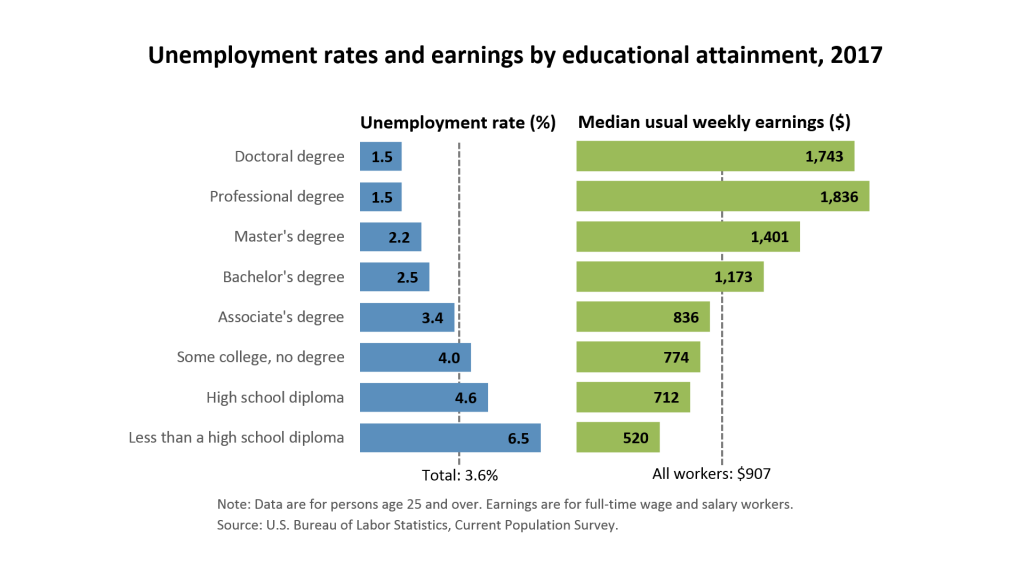
    Is College Worth the Cost in 2018? Unemployment rate chart by level of education.

    This graph from the Bureau of Labor Statistics compares the average weekly pay and unemployment rates based on your level of education.

    College is a Gamble

    We already know that some college degrees will pay off faster than others. The average salary in technology, medicine, or science is going to much higher than a starting salary in arts or humanities.

    That doesn’t mean we shouldn’t pursue arts if that’s our passion. But should we go the route of student loans in that case?

    It’s a gamble.

    If you decide to pursue one of these routes–like sociology, arts, psychology, or political science–consider how much you’ll realistically earn in 5-10 years before you take out student loans. In this case, it’s probably wiser to seek financial aid in the form of scholarships. The debt isn’t worth it.  


    Not All Debt is Bad

    Having a little bit of debt can actually be beneficial.

    After all, taking out student loans, car payments, or credit cards is how you start to build your credit history.

    If you’ve never borrowed money, you don’t have any credit. This makes it harder to take out a loan for large purchases in the future–like when you’re ready to buy a house

    When you make on-time payments on your debt, you’re demonstrating you can borrow money responsibly and pay it off. I saw this happen first hand when I paid off my first car and my credit score jumped up to excellent!

    I still have a significant amount left on my student loans, but my credit has never looked better.   

    However, I wish I had known exactly what I was getting myself into when I borrowed money in college. Nobody really explained student loans to me, they just let me rack up debt with no questions asked. The Graduate Survival Guide: 5 Mistakes You Can’t Afford To Make In College is a fantastic resource for high school seniors or any students who want to understand their financial decisions better.


    In Conclusion

    Is college worth it today? That is ultimately your call to make, but I think it’s absolutely worth every penny. If I could do it all over again, I’d still go back to college.

    What do you think? Let us know in the comments below.

    Resources

    The Graduate Survival Guide: 5 Mistakes You Can’t Afford To Make In College by Anthony O’Neal

    Student Loan Planning: A Borrower’s Guide to Understanding and Repaying Student Loan Debt by Ryan H Law

    Paying for College Without Going Broke, 2018 Edition: How to Pay Less for College (College Admissions Guides) by Princeton Review


  • How to Do Well in College: 5 Tips for Student Success

    How to Do Well in College: 5 Tips for Student Success

    How to Do Well in College: 5 Tips for Student Success

    So you want to learn how to do well in college?

    Whether you’re new to campus or want to take things to the next level this semester, here are 5 tips for student success.

    Let’s jump into it.

    1. Get 7 Hours of Sleep

    It might seem like stating the obvious, but getting enough sleep each night is the key to student success.

    Why? When you get 7-8 hours of sleep each night, you’ll perform better at school. Rest keeps you alert, focused, and motivated. On the other hand, sleep deprivation can lead to increased anxiety and stress.

    But who doesn’t want to sleep more, anyway?

    Well, college isn’t exactly known for its downtime. Late night sessions at the library and all-nighters during exam time aren’t exactly news here. And to be 100% honest, there likely will be times where you find yourself up WAY later than planned to finish working on a project or writing the rest of that paper.

    Hey, nobody’s perfect.

    But if we’re being real, those late night study sessions can usually be prevented with better planning. Yes, you’re juggling a lot in school. You’re busy running from class to class and balancing homework with extracurricular activities or jobs—but you probably have a little more time than you realize.

    So how can you find enough time to get in those zZz’s and stay on top of your studies? Keep reading to find out.

    How to Do Well in College: 5 Tips for Student Success

    2. Break Up Your Tasks

    This student productivity idea has two steps. First, find pockets of time where you can complete some work.

    Then break up your major projects into smaller chunks. Instead of trying to cram in 150 pages into one study session, you could read a couple of chapters while you’re waiting for your next class to start.

    You might need to reorder your to-do list.

    I’ll bet that if you find yourself with 10 minutes to kill, you probably spend it on social media. However, keep in mind those few minutes will add up big time throughout the day. What are some other ways you can squeeze in a small task during that time?

    I know you can find some pockets of time in your day if you try hard enough. Because the truth is, another benefit of breaking down your tasks is the big assignments become less overwhelming. For example, when you’re working on a paper. Have you ever found yourself staring at a blank page, struggling to get started? Writer’s block is pretty common.

    What if you could cut the amount of time you spend on writing in half by turning that 15-page term paper into a step-by-step process?

    Start with gathering research, put it into a thorough outline, and then turn it into a paper. If you flesh out your outline, the paper will nearly write itself. (Seriously, try it out and let us know how it goes!)

    When you start using your time more efficiently, you can improve your performance.

    How’s that? Let’s go back to the cram session. If you’re trying to read 150 pages in one session, it’s tough. You’ll probably rush through the material and skim through a lot of it, missing out on a lot of information.

    At the time same, when you know you only need to read 1 or 2 chapters you’ll feel less pressure to rush through the material.


    3. Participate in Class

    Believe it or not, your professors want you to learn.

    Participating during their lectures will actually help you retain the material better. This is because it forces you to think critically and analyze what your professor is teaching. What’s more, participation makes the class more interesting.

    When your professors know you want to learn, they’ll naturally try to help you in any way they can. Class discussions offer you the opportunity to receive feedback from your professors that will help you improve and grow as a student.

    Plus, starting conversations leads to a mentor relationship. If something ever DID come up or you made a mistake, your professor will probably be more understanding with a student they know is hard-working.

    How to Do Well in College: 5 Tips for Student Success

    4. Get Organized

    Now, you don’t need a ton of supplies to stay organized. An accordion binder (labeled for each class) and a planner are a great place to begin.

    Take these with you to every single class so they’re always handy. Pencil in assignments, exams, and other major due dates into your planner as soon as you find out about them.

    Then, take time at the beginning of each week to (roughly) plan things out.

    In this case, you’ll be able to see what’s on your agenda ahead of time and go into each week with a game plan.


    5. Take Notes (Lots of Them)

    You already know you’re supposed to take notes–but I want to offer you one particular piece of advice on note-taking.

    Physically write them out. In a notebook during class. Even if your professor gives out printed notes or study guide…take your own. According to NPR, handwriting out notes seems to help your brain retain what you’re learning better than note-taking on a laptop or tablet.

    Remember how we said participating in class helps make it more interesting? So does taking notes.

    In fact, professors seem to LOVE throwing in extra credit on exams that came directly from lectures. It’s their reward for attending class. It never hurts to take advantage of extra points, right?


    In Conclusion

    Overall, college is learning time management skills. Getting enough rest, organizing your deadlines, and following along in class (through participating and note-taking) are all ways to boost your performance in school.

    And breaking down huge projects into smaller tasks will make everything more manageable–and less overwhelming.

  • Find Out the Average Starting Salary for College Graduates in 2018

    Find Out the Average Starting Salary for College Graduates in 2018

    Find Out the Average Starting Salary for College Graduates in 2018

    I remember it so vividly.

    Watching my parents smile proudly at me. Snapping hundreds of selfies with my classmates. Walking across the stage and shaking the dean’s hand.

    You never forget the day you graduate from college.

    Graduation day is packed with emotion. There’s the rush of excitement, accomplishment, and awe.

    The next day? Reality sinks in. It’s time to start your job hunt. You’re thrilled to take the next steps in “the real world” but there’s still a lot of uncertainty.

    How long will it take me to find a job? How much will it pay? Where do I even WANT to work?

    LendEDU decided to investigate what it’s really like for brand-new college grads entering the workforce this year. They polled 1,000 graduates from the Class of 2018 to see how their job search has gone over the last couple of months (and how much they’re really making).

    So what’s the starting salary for a new college graduate?

    Let’s look into their results.


    How Much New College Graduates Should Expect to Make

    Good news: LendEDU found that nearly half of the former students they surveyed already found their first full-time job this summer. When asked how they would describe their current situation, they responded:

    • 41.3% of 2018 graduates have landed a job
    • 34.4% are still on the search for a job
    • 24.3% are taking summer off to figure out their next steps

    Find Out the Average Starting Salary for College Graduates in 2018

    In less than two months, many recent graduates have already ended their job search with success! 20% of those who found a full-time job listed that it wasn’t in a field like tech, health, education, engineering, or in media.

    If you’ve ever felt unsure about your job future due to your college major–rest assured that there is still a lot of potential work out there for you.

    What’s the Average Starting Salary for College Graduates in 2018?

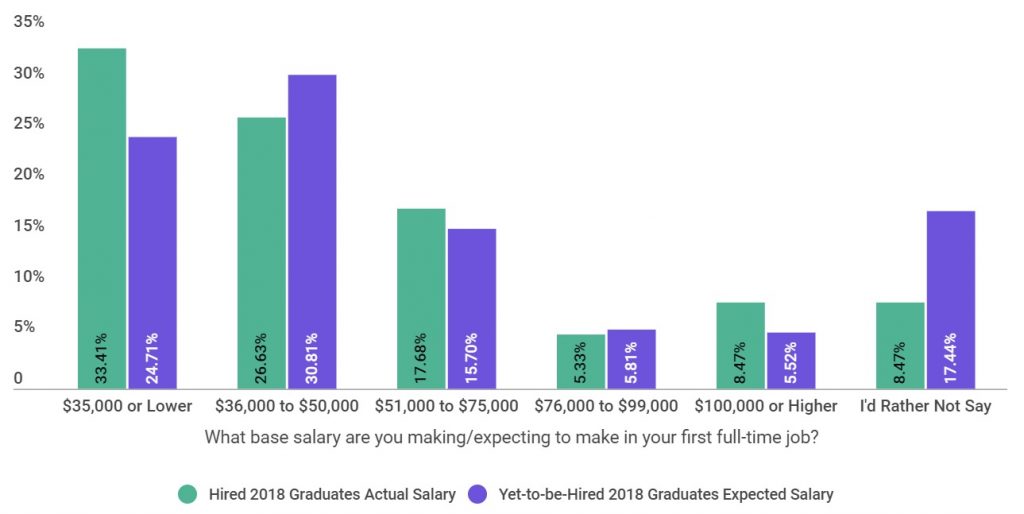
    According to The Class of 2018 Career Report, most students expect to make between $36,000-50,000 per year in their first job out of college. But does this expectation match the job market today?

    While over ¼ of new graduate ARE making that much in an entry-level position, 33.4% are actually earning below $35,000.

    You might be thinking, “But wait–I went to college to make a good living!”

    I know the feeling.

    But this study matches my experience with my first job out of college, where I was making $30,000. It wasn’t easy. I was living in a metropolitan city where my rent took up the majority of my income.

    However, it wasn’t a major difference from life in college. I knew how to stretch my budget in order to get by. I even saved some money in the first year! It turns out, I wasn’t stuck at that salary for long either–I started searching for jobs after a year of getting experience in my field.

    Flash forward 6 months. I had landed my DREAM job and my salary jumped up to expectations. Was it worth sticking out that first year being broke? I definitely think so.  

    Here’s a closer look at the results from Salary Expectations vs. Graduates Actual Salary:

    Find Out the Average Starting Salary for College Graduates in 2018

    As you can see, some graduates are earning over $50,000 but it’s the exception. In this case, their job duties probably involve some specialized skill set or they have work experience under their belt.


    So How Did These Graduates Find Their First Job?

    One of the biggest challenges new graduates face when they’re looking for their first full-time job is knowing where to look.

    Then again, it’s never been easier to search for jobs today. You can search online through job boards like Indeed and Glassdoor–or look directly on a company website to find out what roles they’re currently hiring for.

    At the same time, don’t ignore your personal network. It turns out nearly 30% of recent college graduates found their job through connections.

    Find Out the Average Starting Salary for College Graduates in 2018

    Don’t think you have the right connections? Reach out to your friends and family, anyway. They have years of experience (in work AND life) where they’ve built connections. You never know which connections could be valuable.

    As you can see from the chart above, there are plenty are ways to find a job outside of your network too.

    All in all, it’s safe to say future salary projections are on the minds of every college student. If you’re a current student or soon-to-be graduate, you can prepare for what’s next by gaining some “real world” work experience, an internship, and building your network.

    Want to get the full scoop on the rest of the survey results? Check it out here on the LendEDU blog.

  • When Is It Too Late to Change Your College Major?

    When Is It Too Late to Change Your College Major?

    Is It Too Late to Change My College Major?

    So you want to study a different field. When is it too late to change your college major?

    Want to know a secret?

    The truth is more than 75% of all students change their majors at least once during college. I changed my major three times! And the degree I graduated with was in the field of my dream career–it was definitely worth it.

    Check this out:

    Most advisors suggest that you change your major after your first year. This gives you a chance to take some of the core “introduction” classes and you’ll have an idea of whether or not you enjoy your chosen field.

    What if you’ve stuck out that first year and it still doesn’t feel right?

    Maybe it’s not a matter of whether or not you like the subject matter in your courses. It’s just not a fit. Sometimes students go into majors in college because we think it will lead to the best jobs or we were following the advice of our parents.

    But what should you do when do you find yourself wondering if you’re in the right program?

    Let’s take a look.


    Is Changing Majors Bad?

    Is It Too Late to Change My College Major?

    The downsides to changing your major:

    • It can take longer than you planned to earn your degree
    • You’ll end up paying more tuition if you stay in school longer
    • If your parents support you financially they’ll probably want a say in the decision

    Here’s another side of the matter.

    College is big-time expensive. But what’s the point in spending thousands of dollars on your education if you don’t LIKE what you’re studying? If you find no meaning in your classes, you’ll probably feel the same way about a career in the same field.

    Trust me.

    You don’t want to spend your entire life in a job that makes you feel miserable. We spend the majority of our lives at work. I’m not saying you have to be in love with your jobs to live a happy life because that’s not realistic. Some of our dreams just can’t support us financially.

    But imagine waking up every single day with a feeling of dread about what lies ahead. It’s not a great way to live.

    There are no right or wrong reasons to switch majors.  

    Students make the change because:

    • They weren’t interested in the coursework
    • The classes were too difficult
    • Their courses led them to discover a new area of interest
    • They found out about potential opportunities in another field

    Let’s consider the ramifications of changing your major in school and what that looks like during each year.


    When Is It Too Late to Change Your College Major?

    Is It Too Late to Change My College Major

    Changing Majors Freshman Year:

    If you’re like me, you started having second thoughts about your major immediately.

    Here’s the thing. In my case, it was good that I realized my first instinct wasn’t right for me. Just because I was interested in something didn’t mean the potential jobs in that area were the right fit.

    The only problem? I chose to declare a new major after the first quarter of school. My new major was based on another course I was taking that I happened to enjoy. I hadn’t given it enough practical thought, which led to me changing majors again later in the game.


    Changing Majors Sophomore Year:

    Switching majors after your first year of college is pretty common. in fact, this is when most students change their major.

    Why’s that? You could have known right away that you didn’t like the classes that you were taking. but still wanted to give it a full year to decide. Plus, you had time to get away from the routine of day-to-day life on campus and think about school over the summer. It’s not too late yet. Even if you’re halfway through your sophomore year.


    Changing Majors Junior Year:

    This is where it starts to get a little tricky. If it’s the beginning of your junior year and you spent the first two years focusing on gen ed requirements, it’s not too late to rethink things.

    Once you’re halfway through or reaching the end of your junior year, it’s time to consider that it may not worth it to change your major.

    Why? It makes more sense financially to attend grad school rather than extending your time in an undergraduate program.


    Changing Majors Senior Year:

    Changing majors in your senior year of college doesn’t make sense. You’ve stuck it out this long–keep pushing through. There’s always post-grad school if you need more education to pursue another career path.

    Because the truth? Most college grads aren’t working in their field of study after school. According to the Washington Post, only 27% of college grads have a job related to their degree.

    In Conclusion

    All in all, there’s no specific year where it’s considered too late to change your college major. However, if you want to spend less money on your education and get out of school faster, it’s best not to change you’re major after junior year.

  • Studying Tips To Help You Be Successful This Semester

    Studying Tips To Help You Be Successful This Semester

    Studying can be tough and when you are in college it you simply cannot avoid tests, quizzes and exams. So here are some studying tips for you to ensure that you are successful this semester.

    These tips are relatively simple all you need to do is follow them no matter what. Stick to these and you will see how you excel this semester.

    Schedule A Time

    Similar to your classes/lectures, you need to set aside time for studies as well. Nothing but studies. You need to schedule some time for some uninterrupted studying. You could even do it bit by bit during your normal activities keep your college books closeby always. Or there are online books you could start some online studying slowly. It’s a little like that Shia Labeouf video… “Just Do it”

    Set the best time when you feel the most alert and fresh. It could be early morning, evening or late at night whatever works out best for you.

    Comfortable, Study Space

    Now the second thing is about having an environment to study. It can be difficult to study in a dorm or rather impossible because sometimes friends are unable to take a hint that you need to study. Or simply you guys are having so much fun that the idea of studying sounds boring right? It happens. But studying is important and to clear the semester you have to study. Empty classrooms in the building, unoccupied library floors are great for quiet studying. Find a cozy corner and get to it.

    Pack your bag with some snacks so your time is not wasted on trips to vending machine. Music is great for math/chemsitry so have some instrumentals or classical music with you. Make the best study environment for yourself so that you are not distracted and can focus fully. Put your phone away on silent. Take a phone break every half hour for five minutes.

    Practicing a Study Method

    For some re-reading the notes and college text books is sufficient enough so are able to absorb quickly. For some flash cards work best. They are really old and can assist you in getting as much information you mind can retain for your next if it involves a lot of vocabulary or terminology.

    If writing them yourself is too much trouble you could get study material online from online books to free online flashcards.

    Find a method and stick to it

    As stated earlier, different methods and techniques work for different people. Some students are comfortable in studying from online lectures and online books. For those who cannot afford the costly books, there is also the option of getting cheap textbooks easily. These cheap textbooks not only affordable and find them a great help too.

    So whatever that helps you in studying and in retaining information do not stop doing it. If you tend to get bored of monotonous study methods and college books, try something else for some time. But if they are helping you in getting good grades then it is wise to continue with them.

    So, stick to a schedule find the best studying method and stick to it. Being consistent is the key and you shall see for yourself how your grades go up.

    Good luck!