If you want to spend less on textbooks in 2026, the fastest path is not a random coupon search. Start by comparing the exact ISBN, questioning whether you truly need the newest edition, and checking whether the class uses an access code or automatic billing. Those three decisions usually matter more than any one marketplace price.
That advice is even more important now than it used to be. In its 2026 report, Student PIRGs says students are still dealing with access codes, automatic textbook billing, and other course-material traps even as open educational resources become more common. And the College Board’s 2025 Trends in College Pricing and Student Aid report reminds us that books and supplies are still part of the overall cost of attendance, including hardcopy textbooks, online textbooks, rentals, and other supplies.
So here’s the practical version: save where you actually have control, and don’t overpay for features you don’t need.
1) Start with the ISBN, not the bookstore listing
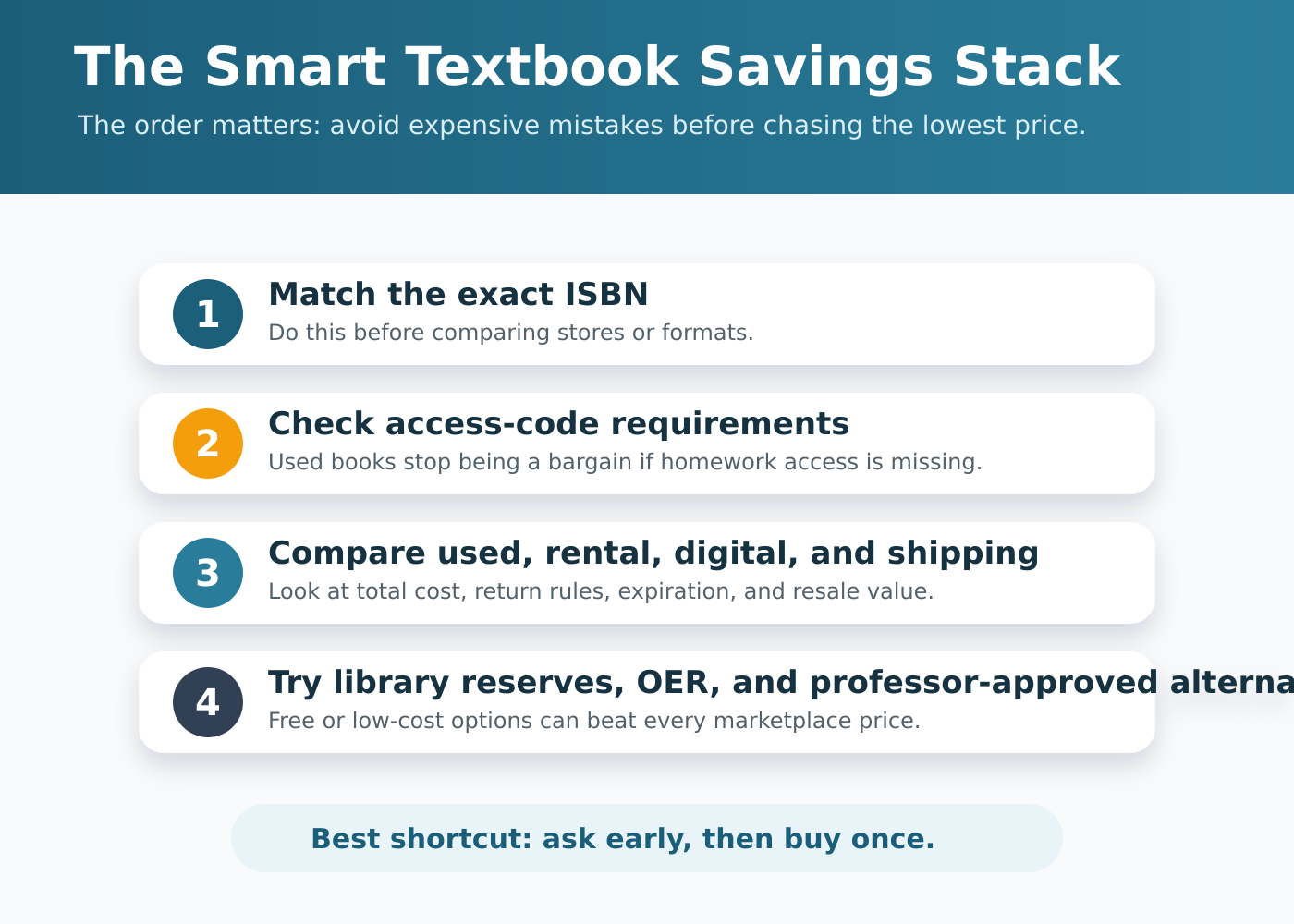
The first step is boring, but it works. Search by ISBN, not just by title. A textbook title can hide multiple editions, bundled versions, and digital packages that look similar until checkout.
Use this order:
- Copy the ISBN from the syllabus.
- Search that exact ISBN through Textbook Nova, your campus bookstore, used-book sellers, rental listings, and other marketplaces.
- Compare the total price, including shipping.
- Check whether the copy includes any online code or access portal.
This matters because a “cheap” book can stop being cheap the second you learn it doesn’t include the code your class requires. If the professor only needs the text, you have more options. If the grade depends on the platform, the format matters more than the sticker price.
If you want a broader strategy for this kind of comparison, our older guide on how to save money on textbooks still covers the basics. This update just adds the 2026 reality: the digital add-ons are often the trap.
2) Don’t pay extra for the exact edition unless you have to
Students get burned here all the time. A professor may say “latest edition required” when they really mean “the course will follow this text closely.” Those are not the same thing.
Before you buy the newest version, ask:
- Does the syllabus say the latest edition is required, or just recommended?
- Are chapter numbers or page numbers used in assignments?
- Will an older edition still match the homework well enough?
- Is there a course pack or instructor notes that make the edition less important?
If the answer is “recent edition is fine,” shop the used market first. Older editions are often dramatically cheaper, and they can be perfectly workable when the core concepts haven’t changed.
This is one of the simplest ways to reduce costs without giving up the book itself.
3) Buy used when the book is just a book
Used textbooks still make sense when there’s no required code attached. That sounds obvious, but the fine print matters. A used copy is only a win if you can actually use it for the class.
Used is usually your best move when:
- the class uses the book for reading only,
- homework is not tied to an online portal,
- the professor allows an older edition,
- and you plan to keep the book or resell it later.
Used is a bad deal when:
- the required access code is single-use,
- the course is built around a digital homework system,
- or the seller’s listing is vague about what’s included.
If you buy used, check the condition notes carefully. “Good enough” can be fine for a reading-heavy class, but not if the pages are missing, highlighted to the point of distraction, or water-damaged.
4) Choose rental or digital only when the math actually works
Renting and digital access are not automatically cheaper. Sometimes they are. Sometimes they just move the cost around.
Rent when:
- you need the book for one term only,
- you don’t care about keeping it,
- and the rental total is clearly lower than used + resale risk.
Choose digital when:
- the class already requires a digital platform,
- you prefer carrying less weight,
- and the ebook price is meaningfully below print.
But watch the hidden catches. A digital package might look cheaper until you realize it expires, locks you into a single device, or still requires a separate access code. That’s why the College Board’s 2025 report is useful here: it treats books and supplies as a budget category that can include hardcopy textbooks, online textbooks, rentals, and other supplies. In other words, your “book” cost may show up in more than one form.
Rule of thumb: if you can resell a print book, include that in the comparison. If you can’t resell a rental or digital license, don’t pretend the up-front price tells the whole story.
5) Watch for access codes and automatic billing before you click buy
This is the biggest 2026 trap.
Student PIRGs reports that access codes have become common in required coursework, and that many campuses now use automatic textbook billing. That means the cost can appear by default, not by choice.
Before you pay, ask three questions:
- Is the access code required for homework, quizzes, or grading?
- Can I opt out of automatic billing?
- Can I buy the material somewhere else and still complete the class?
If the answer to the first question is yes, a used copy may not help unless it includes the code. If the answer to the second question is unclear, don’t assume the default charge is your only option. And if the bookstore or LMS is pushing an “inclusive access” style package, compare the real total before accepting it.
A lot of students lose money here because they shop for the book first and discover the code problem later. Reverse that order.
6) Use library reserves, OER, and professor-approved alternatives
This is where students can sometimes save the most.
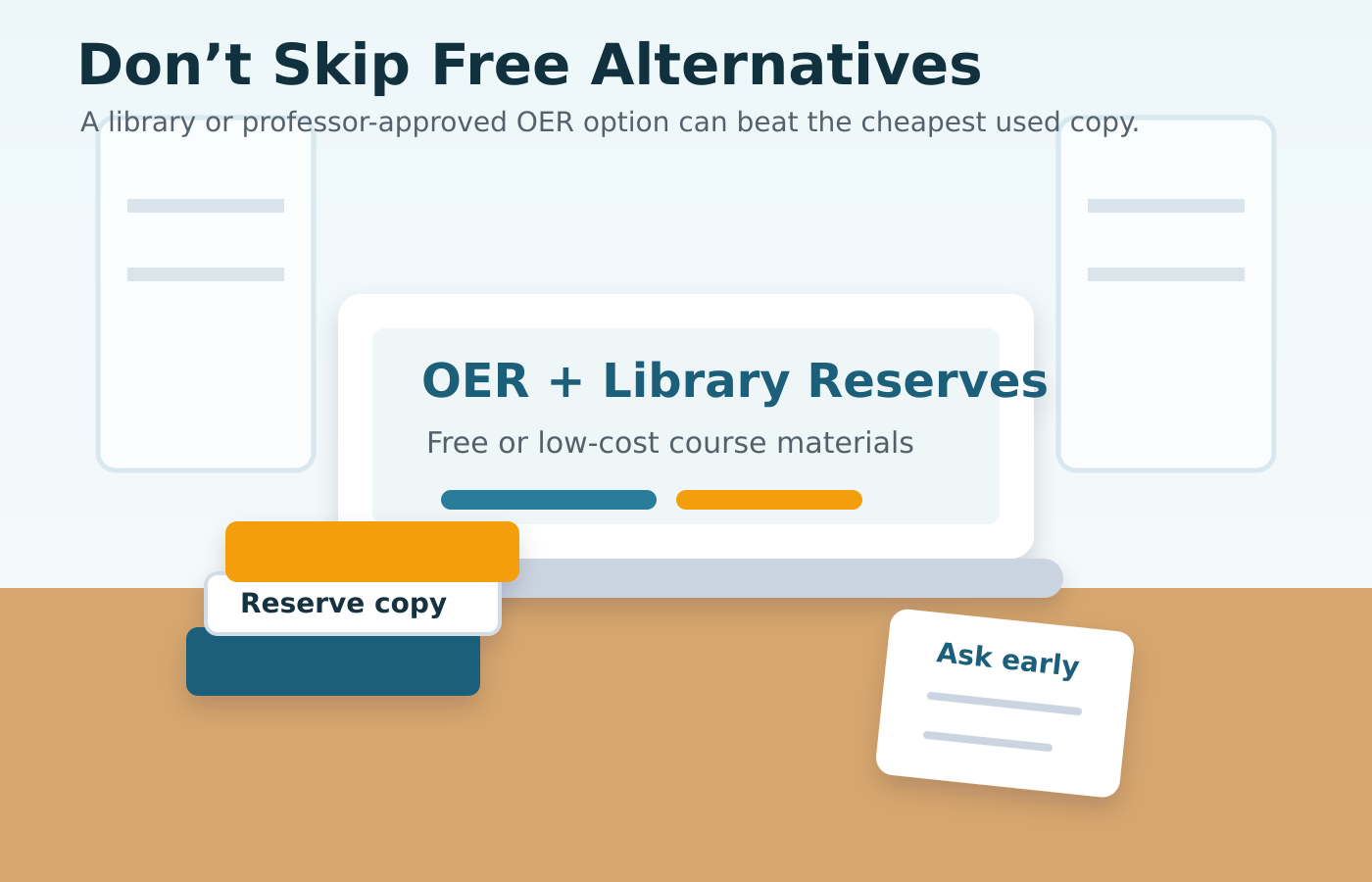
Start with your campus library. Some schools keep course reserves, ebook access, or short-term lending copies for high-demand classes. Those options are easy to miss, and they are often free.
Next, look for open educational resources, or OER. Student PIRGs notes that growing awareness of open textbooks and other free materials has expanded access, even while the market has gotten more complicated. That means more courses may already have cheaper or free alternatives available.
Here’s what to ask:
- Does the library have a reserve copy or ebook license?
- Is there an open textbook option for this course?
- Will the professor accept a previous edition or alternate source?
- Is the “required” book really required, or just recommended?
If you’re stuck, ask early. Professors are usually much more flexible before the semester starts than after assignments are already underway.
For context on why this problem keeps coming back, our post on why college textbooks are so expensive goes deeper on the publisher and bundling side.
7) End the semester by deciding whether to resell, keep, or donate
Saving money on textbooks does not end when you buy them. It ends when you decide what they’re worth to you after the class.
Resell when:
- the book is still current,
- it’s a common title,
- and you don’t need it for a later course.
Keep when:
- it’s a major reference for your field,
- the content will matter in later classes,
- or it’s a book you actually want on your shelf.
Donate when:
- resale value is basically gone,
- another student can use it,
- or your campus has a reuse program.
Even a modest resale return changes the math on the next purchase. A $90 book that sells for $30 later is not the same as a $90 book that goes in the closet forever.
The short version
If you want the biggest savings, do these five things in order:
- Compare by ISBN.
- Verify whether the exact edition matters.
- Check for access codes before buying used.
- Compare rental, print, and digital on total cost.
- Use library reserves and OER whenever you can.
That’s the 2026 textbook-saving playbook. The market is still messy, but students do have leverage when they shop in the right order.
If you want more textbook-buying tips and learning-cost advice, start at Textbook Nova and work outward from there.