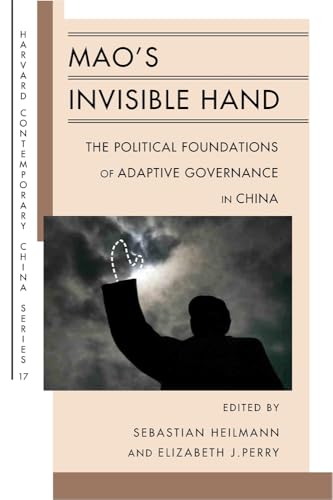
Mao’s Invisible Hand: The Political Foundations of Adaptive Governance in China (Harvard Contemporary China Series)
by Joseph Fewsmith, Elizabeth J. Perry, Sebastian Heilmann, Jae Ho Chung, Nara Dillon, Benjamin L. Liebman, Patricia M. Thornton, Shaoguang Wang, Yuezhi Zhao

Mao’s Invisible Hand examines the political foundations of adaptive governance in China, drawing on Maoist legacies to explain modern policy-making. Part of the Harvard Contemporary China Series, it features expert analyses from scholars like Joseph Fewsmith and Elizabeth J. Perry, illuminating the ideological influences on China's evolving political structures.
About This Book
Mao’s Invisible Hand delves into the political underpinnings of adaptive governance in contemporary China, highlighting the role of ideological frameworks in policy evolution.
As part of the Harvard Contemporary China Series, the book features contributions from leading scholars including Joseph Fewsmith, Elizabeth J. Perry, and others, offering insights into China's governance dynamics.
The work addresses how historical political foundations continue to influence adaptive strategies in governance, providing a scholarly perspective on China's political landscape.
With a focus on the interplay between ideology and policy, it serves as a key resource for understanding the complexities of Chinese political systems.
Reviews
No reviews yet. Be the first to review this book!