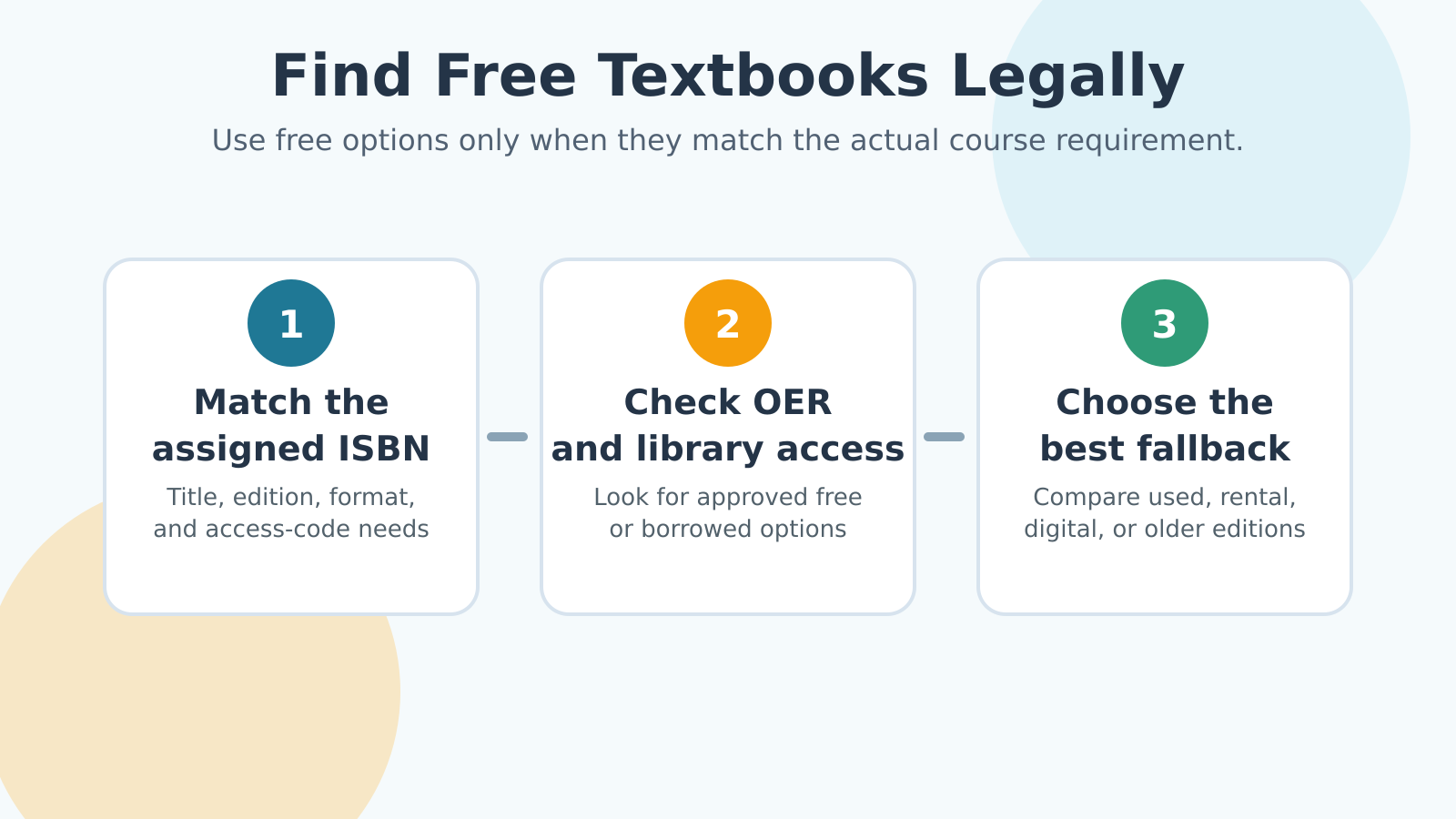
If you’re hunting for free textbooks, start with the assigned ISBN—not a random PDF search. That one habit saves time, avoids sketchy download sites, and keeps you from grabbing a book that looks right but fails the class requirements. The honest goal is not “find any free book.” It’s “find a legal free option that actually matches the course, or quickly confirm that you should move on to the best paid fallback.”
That distinction matters because free can mean very different things. Some books are openly licensed and designed to be shared. Some are in the public domain. Some are free only through a library license or course reserve. And some are just pirated scans with a nice-looking download button. The first three can be useful. The last one is not worth the risk.
Start with the assigned ISBN, not a random title search
The syllabus is your best starting point. Copy the exact ISBN, edition, and author name before you compare anything else. A lot of textbook frustration comes from treating similar-looking editions as interchangeable when they are not.
Once you have the ISBN, search it on Textbook Nova first so you can verify the exact book, edition, and title before you decide whether a free alternative is good enough. If you need a quick refresher on that workflow, How to use Textbook Nova explains the ISBN/title search approach in plain language.
This step is useful even if you ultimately want a free option, because the free option only matters if it matches what the class actually needs.
What counts as a legal free textbook?
A legal free textbook is one you can access without paying and without breaking copyright.
The cleanest examples are open educational resources, or OER. Creative Commons explains that OER are teaching and learning materials released with open permissions, so they can usually be kept, reused, revised, remixed, and redistributed under the license terms.
That is very different from “free on a file-sharing site.” If a book is still under copyright, the fact that someone uploaded a scan does not make it legal. For a recent reminder of why that matters, the AP News coverage of the Internet Archive e-book copyright case is a useful cautionary backdrop: not every free-looking ebook is a safe or legitimate source.
OER, public domain, and library access are not the same thing
- OER are openly licensed and meant to be shared.
- Public domain works are old enough, or otherwise eligible, to be free of copyright restrictions.
- Library access may be free to you, but the library is licensing the content for its users.
That difference matters because a library ebook can be legal and free for you without being a universal free download. It also matters because a public-domain classic can be a great reading resource while still being a poor substitute for a modern biology or chemistry textbook.
Where to look first: OER textbook libraries
If you want the most practical free-textbook search path, begin with vetted OER collections. They are built for exactly this problem.
Start with OpenStax
OpenStax is the easiest place to start for students because it publishes free textbooks in major college subjects and presents them in student-friendly formats. If your course lines up with one of its titles, you may already have a strong legal free option.
Then check discovery libraries
Open Textbook Library is a strong discovery tool because it lets you browse open textbooks by subject instead of making you guess which publisher or random site might have the right match. That makes it especially helpful when you know the course area but not the exact free title.
LibreTexts Commons is also worth checking. It spans a broad range of disciplines and can surface open textbook content, modular chapters, and course-ready material that is useful when a full one-to-one replacement does not exist.
What to check before you trust an OER match: a free textbook is only a real substitute if it lines up with the course. Look for subject fit, edition or revision date, chapter coverage, whether the instructor uses the same topic order, and whether homework depends on a separate platform. If the course uses a very specific edition for page references, a close OER title may still be helpful—but it may function more like a study support book than a drop-in replacement.
Use your library and public-domain collections before you pay
Before you buy anything, check your campus library.
Many libraries provide course reserves, ebook access, or short-term borrowing for high-demand titles. Some also maintain interlibrary options that can cover a course book for at least part of the term. Those resources are often overlooked because students assume the bookstore is the only official source.
A good library search can save you from paying full price for a book you only need for a few weeks. It can also help you separate “required” from “required to own.” Those are not always the same thing.
If your professor or department allows it, ask whether the library’s version is acceptable for your assignments. A reserve copy may not be convenient for every class, but it can be enough for reading-heavy courses or short-term use.
Public-domain collections are the other big free option, especially for classics. Project Gutenberg is the classic example. It is especially useful for older works that are no longer under copyright, which makes it a strong legal source for classics and historical reading. It is not, however, where you should expect to find the latest commercial nursing, accounting, calculus, or psychology text.
That is the simplest rule here: public domain is a big win for old books and a weak bet for current textbooks.
Decide whether a free option is a safe substitute
This is the part that saves you from false hope.
A free option is probably a safe substitute when it matches the exact course goal and the professor is not relying on a platform, code, or special edition features. It is less likely to work when the class uses chapter-specific homework, embedded quizzes, or tightly matched page references.
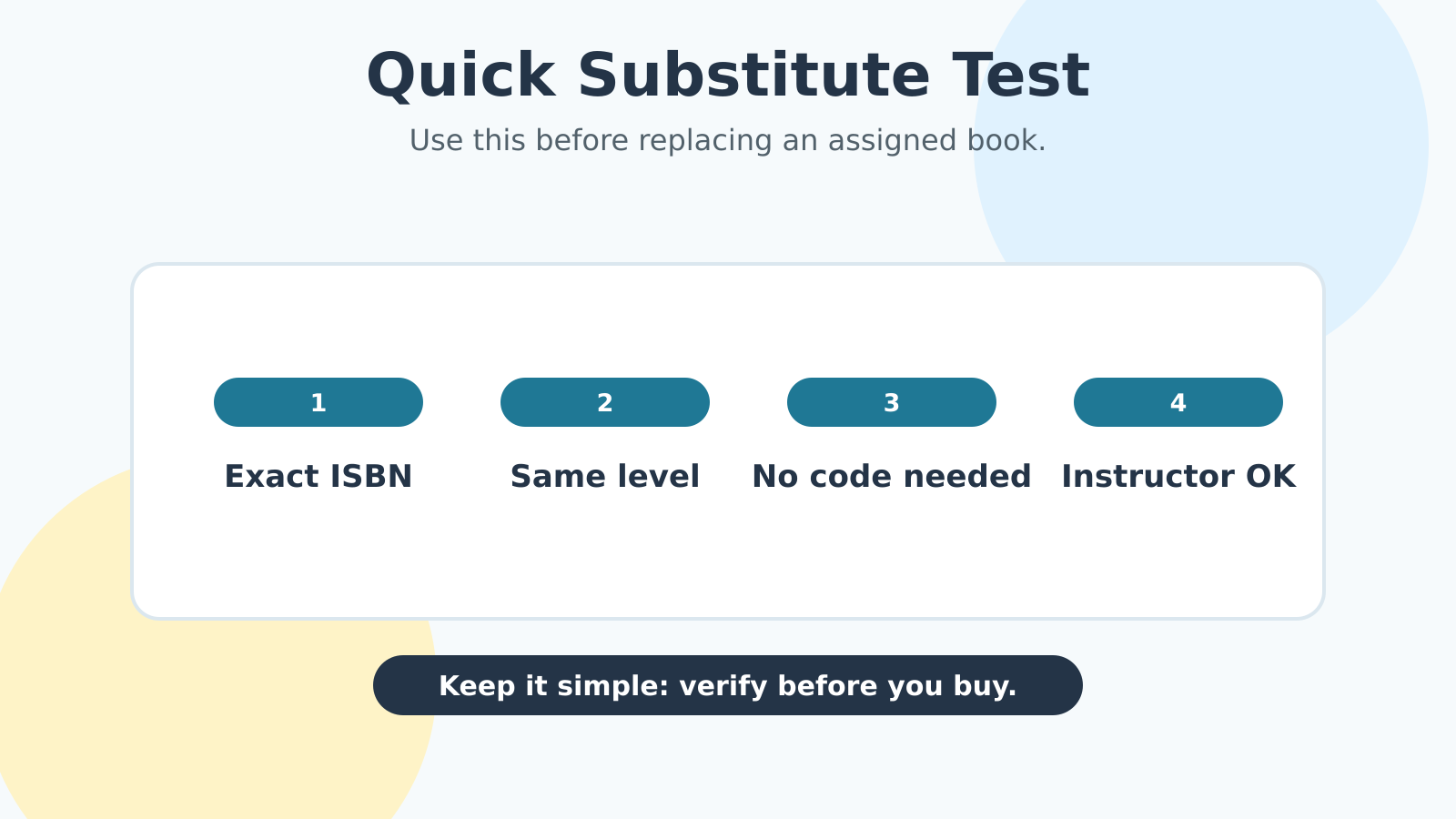
Quick substitute test
Ask four questions:
- Does it cover the same subject at the same level?
- Does it match the edition closely enough for class work?
- Does the course require any access code, lab platform, or digital homework system?
- Has the instructor said an alternate version is okay?
If you get a clean yes on the first two and no on the third, you may have a real free substitute. If the homework system is separate, the free text may still help—but it probably will not replace everything you need for the class.
That is the key boundary this article is trying to make clear: a free book can be a great resource without being the assigned textbook.
If there is no true free match, compare paid options
When the free path does not produce a true substitute, don’t waste another hour clicking random download sites. Move to the best legitimate paid option and compare it on total cost.
Usually that means looking at:
- used copies,
- rental options,
- digital editions,
- or an older edition that still fits the class.
If you want a broader comparison framework, how to save money on textbooks in 2026 walks through the paid-side decision tree in more detail.
The goal is to avoid paying for features you do not need. Sometimes the right answer is a free OER. Sometimes it is a library copy. Sometimes it is a cheaper used edition. And sometimes the assigned text is so specific that there is no legal free replacement at all.
That is normal. It is not a failure.
The smart move is to verify the ISBN, check the legal free sources, and then choose the cheapest option that still lets you do the course well.
If you want free textbooks legally, use this order:
- Verify the exact ISBN and edition.
- Check OER sources like OpenStax, the Open Textbook Library, and LibreTexts Commons.
- Search your library for reserves, ebooks, and borrowing options.
- Use Project Gutenberg for public-domain classics.
- Only treat a free option as a substitute if it actually matches the course.
- If it does not, compare used, rental, digital, and older-edition options instead.
That approach is slower than clicking the first “free PDF” result you see, but it is the path that actually works.