
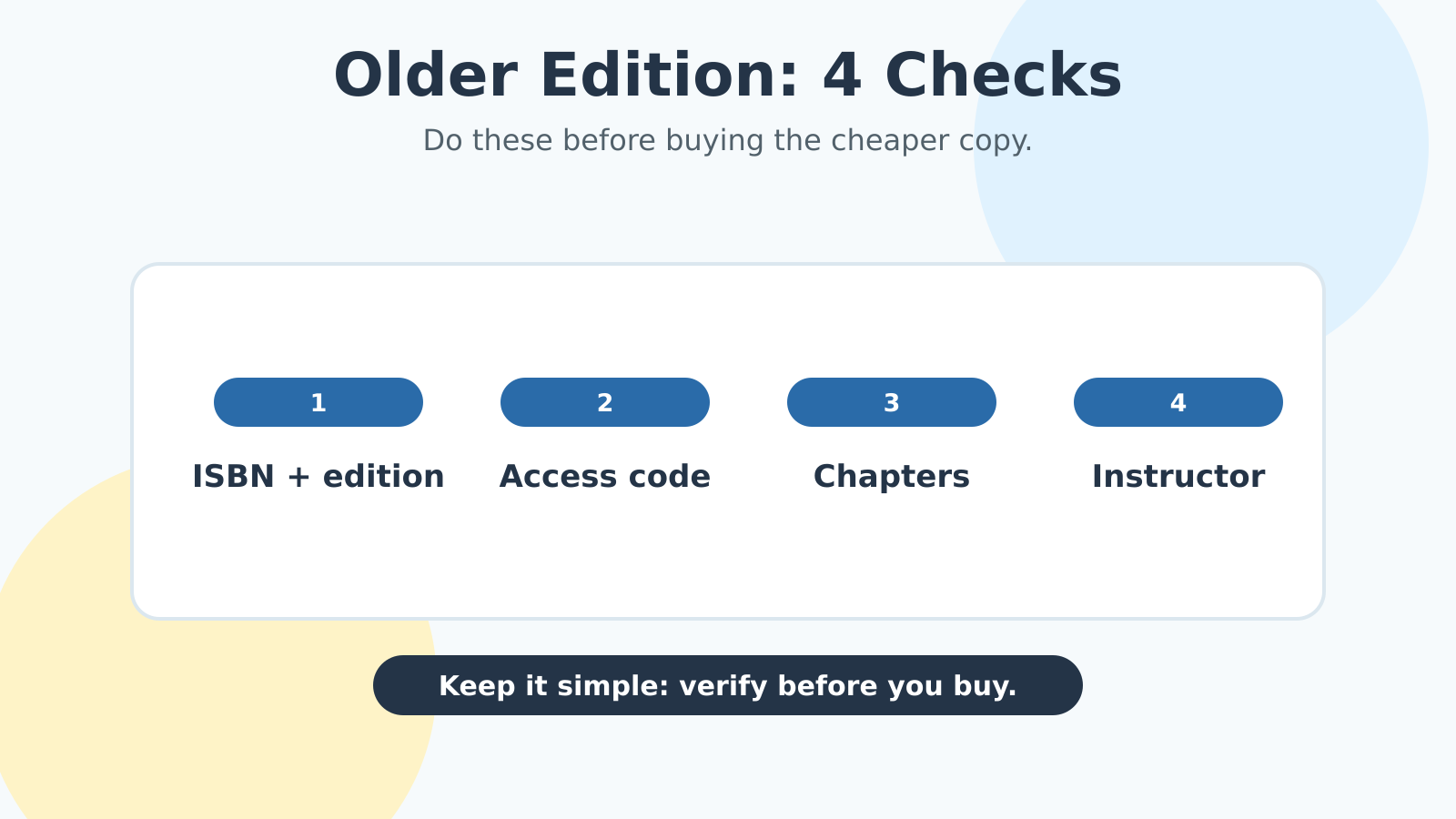
An older textbook edition can be a smart buy, but only if it still matches the way your class is actually taught. Before you order the cheaper copy, check four things: the ISBN and edition, any required access code or homework platform, the assigned chapters and problem numbers, and whether your instructor will accept the older version.
That quick check matters because “close enough” can still cost you money. A previous edition might explain the same concepts, but the page numbers, case studies, problem sets, online homework, or bundled digital access can be different. If the older copy fails one of those checks, the savings may disappear fast.
Use this as a go/no-go checklist before you buy.
Use the older edition only if all four checks pass
- The ISBN or edition is close enough for the assignment.
- No required access code or courseware is missing.
- Chapter order and problem numbers still line up.
- Your instructor says yes, or the syllabus leaves room for it.
Quick answer: older editions can work, but only after four checks
A used older edition is usually worth considering when the course uses the textbook mainly for reading, concepts, definitions, or optional practice. It is riskier when your grade depends on assigned page numbers, exact problem sets, current legal or medical information, publisher homework, quizzes inside a course platform, or a one-time access code.
Here is the short version:
- Match the assigned title, author, edition, format, and ISBN.
- Confirm whether an access code, courseware subscription, or course ID is required.
- Compare the table of contents, chapter order, and assigned questions.
- Ask the instructor one specific question before you rely on the older copy.
If you are using an older edition to save money on textbooks, do these checks before the return window closes. The goal is the cheapest version that will not break your class workflow.
Check 1: match the ISBN, edition, author, and format
Start with the course listing or syllabus. Write down the exact title, authors, edition number, publisher, publication year, format, and ISBN. The University of Portland’s student textbook guidance specifically tells students to check the ISBN, edition, and access-code requirement before buying, which is exactly the information you need for this decision.
The ISBN is especially useful because an ISBN identifies a specific edition and format. A hardcover, paperback, ebook, loose-leaf copy, international edition, or custom campus edition can have a different ISBN even when the title looks nearly identical.
A different ISBN is not automatically unusable, but it does mean you should slow down. Search the required ISBN and title on the bookstore page, publisher page, library catalog, and marketplaces. You can also search by ISBN on Textbook Nova to compare the assigned book against cheaper used or rental options. Treat the older edition as a candidate, not a confirmed match.
Red flags in the listing
Be careful if the cheaper copy says any of these:
- “Instructor’s edition”
- “International edition”
- “Custom edition”
- “Volume 1 only” or “Volume 2 only”
- “Access code not included”
- “May not include supplemental materials”
- “Loose-leaf pages only”
Check 2: look for access codes, homework platforms, and course IDs
This is where many older-edition savings plans fail.
If your course uses MyLab, Mastering, Connect, MindTap, Achieve, WebAssign, WileyPLUS, or another publisher platform, the physical book may not be the main purchase. Your grade may depend on online homework, quizzes, an ebook, or a course-specific enrollment link.
Pearson’s support page notes that used textbooks may not include usable access codes, and McGraw Hill’s support documentation explains that publisher access may need to be purchased separately if a registration code did not come with the book. In plain English: a used copy with a scratched-off or missing code may not save you anything if you still have to buy platform access.
Before buying the older edition, answer these questions:
- Does the syllabus require online homework or quizzes?
- Does the bookstore listing say “access code required”?
- Is the code bundled only with a new book or digital package?
- Can you buy access separately, and what does that include?
- Does standalone access include the ebook, making the print book optional?
If the class is already charging a digital course-material fee, read the details before buying another copy. This is where inclusive access textbooks can get confusing: you may already be billed for digital access unless you opt out by the deadline.
Check 3: compare chapters, problem numbers, and assigned readings
If there is no access-code issue, compare the content itself. Do not just compare titles. Open the table of contents for both editions if previews are available, or use library copies, bookstore screenshots, publisher samples, or classmates’ books.
Look for:
- chapter titles and order
- missing or added chapters
- page-number changes
- end-of-chapter problem numbers
- case studies, datasets, readings, or examples
- lab manuals, appendices, charts, or online supplements
For a history, literature, philosophy, or general education class, a previous edition may be fine if your instructor assigns broad chapter topics and lecture fills in the details. For accounting, chemistry, math, engineering, statistics, law, health sciences, or courses with graded problem sets, the exact edition matters more because question numbers and examples can shift.
The problem-number test
Here is the fastest practical test: find one week of assigned homework and compare those exact problems in both editions.
If “Chapter 4, problems 12, 18, 24, and 31” are the same in both books, the older edition may work. If problem 18 is completely different, you will spend the semester translating assignments. That is possible, but it is not free.
The current-information test
Some subjects age faster than others. An older edition of a calculus text may still teach derivatives, but an older edition of a tax, nursing, computer security, legal, or public policy text may miss important updates. OpenStax’s explanation of textbook revisions and updates notes that updates can range from small corrections to more substantial edition-level changes, which is a useful reminder that “new edition” does not always mean the same amount of change.
Ask whether the course depends on current rules, current data, or recent research. If yes, be more conservative.
Check 4: use reserves or scans legally while you verify
If you are not sure yet, do not panic-buy the expensive copy on day one. Check whether the library has a reserve copy, ebook access, or a short-term loan. George Mason University Libraries notes that course reserves can help while you verify the right edition, though reserve copies may have limited checkout windows and may not match every assigned version.
A reserve copy can help you compare the required edition before spending money and can cover the first week while you wait for a used copy, rental, or instructor answer. Stay inside your school’s rules: use library reserves, legitimate ebooks, bookstore previews, or legally shared excerpts, not pirated PDFs.
When an older edition is usually low risk
An older edition is usually safer when most of these are true:
- The instructor says older editions are okay.
- The book is used mainly for concepts, not exact homework problems.
- There is no required access code or platform.
- The table of contents is mostly the same.
- Assigned readings use chapter topics instead of exact page numbers.
- The subject is not heavily dependent on current rules or recent data.
- You can borrow the current edition if you need to compare a few assignments.
In that situation, the older copy can be a reasonable way to cut costs, especially if the price difference is large and the return policy gives you a safety net.
When you should buy or rent the required edition instead
Buy, rent, or use the assigned version when your grade depends on exact alignment. The required edition is usually the safer choice if:
- online homework access is required
- the older copy does not include a usable code
- problem numbers differ
- page-specific readings are assigned every week
- the instructor uses a custom campus edition
- the class relies on current laws, standards, or clinical guidance
- the professor says older editions are not acceptable
You may still be able to rent the correct edition, buy used with access separately, use an ebook, borrow from the library, or compare prices across sellers. In these cases, “older” is not the first filter. “Correct” is.
A short email to ask your professor before you buy
If the checklist is still unclear, ask one specific question. Do not send a vague “Can I use an older edition?” message with no details. Make it easy for the instructor to say yes, no, or “yes, but watch out for Chapter 8.”
Try this:
Hi Professor [Name],
I found a cheaper copy of [Book Title], [Older Edition], ISBN [older ISBN]. The syllabus lists [Required Edition], ISBN [required ISBN]. I checked that the chapters look similar, but I wanted to confirm before buying: will the older edition work for readings and assignments in this course, or do we need the exact required edition because of page numbers, problem sets, or online access?
Thank you,
[Your Name]
That email gives your professor the information they need. If they approve the older edition, save the reply. If they warn you about access codes or mismatched assignments, you just avoided a bad purchase.
The best textbook deal is the one that actually works for the course. Check the ISBN, access, assignments, and instructor expectations first; then buy the cheapest acceptable option with a return window you can live with.