Category: Student Savings

  • Is a Textbook Subscription Worth It? Compare Before You Pay

    Is a Textbook Subscription Worth It? Compare Before You Pay

    Usually, a textbook subscription is worth it only when it replaces enough required material to beat the total cost of buying, renting, or using a used copy. That sounds obvious, but students get tripped up because they compare the subscription price to just one book price. The real comparison has to include how many courses the plan covers, whether the class needs graded homework access, how long you need the material, and whether you can resell anything later.

    If you think of it as “subscription vs. one book,” you can overpay fast. If you think of it as “total course-material cost for this term,” the answer gets much clearer.

    Quick answer: a textbook subscription is worth it only when it covers enough required material

    A subscription makes the most sense when all of these are true:

    • you have multiple required titles or platforms from the same publisher,
    • the subscription covers the exact books or courseware your classes need,
    • you will use the access long enough to justify the term price,
    • and you would otherwise have to buy several separate eBooks, rentals, or access codes.

    That is why a plan like Cengage Unlimited can be a smart deal for some students and a waste for others. Cengage says the plan covers its learning platforms and thousands of eBooks, but it is still only valuable if your courses are actually inside that ecosystem. Cengage offers term-based access, but prices, included products, and campus bookstore arrangements can change, so check the current checkout page before you decide.

    First, separate reading access from graded homework access

    This is the biggest mistake students make. Not every required digital product is just an eBook.

    Reading-only eTextbooks are easier to compare

    If you only need a reading copy, the comparison is straightforward: used book, rental, eBook, subscription, or free/open textbook. In that case, the cheapest option often wins as long as the edition matches what the instructor wants.

    Courseware and access codes can be mandatory even if you find the book cheaper

    Platforms like McGraw Hill Connect are not just books in digital form. They are complete course experiences with assignments, quizzes, and homework tools. If your grade depends on that platform, a used textbook does not replace it.

    That same logic applies to publisher bundles and access-code packages. A cheaper used copy can still leave you paying twice if the course requires separate digital access.

    Build a quick break-even table before you pay

    Before checkout, list the exact ISBN, platform, access length, and return window for every required item. Then compare the real totals, not the sticker prices.

    What to compare Subscription Used / rental / eBook
    Base price Flat term fee Single-item price
    Shipping / handling Sometimes extra Often extra
    Taxes Maybe Maybe
    Included access length Must cover the full course Must cover the full course
    Homework / courseware Sometimes included Often separate
    Resale value Usually none Used books may have some
    Extra rentals / extensions Can add up Can add up
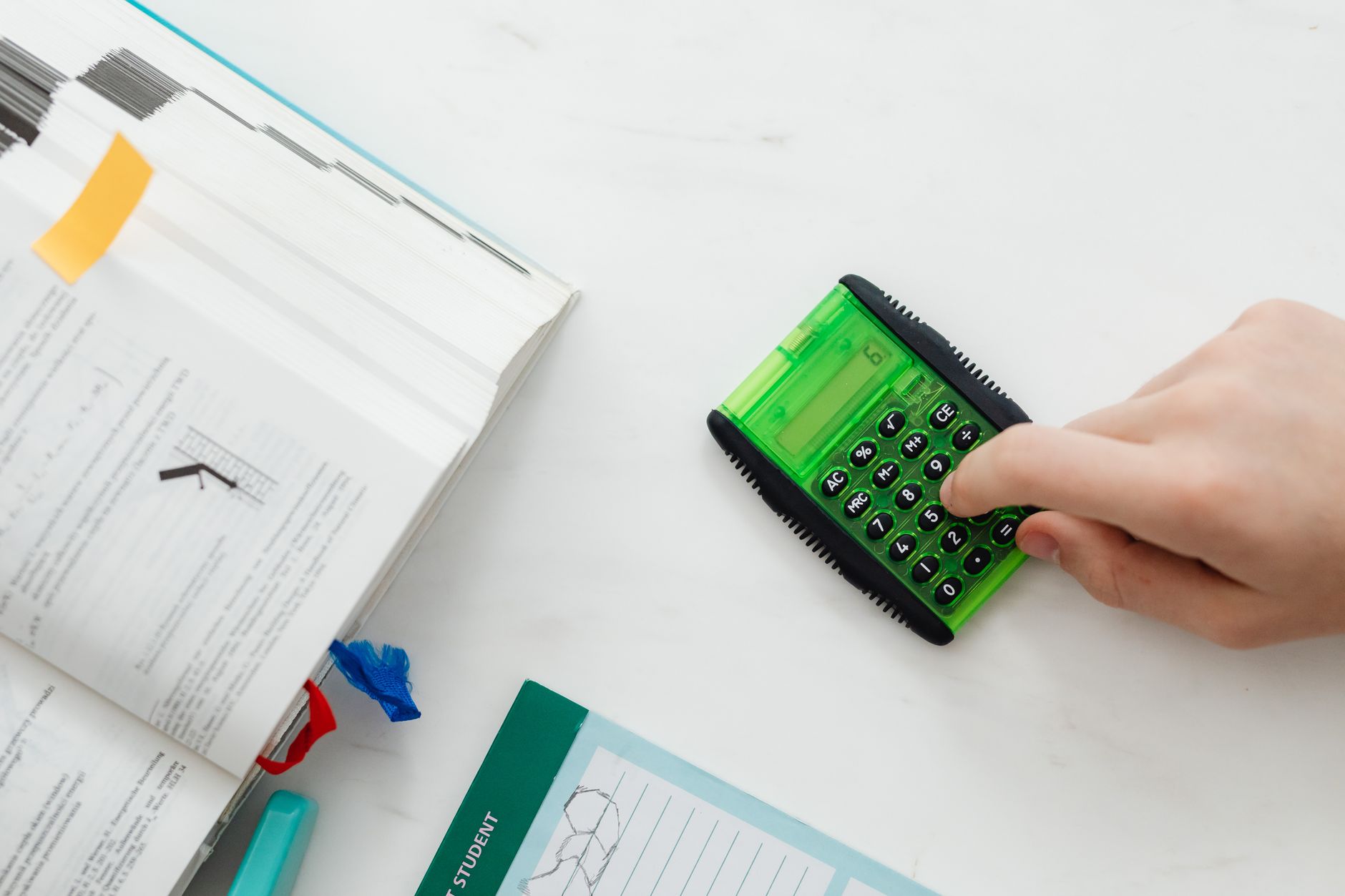
    Student studying with books and a laptop while comparing course material options.
    Compare textbook subscriptions against exact ISBN, rental, used, and eBook options before checking out.

    A simple break-even rule:

    If the subscription cost + fees is less than the total of the cheapest combination of required books/platforms minus any resale value you would keep, the subscription wins.

    That means you should compare against the full semester cost, not just one title. NerdWallet’s textbook guide gives the right shopping habit here: search by title, author, or ISBN, and include shipping, handling, taxes, and returns in the total cost. It also warns that older editions may not include everything your course needs, which is exactly how students end up buying the wrong “cheap” book.

    When Cengage Unlimited or a similar all-access plan can make sense

    A broad subscription can be a good deal when you have several covered courses in the same term.

    For example, if two or three classes all use Cengage materials, the subscription may beat buying each courseware package separately. Cengage also says included print rentals exist, which can help if you still prefer paper for reading. But the fine print matters: Cengage’s print-rental help says included print rentals are limited by subscription length, students still pay shipping and handling, and additional rentals after the allowance are priced separately. That is useful, but it is not the same as “unlimited physical books.” It is a capped perk, not a blank check.

    A Cengage-style plan is most attractive when:

    • several of your courses use the same publisher,
    • you need both the eBook and the homework platform,
    • and you will actually use the included rentals instead of letting them go to waste.

    When a single-title eTextbook subscription may be enough

    Not every student needs a giant bundle. Sometimes a single-title digital access plan is enough, especially if you only need one book for one class.

    Pearson’s Pearson+ is a good example. Pearson lists monthly and up-front payment options for Pearson+ eTextbooks, and fixed 6-month access can function like a digital rental. It also describes a longer “lifetime access” option as a one-time 5-year web access term, with app access if the book is downloaded before the term ends. Extension charges can continue monthly until you cancel.

    That makes Pearson+ a different kind of decision than an all-access subscription. If you need one Pearson title for one term, a fixed access window may be perfect. If you need long-term reference access, or if the class runs longer than the access period, buying a different format may be smarter.

    When buying used, renting, or using free options is smarter

    Sometimes the subscription answer is simply no.

    Buy used, rent, or go open when:

    • you only need a reading copy,
    • the class does not require a proprietary platform,
    • the book has solid resale value,
    • or the professor allows an open resource.

    OpenStax is the cleanest reminder that not every class needs a paid publisher platform. OpenStax says its digital textbooks are free online or downloadable as PDFs, which can save a ton of money when the course allows it.

    That said, free does not always mean complete for every class. If the syllabus requires a branded homework system, an open textbook may cover the reading but not the graded assignments.

    Student PIRGs’ 2026 report on textbook market problems also makes the broader point that students often get squeezed by access codes and automatic billing. It is advocacy research, so treat it as a consumer warning rather than a neutral publisher guide, but the underlying lesson is useful: always confirm what is truly required before paying for a bundle you may not need.

    Subscription red flags and the final checklist

    Watch for these warning signs before checkout:

    • The subscription covers only some of your required courses.
    • The class needs a platform, not just a book.
    • The access term ends before finals.
    • The “included” rentals still charge shipping or come with strict limits.
    • The book is cheaper used, but the platform still costs extra.
    • You could use a resale-friendly print copy and recover part of the cost later.
    • The plan’s terms say products or ancillaries may change.

    That last one matters. Cengage’s legal terms note that Cengage Unlimited products can change and that not all materials or ancillaries are guaranteed. In plain English: do not assume every future course will be covered exactly the way the sales page makes it sound today.

    So the final call is simple:

    • Subscribe if multiple required courses are covered and the total is lower than buying each item separately.
    • Rent if you only need one book for one term and resale does not matter.
    • Buy used if the class only needs a reading copy and the edition matches.
    • Use open/free resources if the instructor allows them and the assignment requirements are covered.
    • Ask first if the syllabus mentions access codes, courseware, or inclusive-access billing.

    If you want the safest move, compare exact ISBNs and platform names before you pay; a quick search on Textbook Nova can help you sanity-check used, rental, and edition options before you commit to a subscription. The best deal is not the lowest price on the screen; it is the lowest total cost for the actual course requirements.
  • How to Find Free Textbooks Legally: OER, Library, and Public Domain Options

    How to Find Free Textbooks Legally: OER, Library, and Public Domain Options

    If you’re hunting for free textbooks, start with the assigned ISBN—not a random PDF search. That one habit saves time, avoids sketchy download sites, and keeps you from grabbing a book that looks right but fails the class requirements. The honest goal is not “find any free book.” It’s “find a legal free option that actually matches the course, or quickly confirm that you should move on to the best paid fallback.”

    That distinction matters because free can mean very different things. Some books are openly licensed and designed to be shared. Some are in the public domain. Some are free only through a library license or course reserve. And some are just pirated scans with a nice-looking download button. The first three can be useful. The last one is not worth the risk.

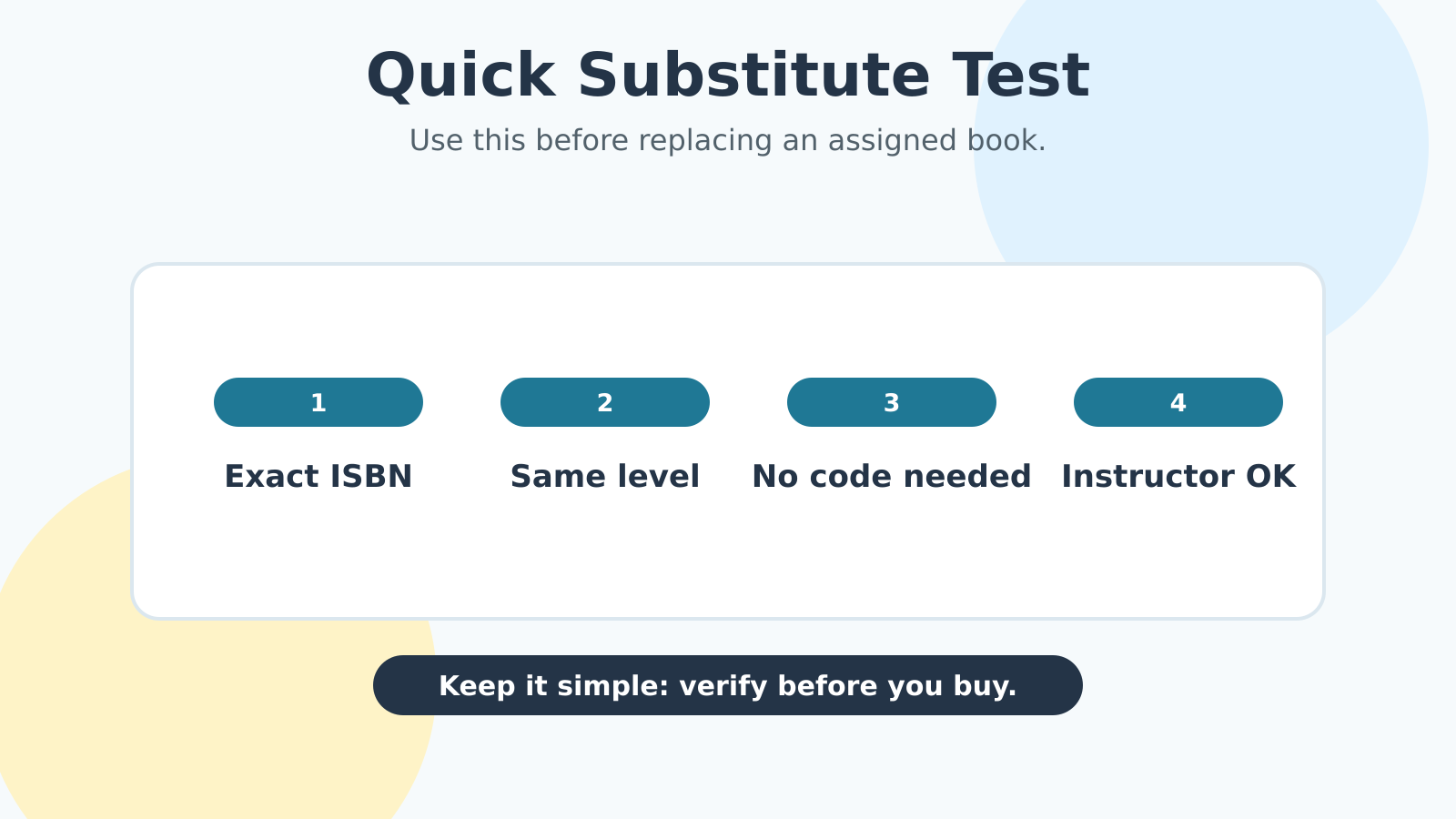
    Quick substitute test for deciding whether a free textbook option can replace an assigned book.
    A free textbook is only useful if it matches the class closely enough to use safely.

    Start with the assigned ISBN, not a random title search

    The syllabus is your best starting point. Copy the exact ISBN, edition, and author name before you compare anything else. A lot of textbook frustration comes from treating similar-looking editions as interchangeable when they are not.

    Once you have the ISBN, search it on Textbook Nova first so you can verify the exact book, edition, and title before you decide whether a free alternative is good enough. If you need a quick refresher on that workflow, How to use Textbook Nova explains the ISBN/title search approach in plain language.

    This step is useful even if you ultimately want a free option, because the free option only matters if it matches what the class actually needs.

    What counts as a legal free textbook?

    A legal free textbook is one you can access without paying and without breaking copyright.

    The cleanest examples are open educational resources, or OER. Creative Commons explains that OER are teaching and learning materials released with open permissions, so they can usually be kept, reused, revised, remixed, and redistributed under the license terms.

    That is very different from “free on a file-sharing site.” If a book is still under copyright, the fact that someone uploaded a scan does not make it legal. For a recent reminder of why that matters, the AP News coverage of the Internet Archive e-book copyright case is a useful cautionary backdrop: not every free-looking ebook is a safe or legitimate source.

    OER, public domain, and library access are not the same thing

    • OER are openly licensed and meant to be shared.
    • Public domain works are old enough, or otherwise eligible, to be free of copyright restrictions.
    • Library access may be free to you, but the library is licensing the content for its users.

    That difference matters because a library ebook can be legal and free for you without being a universal free download. It also matters because a public-domain classic can be a great reading resource while still being a poor substitute for a modern biology or chemistry textbook.

    Where to look first: OER textbook libraries

    If you want the most practical free-textbook search path, begin with vetted OER collections. They are built for exactly this problem.

    Start with OpenStax

    OpenStax is the easiest place to start for students because it publishes free textbooks in major college subjects and presents them in student-friendly formats. If your course lines up with one of its titles, you may already have a strong legal free option.

    Then check discovery libraries

    Open Textbook Library is a strong discovery tool because it lets you browse open textbooks by subject instead of making you guess which publisher or random site might have the right match. That makes it especially helpful when you know the course area but not the exact free title.

    LibreTexts Commons is also worth checking. It spans a broad range of disciplines and can surface open textbook content, modular chapters, and course-ready material that is useful when a full one-to-one replacement does not exist.

    What to check before you trust an OER match: a free textbook is only a real substitute if it lines up with the course. Look for subject fit, edition or revision date, chapter coverage, whether the instructor uses the same topic order, and whether homework depends on a separate platform. If the course uses a very specific edition for page references, a close OER title may still be helpful—but it may function more like a study support book than a drop-in replacement.

    Use your library and public-domain collections before you pay

    Before you buy anything, check your campus library.

    Many libraries provide course reserves, ebook access, or short-term borrowing for high-demand titles. Some also maintain interlibrary options that can cover a course book for at least part of the term. Those resources are often overlooked because students assume the bookstore is the only official source.

    A good library search can save you from paying full price for a book you only need for a few weeks. It can also help you separate “required” from “required to own.” Those are not always the same thing.

    If your professor or department allows it, ask whether the library’s version is acceptable for your assignments. A reserve copy may not be convenient for every class, but it can be enough for reading-heavy courses or short-term use.

    Public-domain collections are the other big free option, especially for classics. Project Gutenberg is the classic example. It is especially useful for older works that are no longer under copyright, which makes it a strong legal source for classics and historical reading. It is not, however, where you should expect to find the latest commercial nursing, accounting, calculus, or psychology text.

    That is the simplest rule here: public domain is a big win for old books and a weak bet for current textbooks.

    Decide whether a free option is a safe substitute

    This is the part that saves you from false hope.

    A free option is probably a safe substitute when it matches the exact course goal and the professor is not relying on a platform, code, or special edition features. It is less likely to work when the class uses chapter-specific homework, embedded quizzes, or tightly matched page references.

    Quick substitute test

    Ask four questions:

    1. Does it cover the same subject at the same level?
    2. Does it match the edition closely enough for class work?
    3. Does the course require any access code, lab platform, or digital homework system?
    4. Has the instructor said an alternate version is okay?

    If you get a clean yes on the first two and no on the third, you may have a real free substitute. If the homework system is separate, the free text may still help—but it probably will not replace everything you need for the class.

    That is the key boundary this article is trying to make clear: a free book can be a great resource without being the assigned textbook.

    If there is no true free match, compare paid options

    When the free path does not produce a true substitute, don’t waste another hour clicking random download sites. Move to the best legitimate paid option and compare it on total cost.

    Usually that means looking at:

    • used copies,
    • rental options,
    • digital editions,
    • or an older edition that still fits the class.

    If you want a broader comparison framework, how to save money on textbooks in 2026 walks through the paid-side decision tree in more detail.

    The goal is to avoid paying for features you do not need. Sometimes the right answer is a free OER. Sometimes it is a library copy. Sometimes it is a cheaper used edition. And sometimes the assigned text is so specific that there is no legal free replacement at all.

    That is normal. It is not a failure.

    The smart move is to verify the ISBN, check the legal free sources, and then choose the cheapest option that still lets you do the course well.

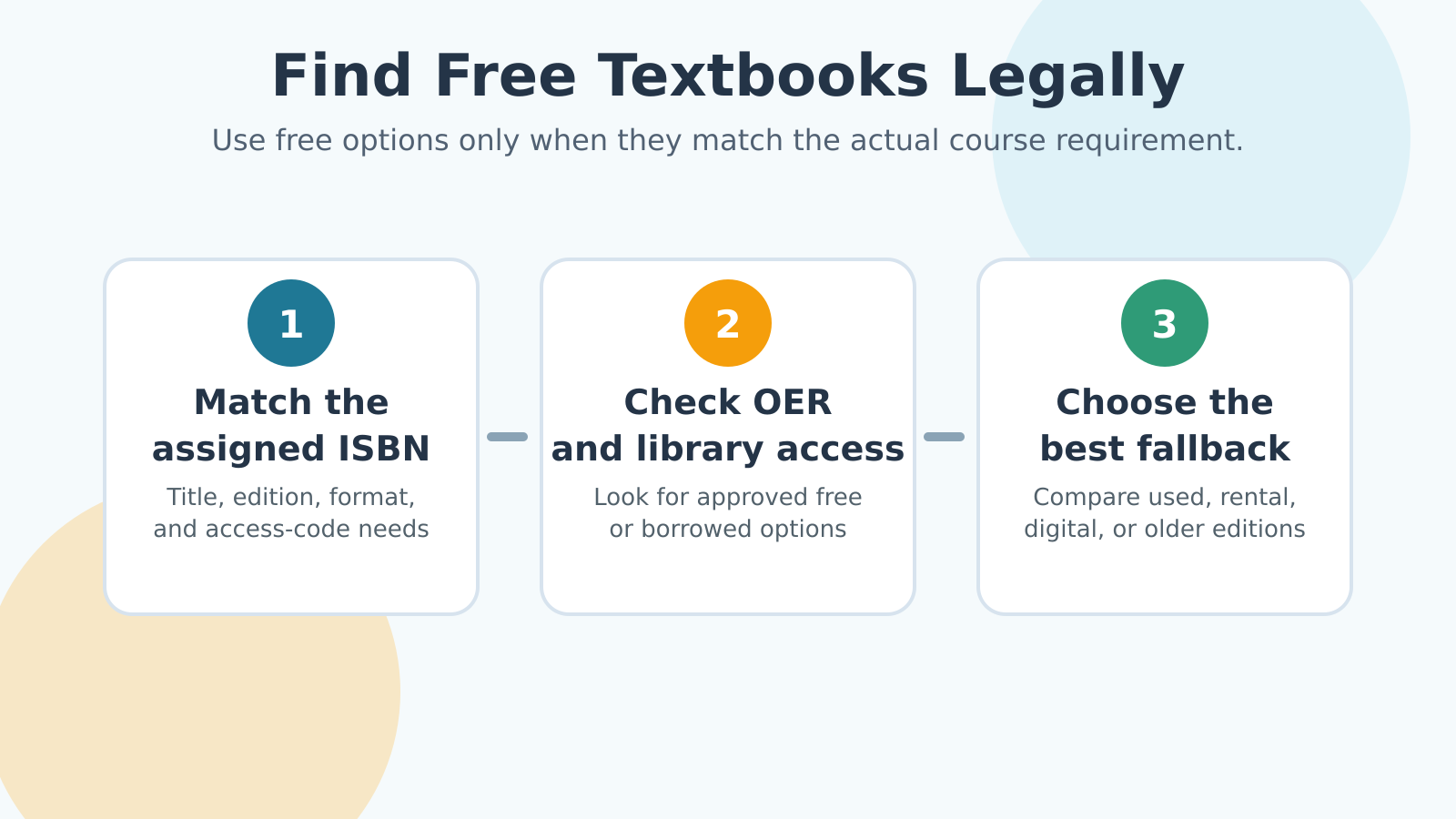
    If you want free textbooks legally, use this order:

    1. Verify the exact ISBN and edition.
    2. Check OER sources like OpenStax, the Open Textbook Library, and LibreTexts Commons.
    3. Search your library for reserves, ebooks, and borrowing options.
    4. Use Project Gutenberg for public-domain classics.
    5. Only treat a free option as a substitute if it actually matches the course.
    6. If it does not, compare used, rental, digital, and older-edition options instead.

    That approach is slower than clicking the first “free PDF” result you see, but it is the path that actually works.